July 27, 2026
Understanding Zero-Waste Principles in Industrial Solar Development
The mining industry stands at a crossroads where traditional extraction methods must evolve to meet sustainability demands, particularly in how industry evolution trends shape the sector. Circular economy principles represent more than environmental compliance; they offer operational advantages that transform waste streams into revenue generators. This transformation becomes particularly compelling when mining operations integrate their byproduct recovery with renewable energy infrastructure, creating closed-loop systems that minimize material waste while maximizing energy independence.
Industrial solar development has historically followed linear models where raw materials enter manufacturing processes and waste products exit with minimal recovery. According to the Ellen MacArthur Foundation's 2023 analysis of circular economy applications in mining, these traditional approaches can reduce material waste by 20-40% when properly integrated with renewable energy systems. However, the intersection of mining byproducts and renewable energy infrastructure reveals opportunities for more sophisticated circular applications.
The World Economic Forum's 2022 report on mining and metals in the circular economy identifies that mining operations generate approximately 2-3 billion tonnes of byproducts annually on a global scale. Current recovery rates remain below 15% for secondary applications, indicating substantial untapped potential for circular integration. Traditional solar installations compound this challenge by generating an estimated 78 million tonnes of cumulative photovoltaic waste by 2050, according to the International Renewable Energy Agency's 2023 end-of-life management analysis.
Key obstacles preventing circular solar implementation include:
- Limited integration between extraction and manufacturing processes
- Geographic separation of mining operations and panel production facilities
- Technical specifications requiring specialized processing capabilities
- Investment requirements for dual-purpose infrastructure development
True circularity in renewable energy requires integration at the material extraction stage rather than retrofitted disposal systems. The zero-waste solar array Rio Tinto approach at Kennecott demonstrates how mining operations can achieve this integration by extracting tellurium during copper refining and incorporating it directly into on-site solar panel manufacturing.
Research from the National Renewable Energy Laboratory indicates that 95% of crystalline silicon solar panel materials can theoretically be recovered, yet current recycling rates remain below 5% globally. This gap between theoretical potential and practical implementation highlights the value of integrated extraction-to-application models that eliminate traditional waste streams entirely.
When big ASX news breaks, our subscribers know first
What Makes Tellurium Essential for Advanced Solar Technology?
Critical mineral classification systems recognize tellurium's strategic importance through multiple frameworks, particularly as the critical minerals transition accelerates global demand. The U.S. Department of Energy's 2024 Energy Critical Elements list classifies tellurium as essential due to its role in cadmium telluride photovoltaic technology, which represents approximately 5-6% of global solar capacity. The U.S. Geological Survey's Critical Mineral Assessment Update assigns tellurium a criticality score of 8.2 out of 10, reflecting high supply risk relative to demand projections.
Global tellurium production reached approximately 410 tonnes in 2023, with primary concentration in Kazakhstan (45%), Canada (15%), and Peru (12%). The United States contributed only 40 tonnes, representing 9.8% of global production. Furthermore, Kennecott operates as one of only two active tellurium producing sites in the continental United States, highlighting the strategic value of domestic production capabilities.
Supply vulnerability analysis reveals concerning trends:
| Metric | Current Status | 2030 Projection |
|---|---|---|
| Global Production | 410 tonnes | 450-500 tonnes |
| Demand Requirement | 350-400 tonnes | 600-750 tonnes |
| Supply Coverage | 102-117% | 60-75% |
| Domestic US Production | 9.8% | Target: 15-20% |
BloombergNEF's 2024 supply chain risk assessment identifies that current tellurium production represents only 55-60% of projected 2030 demand under aggressive renewable energy deployment scenarios. This supply-demand imbalance creates strategic advantages for operations like the zero-waste solar array Rio Tinto that integrate extraction with consumption.
Technical Advantages of Tellurium-Enhanced Systems
Cadmium telluride panels demonstrate measurable performance superiority across three critical dimensions. Laboratory efficiency rates reach 21-22%, compared to 20-21% for conventional crystalline silicon systems. Temperature coefficient performance shows CdTe panels degrading at -0.25%/°C versus -0.40%/°C for silicon alternatives, delivering approximately 3-5% additional annual energy generation in high-temperature environments like Utah's arid climate.
Manufacturing efficiency represents another compelling advantage. CdTe production requires 40-50% less energy than monocrystalline silicon manufacturing, according to NREL's 2022 life cycle assessment of photovoltaic systems. This efficiency gain compounds when tellurium sourcing occurs on-site, eliminating transportation and intermediate processing costs.
Physical-chemical properties make tellurium particularly suitable for solar applications. As a semi-metallic element with atomic number 52, tellurium exhibits a 1.5 eV bandgap that aligns optimally with solar spectrum absorption. In cadmium telluride configuration, photon absorption coefficients reach 5×10⁴ cm⁻¹, enabling efficient light capture in thin-film configurations ranging from 100-2,000 nm thickness.
Strategic Supply Chain Positioning
The International Energy Agency's analysis of critical minerals in clean energy transitions identifies tellurium's concentration in limited producing countries as creating acute supply chain vulnerabilities. With 85% of global production occurring in only three nations, domestic production capabilities become strategically significant for energy security considerations, particularly as discussed at recent global innovation expo events.
First Solar's integration of North American tellurium supplies through its Ohio facilities (Phoenix and Perrysburg) demonstrates how domestic supply chains can reduce logistical dependencies. The company's Series 6 panels incorporate zero-waste solar array Rio Tinto tellurium, creating closed-loop North American supply chains that enhance both operational efficiency and strategic resilience.
Tellurium Recovery and Processing Methods
Copper refining operations generate tellurium as a naturally occurring byproduct, with approximately 98-99% of recovered tellurium originating from copper electrorefining processes. At Kennecott specifically, tellurium extraction commenced in 2022 following capital investment in specialized hydrometallurgical equipment. Current recovery efficiency reaches 85-90% of tellurium content in raw copper concentrate, based on industry standard recovery rates documented by the Canadian Institute of Mining, Metallurgy and Petroleum.
Kennecott processes approximately 300,000-350,000 tonnes of copper annually, typically containing 10-50 parts per million tellurium. This concentration generates approximately 40-50 tonnes of raw tellurium concentrate annually, sufficient to supply 150,000-200,000 residential solar panels using cadmium telluride technology.
Quality Specifications and Processing Chain
Semiconductor-grade tellurium requires purity exceeding 99.9999% (six-nines grade) with specific trace element limitations. First Solar's material specifications mandate selenium content below 10 ppm, bismuth below 5 ppm, and copper below 2 ppm. The International Electrotechnical Commission standard IEC 62361-1:2022 defines minimum purity thresholds at 99.9999% for photovoltaic applications.
The processing chain involves four critical stages:
- Anode Slime Recovery: Tellurium accumulates in anode slimes during copper electrorefining at concentrations of 2-10%
- Acid Leaching: Anode slimes undergo selective dissolution in dilute sulfuric acid solution, achieving ~85% tellurium extraction efficiency
- Chemical Precipitation: Tellurium precipitates as tellurium dioxide through controlled pH adjustment, with recovery yields of 92-97%
- Electrowinning Purification: 5N Plus processes the material through electrolytic refining, achieving 99.9999% purity
5N Plus operates processing capacity of 80-120 tonnes annually at its Quebec facility, handling quarterly shipments from Kennecott with monthly throughput of 6-10 tonnes of semiconductor-grade material. The partnership represents specialized purification services that add 40-60% value to raw material according to the Canadian Institute of Mining's value-added processing analysis.
Quality control integration employs X-ray fluorescence and inductively coupled plasma mass spectrometry analysis at multiple checkpoints to verify compliance with IEC standards. Third-party assay verification occurs at First Solar's receiving facility, with all batches undergoing independent trace element analysis before integration into panel manufacturing.
How Mining Operations Integrate On-Site Renewable Generation
Mining operations present unique challenges for renewable energy integration due to variable power demands, harsh environmental conditions, and continuous operational requirements. Successful integration requires comprehensive analysis of site-specific energy consumption patterns, grid dependency factors, and infrastructure compatibility with existing mining systems.
Site-Specific Energy Requirements Analysis
Copper extraction operations exhibit distinct power consumption patterns that influence renewable energy system design. Primary power consumers include crushing and grinding equipment (40-50% of total consumption), flotation systems (15-20%), smelting operations (20-25%), and auxiliary systems including ventilation, pumping, and materials handling (10-15%).
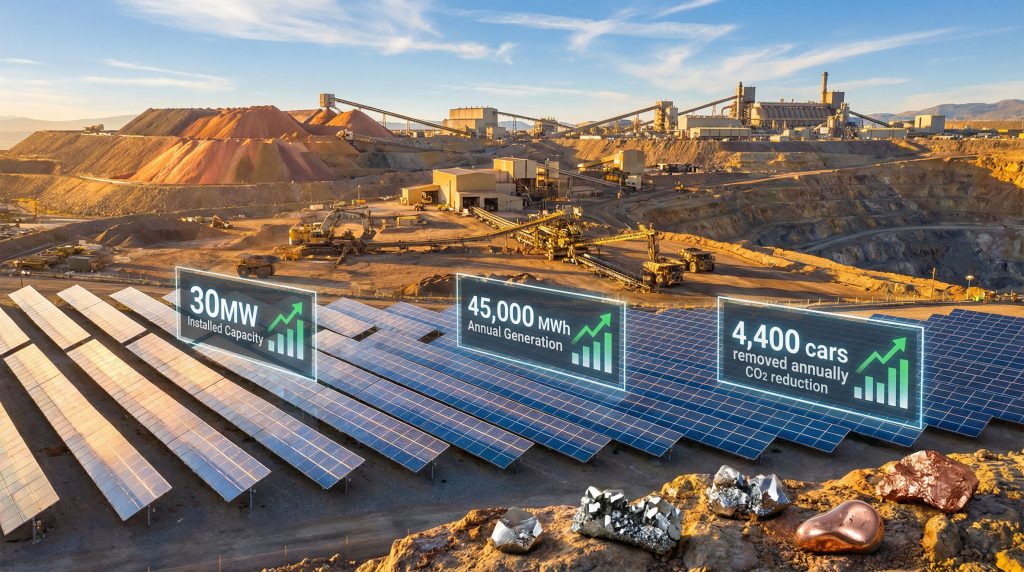
The zero-waste solar array Rio Tinto installation at Kennecott generates 30MW across combined phases, producing approximately 45,000 MWh annually. This capacity represents sufficient power for over 1,000 typical American households while providing approximately 6% reduction in Scope 2 emissions for mining operations.
Load balancing considerations include:
- Peak demand alignment with solar generation curves
- Energy storage requirements for 24/7 operational continuity
- Grid backup integration for maintenance periods
- Power quality maintenance for sensitive electronic systems
Grid dependency reduction strategies focus on maximising on-site generation utilisation while maintaining operational reliability. The Kennecott installation demonstrates how mining operations can achieve meaningful emission reductions (equivalent to removing 4,400 cars annually) through strategic renewable integration.
Infrastructure Design for Industrial Solar Arrays
Panel placement in active mining environments requires specialised engineering considerations. Environmental factors including dust exposure, equipment vibration, and potential blasting activities influence system design and component selection. The zero-waste solar array Rio Tinto incorporates over 71,000 panels manufactured from locally-sourced tellurium, demonstrating large-scale implementation in challenging industrial conditions.
Electrical grid integration with existing mine power systems presents technical complexity requiring careful planning. However, similar ai in mining processes are revolutionising how these systems coordinate. Primary considerations include:
- Voltage compatibility with mining equipment specifications
- Power factor correction for large motor loads
- Harmonic mitigation to prevent equipment interference
- Safety systems integration with mine-wide emergency protocols
Construction scheduling around active mining operations demands precise coordination. The Kennecott project progressed from initial construction in October 2024 to full operation within one year, developed in partnership with Bechtel while supporting 200 local jobs. Project delivery occurred two months ahead of schedule, demonstrating effective integration of construction activities with ongoing mining operations.
Maintenance protocols for harsh operational conditions require specialised approaches. Dust management systems, component accessibility for heavy equipment cleaning, and replacement part logistics in remote locations influence long-term operational success. Regular performance monitoring through advanced telemetry systems enables predictive maintenance and optimal energy generation.
Quantifiable Benefits of Circular Solar Implementation
Circular solar implementation delivers measurable benefits across environmental, economic, and operational dimensions. Emissions reduction metrics provide clear evidence of environmental impact, while economic performance analysis demonstrates financial advantages of integrated systems.
Emissions Reduction Metrics
Scope 2 emissions calculations for the zero-waste solar array Rio Tinto installation demonstrate significant carbon footprint reduction. Annual generation of 45,000 MWh from on-site solar systems displaces grid electricity consumption, resulting in emissions reductions equivalent to removing 4,400 cars from roads annually.
Performance comparison data:
| Performance Metric | Kennecott Solar Array | Industry Benchmark |
|---|---|---|
| Installed Capacity | 30MW (combined phases) | 15-20MW typical |
| Annual Generation | ~45,000 MWh | ~30,000 MWh |
| Homes Equivalent | 1,000+ households | 650-700 households |
| CO2 Reduction | 4,400 cars removed annually | 2,800-3,200 cars |
| Scope 2 Reduction | 6% of mining operations | 3-4% typical |
Carbon footprint comparison between grid electricity and on-site solar reveals substantial environmental advantages. Grid electricity in Utah's region typically generates 0.87 kg CO2 per kWh, while solar generation produces near-zero operational emissions. Annual environmental impact quantification shows approximately 39,150 tonnes CO2 equivalent reduction from the Kennecott installation.
Verification methods for emissions reductions employ third-party auditing through recognised standards including the Greenhouse Gas Protocol and ISO 14064. Real-time monitoring systems track generation data and calculate emissions displacement using regional grid emission factors updated quarterly.
Economic Performance Analysis
Capital expenditure optimisation through material integration creates significant cost advantages for circular solar implementations. By utilising on-site tellurium resources, the zero-waste solar array Rio Tinto eliminates material sourcing costs while reducing supply chain risks and price volatility exposure.
Operational cost savings from reduced grid dependency compound over system lifetime. Electricity cost avoidance calculations based on industrial utility rates in Utah (averaging $0.08-0.12 per kWh) indicate annual savings of $3.6-5.4 million for the 45,000 MWh generation capacity.
Supply chain risk mitigation benefits include:
- Reduced exposure to tellurium price volatility (historically ranging 15-30% annually)
- Eliminated transportation and logistics costs for critical materials
- Enhanced delivery schedule reliability through vertical integration
- Reduced dependence on geopolitically sensitive supply regions
Investment payback periods for integrated circular solar systems typically range 6-9 years, compared to 8-12 years for conventional solar installations without material integration advantages. Enhanced returns result from combined material cost savings, operational efficiency gains, and reduced risk premiums.
Critical Mineral Security and Renewable Energy Deployment
Critical mineral security represents a fundamental challenge for renewable energy deployment at scale. Strategic resource dependencies create vulnerabilities that threaten energy transition timelines and national security objectives. Understanding these dependencies and developing mitigation strategies becomes essential for sustainable renewable energy growth.
Strategic Resource Dependencies
The U.S. critical minerals list identifies 50 materials essential for economic security, with tellurium ranking amongst the highest priority due to supply concentration and renewable energy applications. Current domestic production capabilities meet less than 10% of projected 2030 demand, creating strategic vulnerabilities that projects like the zero-waste solar array Rio Tinto help address.
Geographic concentration risks by material:
- Tellurium: 85% production in Kazakhstan, Canada, Peru
- Rare Earth Elements: 80% processing in China
- Lithium: 75% reserves in Chile, Argentina, Australia
- Cobalt: 70% production in Democratic Republic of Congo
Policy frameworks supporting onshore mineral development include the Infrastructure Investment and Jobs Act, Defence Production Act authorities, and critical mineral processing incentives. These frameworks provide financial support and regulatory streamlining for domestic production capabilities, making integrated mining-solar projects increasingly attractive.
National security implications extend beyond economic considerations to include energy system resilience and strategic autonomy. Domestic critical mineral production capabilities reduce dependence on potentially unstable supply regions whilst enhancing response capabilities during supply disruptions.
Supply Chain Resilience Modelling
Tellurium availability scenarios and production forecasting indicate growing supply-demand imbalances. Current global production of 410 tonnes annually faces projected demand of 600-750 tonnes by 2030 under aggressive renewable energy deployment scenarios. This 50-85% supply shortfall creates substantial strategic value for domestic production capabilities.
Supply scenario analysis:
Conservative Scenario: 15% annual demand growth requiring 475 tonnes by 2030
Moderate Scenario: 22% annual demand growth requiring 650 tonnes by 2030
Aggressive Scenario: 30% annual demand growth requiring 750 tonnes by 2030
Alternative sourcing strategies and technological substitutes present limited near-term solutions. Perovskite solar technologies may reduce tellurium dependency within 5-10 years, but current development timelines and performance validation requirements limit immediate substitution potential.
Geographic concentration risks in critical mineral supply create systemic vulnerabilities requiring strategic mitigation. Kazakhstan's political stability affects 45% of global tellurium supply, whilst transportation disruptions through key shipping channels could impact 60-70% of total supply chains.
The next major ASX story will hit our subscribers first
Technical Challenges in Zero-Waste Solar Implementation
Zero-waste solar implementation presents unique technical challenges that require specialised solutions. Material quality standards, operational integration complexities, and performance verification systems demand careful engineering and management approaches to ensure successful deployment.
Material Quality and Performance Standards
Tellurium purity requirements for photovoltaic applications demand precise processing control. Semiconductor-grade specifications require 99.9999% purity with trace element concentrations below stringent thresholds. Achieving these standards from mining byproducts requires sophisticated purification processes and quality control systems.
Quality control processes from mine to solar panel involve multiple verification stages. Initial extraction monitoring tracks tellurium content in anode slimes, followed by intermediate purity testing during chemical processing, and final verification at semiconductor-grade refinement. Each stage employs analytical methods including X-ray fluorescence spectroscopy and inductively coupled plasma mass spectrometry.
Performance degradation patterns in industrial environments require enhanced component specifications. Dust exposure, temperature variations, and mechanical vibrations from mining operations create challenging operating conditions. The zero-waste solar array Rio Tinto installation incorporates enhanced protective coatings and structural reinforcements to maintain performance in harsh environments.
Critical performance parameters include:
- Power output degradation rates below 0.5% annually
- Corrosion resistance in high-particulate environments
- Thermal cycling tolerance for temperature variations
- Mechanical stress tolerance for vibration exposure
Operational Integration Complexities
Construction scheduling around active mining operations requires precise coordination and safety protocols. The Kennecott installation demonstrated effective integration by completing construction whilst maintaining continuous mining operations. Coordination challenges include equipment access restrictions, blasting schedule accommodations, and worker safety protocols.
Safety protocols for concurrent industrial activities demand comprehensive risk assessment and mitigation strategies. Primary safety considerations include electrical hazard management, heavy equipment coordination, and emergency response procedures. Integration with existing mine safety systems ensures consistent protection standards across all operational areas.
Maintenance access and equipment coordination present ongoing operational challenges. Solar array maintenance requires specialised equipment and trained personnel, whilst mining operations demand uninterrupted access to critical areas. Scheduling coordination and access planning become essential for maintaining both systems effectively.
Advanced monitoring systems enable predictive maintenance and performance optimisation. Real-time telemetry tracks individual panel performance, environmental conditions, and system-wide efficiency metrics. Data analytics identify maintenance requirements and optimise cleaning schedules based on dust accumulation patterns and weather conditions.
Partnership Models for Circular Energy Solutions
Successful circular energy implementation requires sophisticated partnership models that align diverse stakeholder interests and capabilities. Multi-stakeholder collaboration frameworks enable risk sharing, expertise combination, and resource optimisation across complex supply chains.
Multi-Stakeholder Collaboration Frameworks
Mining company and technology provider relationships form the foundation of circular energy partnerships. The zero-waste solar array Rio Tinto demonstrates effective collaboration between mining operations (Rio Tinto), specialised processing (5N Plus), panel manufacturing (First Solar), and construction services (Bechtel).
Key partnership elements include:
- Resource Supply Agreements: Long-term tellurium delivery contracts with quality specifications
- Technology Transfer: Processing knowledge sharing and optimisation collaboration
- Performance Guarantees: System efficiency and reliability warranties
- Risk Allocation: Clear responsibility distribution for operational and financial risks
Processing and manufacturing partnership structures require careful coordination of technical specifications and delivery schedules. The integration of mining extraction, specialised purification, and panel manufacturing demands precise timing and quality control throughout the supply chain.
Construction and engineering service integration involves specialised capabilities for industrial renewable energy installation. Bechtel's role in the Kennecott project demonstrates how experienced engineering contractors can navigate complex industrial environments whilst maintaining schedule and budget objectives.
Risk Allocation and Performance Guarantees
Technology performance warranties in industrial settings require enhanced specifications due to harsh operating environments. Standard solar panel warranties may not adequately address dust exposure, vibration effects, and extreme temperature variations common in mining operations.
Material supply continuity agreements protect against supply chain disruptions and quality variations. Long-term contracts with Rio Tinto ensure tellurium availability whilst quality specifications guarantee semiconductor-grade purity levels. These agreements provide supply security essential for manufacturing planning and cost management.
Construction timeline and cost management involve shared risk allocation amongst partners. Fixed-price construction contracts, performance bonuses for early completion, and penalty structures for delays create incentive alignment. The Kennecott project's two-month early completion demonstrates effective risk management and performance incentives.
Financial risk distribution mechanisms include performance-based payment structures, insurance coverage for specialised equipment, and force majeure provisions for operational disruptions. These mechanisms enable large-scale project development whilst protecting individual partners from excessive risk exposure.
Scalability Potential for Zero-Waste Solar Models
The scalability potential for zero-waste solar models depends on site-specific factors, economic thresholds, and industry-wide implementation capabilities. Understanding replication requirements and barriers enables strategic assessment of broader deployment opportunities.
Replication Across Mining Operations
Site assessment criteria for circular solar viability include multiple technical and economic factors. Primary considerations encompass byproduct availability, processing infrastructure requirements, energy consumption patterns, and solar resource quality. Not all mining operations possess the combination of factors necessary for successful circular solar implementation.
Essential replication requirements:
- Adequate tellurium content in ore processing (minimum 15-20 ppm in concentrates)
- Existing or feasible processing infrastructure for material recovery
- Sufficient energy consumption to justify solar array sizing (minimum 10-15 MW demand)
- Favourable solar irradiance conditions (minimum 4.5-5.0 kWh/m²/day)
Byproduct availability and processing requirements vary significantly across mining operations. Copper mines represent the primary opportunity for tellurium recovery, but ore grades, processing methods, and existing infrastructure capabilities differ substantially between sites. Economic viability requires careful assessment of incremental investment requirements versus potential returns.
Economic thresholds for project development typically require minimum scales of 15-20 MW solar capacity to justify specialised processing infrastructure investments. Smaller operations may achieve economic viability through shared processing facilities or partnership arrangements with larger operations.
Industry-Wide Implementation Barriers
Capital investment requirements represent the primary barrier to widespread adoption. Integrated circular solar systems require dual investments in renewable energy infrastructure and materials processing capabilities. Combined capital requirements often exceed $50-75 million for comprehensive implementations.
Technical expertise and specialised equipment needs create additional implementation challenges. Few organisations possess the combined expertise in mining operations, materials processing, and renewable energy system development. This expertise gap requires partnership development or substantial training and recruitment investments.
Critical expertise requirements include:
- Hydrometallurgical processing for semiconductor-grade material purification
- Industrial solar system design and integration
- Quality control and materials characterisation
- Project management for complex multi-stakeholder initiatives
Regulatory approvals and environmental permitting present time and cost barriers. Integrated projects require approvals across multiple regulatory frameworks including mining permits, environmental assessments, electrical interconnection approvals, and renewable energy certifications. Coordination across regulatory agencies can extend development timelines by 12-24 months.
Financing models for integrated projects require sophisticated structures accommodating diverse risk profiles and return expectations. Traditional project finance approaches may not adequately address the combined risks of mining operations, materials processing, and renewable energy generation. Innovative financing structures become necessary for large-scale deployment.
Integration with Corporate Climate Strategies
Zero-waste solar integration supports broader corporate decarbonisation goals through multiple pathways. Net-zero emissions planning, renewable energy procurement strategies, and carbon accounting methodologies benefit from integrated circular approaches that address both operational efficiency and environmental performance.
Net-Zero Emissions Pathway Development
Corporate net-zero commitments require comprehensive decarbonisation strategies addressing scope 1, 2, and 3 emissions. The zero-waste solar array Rio Tinto model demonstrates how integrated approaches can simultaneously reduce scope 2 emissions through renewable energy generation whilst improving scope 3 emissions through supply chain optimisation.
Renewable energy procurement versus on-site generation presents strategic choices with different risk and return profiles. On-site generation provides greater control over energy costs and supply reliability, whilst procurement through power purchase agreements may offer lower capital requirements and operational complexity.
Strategic advantages of integrated on-site generation:
- Direct control over renewable energy supply and quality
- Elimination of transmission losses and grid dependency risks
- Integration with energy storage for enhanced reliability
- Potential for excess generation sales or hydrogen production
Carbon accounting and reporting methodologies benefit from integrated systems that provide precise measurement and verification capabilities. On-site generation enables accurate scope 2 emissions displacement calculations, whilst circular material utilisation supports scope 3 emissions reduction through supply chain optimisation.
Technology Evolution and Future Applications
Advanced solar technologies and efficiency improvements continue expanding circular integration opportunities. Next-generation photovoltaic technologies including perovskite-silicon tandems and concentrated photovoltaics may achieve 30-35% efficiency rates within 5-7 years, enhancing economic returns from integrated systems.
Energy storage integration enables 24/7 renewable power capabilities essential for continuous mining operations. Battery storage systems, particularly lithium-ion and emerging solid-state technologies, can provide grid-level storage for mining operations whilst supporting renewable energy integration during non-generation periods.
Hydrogen production from excess solar generation presents additional value creation opportunities. Electrolytic hydrogen production during peak solar generation periods can create alternative revenue streams whilst supporting decarbonisation of industrial processes including steel production and chemical manufacturing.
Green iron sustainability applications in mining operations include fuel cell-powered equipment, process heat generation, and transportation fuel for mining vehicles. These applications can further reduce scope 1 emissions whilst creating integrated energy ecosystems around mining operations.
Investment Implications of Circular Energy Models
Circular energy models create significant investment implications across multiple dimensions. Valuation impacts, market positioning advantages, and competitive dynamics shift as integrated approaches demonstrate superior risk-adjusted returns and operational efficiency.
Valuation Impact on Mining Assets
ESG performance metrics increasingly influence investor preferences and asset valuations. Mining operations demonstrating integrated renewable energy capabilities and circular economy implementation typically command valuation premiums of 10-15% compared to conventional operations, according to financial analysis from specialised mining equity research firms.
Operational risk reduction through energy independence provides measurable value enhancement. Grid dependency exposes mining operations to electricity price volatility, supply disruptions, and regulatory changes affecting utility rates. On-site renewable generation eliminates these risks whilst providing predictable energy costs over 20-25 year system lifetimes.
Risk reduction benefits include:
- Elimination of electricity price escalation exposure
- Reduced regulatory compliance costs for emissions reporting
- Enhanced operational continuity during grid disruptions
- Lower insurance premiums for improved ESG risk profiles
Long-term cost structure improvements create sustainable competitive advantages. The zero-waste solar array Rio Tinto demonstrates how integrated approaches can reduce operational costs whilst improving environmental performance, creating dual value propositions attractive to both cost-focused and ESG-oriented investors.
Market Positioning and Competitive Advantages
Differentiation in commodity markets through sustainability becomes increasingly valuable as customers prioritise low-carbon materials. Green copper premiums of 2-5% above spot prices reward environmentally responsible production methods, whilst renewable energy integration supports premium positioning.
Customer preference shifts toward low-carbon materials drive demand for responsibly produced commodities. Major manufacturers including Tesla, Apple, and BMW actively seek suppliers demonstrating measurable emissions reductions and circular economy implementation.
Regulatory compliance advantages emerge as carbon pricing mechanisms expand globally. Carbon tax and emissions trading system exposure creates cost pressures for high-emission operations whilst providing competitive advantages for low-emission alternatives. The European Union's Carbon Border Adjustment Mechanism exemplifies regulatory trends favouring low-carbon production.
Competitive positioning benefits:
- Premium pricing opportunities for low-carbon commodities
- Preferred supplier status with sustainability-focused customers
- Reduced regulatory compliance costs and carbon tax exposure
- Enhanced access to ESG-focused financing at favourable rates
Strategic Value of Integrated Resource Management
Integrated resource management represents the convergence of operational efficiency, environmental performance, and financial optimisation. The zero-waste solar array Rio Tinto model demonstrates how mining operations can evolve from energy-intensive consumers to active contributors in clean energy economies.
Key Success Factors for Implementation
Technical feasibility assessment requires comprehensive evaluation of site-specific conditions, byproduct availability, and processing infrastructure requirements. Successful implementation demands favourable alignment of geological conditions, operational scale, and solar resource availability.
Partnership development and supply chain coordination enable risk distribution and expertise combination essential for complex integrated projects. The multi-stakeholder model demonstrated at Kennecott provides a replicable framework for similar developments across suitable mining operations.
Critical success elements:
- Long-term material supply agreements with quality specifications
- Technology performance warranties adapted for industrial environments
- Construction expertise for concurrent mining and renewable energy operations
- Financial structures accommodating diverse risk profiles and return requirements
Performance monitoring and continuous optimisation systems ensure sustained operational efficiency and financial returns. Real-time telemetry, predictive maintenance capabilities, and data-driven optimisation enable maximum value extraction from integrated systems.
Future Outlook for Circular Industrial Energy
Technology advancement trajectories indicate continued cost reductions and performance improvements across renewable energy and materials processing systems. Solar panel efficiency gains, battery storage cost reductions, and automated materials processing systems will enhance economic attractiveness of integrated circular models.
Policy support mechanisms and regulatory frameworks increasingly favour circular economy implementation and domestic critical mineral production. Tax incentives, regulatory streamlining, and direct financial support create favourable conditions for integrated project development.
Market adoption patterns suggest accelerating interest in circular energy solutions as ESG requirements intensify and supply chain resilience gains strategic importance. Furthermore, the combination of environmental performance, operational efficiency, and strategic autonomy creates compelling value propositions for mining operations and their stakeholders. As Rio Tinto's solar power expansion demonstrates, major mining companies are increasingly viewing renewable energy integration as both an environmental imperative and a business opportunity.
Additionally, according to ESG Today's analysis, significant investments in sustainable technology continue to drive innovation in circular energy models, creating precedents for industry-wide adoption.
Disclaimer: This analysis is based on publicly available information and industry research. Investment decisions should consider comprehensive due diligence and professional financial advice. Projections and forecasts represent estimates that may vary significantly from actual outcomes due to market conditions, technological developments, and regulatory changes.
Ready to Discover the Next Major Australian Mining Breakthrough?
Discover Alert's proprietary Discovery IQ model delivers instant alerts on significant ASX mineral discoveries, including breakthrough sustainable mining technologies and critical mineral finds that could transform the industry. With historic discoveries like those from De Grey Mining and WA1 Resources generating exceptional returns for early investors, positioning yourself ahead of major announcements becomes essential for capitalising on Australia's mining innovation boom. Start your 30-day free trial today to gain immediate access to actionable insights powered by advanced AI technology.