July 16, 2026
Africa's Newest Battery Metal Corridor and What It Means for Global Lithium Supply
The global lithium supply chain has long operated according to a relatively predictable geographic logic: Australia dominates hard-rock spodumene production, South America commands brine-based output from its salt flats, and processing overwhelmingly concentrates in China. That architecture is now shifting. A new production node has activated in equatorial Africa, and the ripple effects on supply dynamics, trade routes, and geopolitical competition over battery metals are only beginning to be understood.
The Democratic Republic of Congo has become synonymous with cobalt, supplying the majority of global output and embedding itself deeply into the supply chains of electric vehicle manufacturers worldwide. However, a quieter transformation has been underway at a remote site in the country's Tanganyika Province, one that positions the DRC to become a meaningful lithium exporter for the first time in its history.
When big ASX news breaks, our subscribers know first
What Makes the Manono Deposit Exceptional Among Hard-Rock Lithium Resources?
Not all lithium deposits are created equal, and the Manono lithium project in the DRC's interior stands apart on several dimensions. The deposit carries an average grade of 1.51% Li₂O, meaningfully above the global hard-rock lithium average of approximately 1.2% Li₂O. In a commodity where ore grade directly determines processing economics, this distinction matters considerably.
The deposit is also notable for its scale. Manono ranks among the largest known hard-rock lithium resources globally, and the processing infrastructure now operational has been designed to handle 5 million tonnes of ore per year, targeting annual spodumene concentrate output of approximately 1 million tonnes. To contextualise that figure, one million tonnes of spodumene concentrate translates, after downstream conversion, into battery-grade lithium compounds sufficient to support a substantial share of global EV battery demand.
Understanding Spodumene Concentrate and Why Grade Matters
Spodumene extraction involves mining and crushing lithium-bearing pyroxene mineral from pegmatite rock formations, followed by flotation and concentration to produce spodumene concentrate, typically graded at around 6% Li₂O. This is then shipped to chemical converters, predominantly in China, for transformation into lithium carbonate or lithium hydroxide for battery manufacturing.
The critical insight for investors and industry observers is that deposit grade affects the economics at every stage of this chain. Higher-grade ore requires less material to be moved and processed per unit of lithium recovered, improving strip ratios, reducing reagent consumption, and lowering per-tonne operating costs. Manono's above-average grade therefore provides a structural cost advantage compared with lower-grade peers, a factor that becomes increasingly significant when lithium prices are under pressure.
| Metric | Manono Project |
|---|---|
| Ore Grade | 1.51% Li₂O |
| Global Hard-Rock Average Grade | ~1.2% Li₂O |
| Annual Ore Processing Capacity | 5 million tonnes |
| Spodumene Concentrate Output Target | ~1 million tonnes per year |
| 2026 LCE Production Target | 30,000 metric tons |
| Projected Global Output Share (by 2028) | ~5% |
| Capital Investment | ~$1 billion |
The Ownership Structure and Its Geopolitical Significance
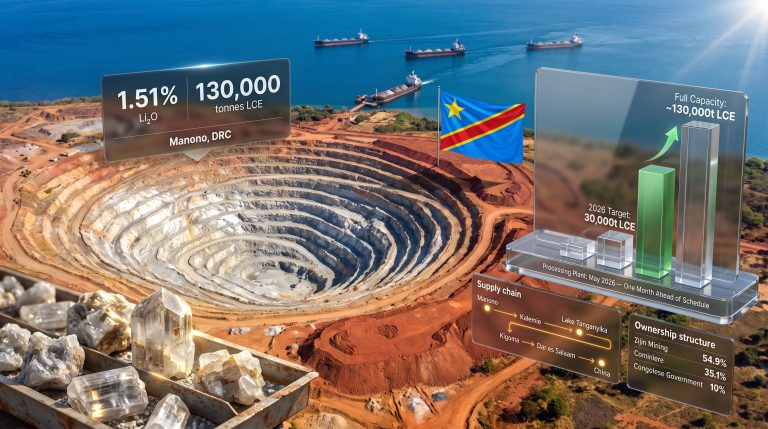
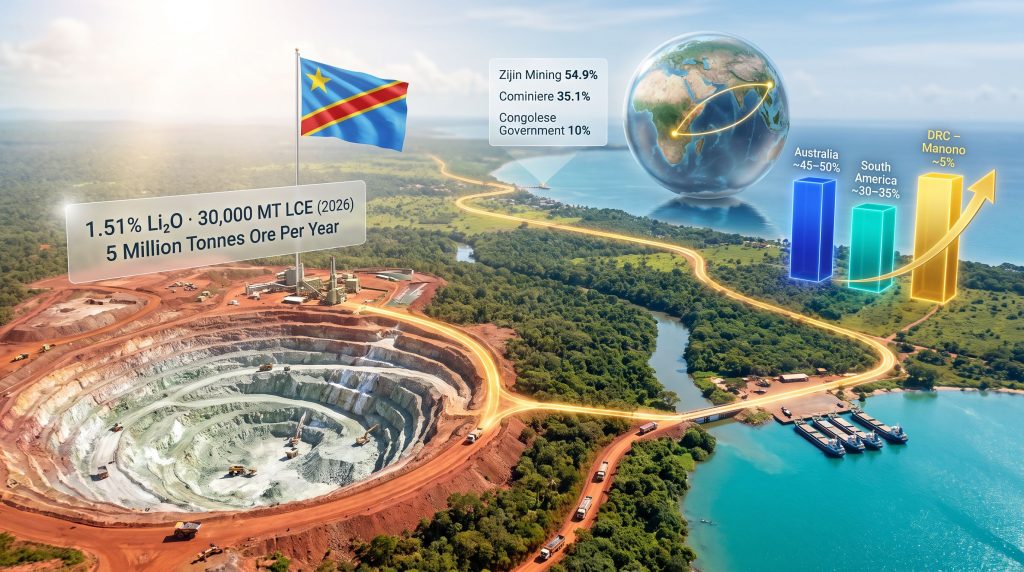
The Manono project operates as a joint venture with a structure that reflects the DRC's evolving approach to resource nationalism. Zijin Mining Group holds a controlling 54.9% stake, while Cominiere, the DRC's state mining company, holds 35.1%, and the Congolese government retains a direct 10% equity position. This tripartite structure is not merely administrative; it shapes how revenues are distributed, how operational decisions are made, and how exposed the project is to policy shifts from Kinshasa.
The state participation model has become increasingly common in African mining jurisdictions. For the DRC specifically, direct equity participation alongside royalty and tax streams gives the government a more immediate claim on project economics than royalty arrangements alone. Whether this translates into meaningful community or national benefit depends heavily on governance quality and transparency mechanisms that remain underdeveloped in the DRC's mining sector.
The Disputed History: AVZ Minerals and the Permit Revocation
The Manono project's path to production has been anything but straightforward. The AVZ Congo dispute arose when the DRC government revoked AVZ Minerals' exploration and development licence over a significant portion of the Manono deposit and reassigned the rights to the Manono Lithium venture now controlled by Zijin. AVZ has contested this revocation, and the dispute remains legally unresolved.
Adding complexity, US-backed technology firm KoBold Metals holds the licence over the adjoining Manono block. KoBold has publicly committed to not advancing development at its section until all legal disputes across the broader project area are fully resolved. This effectively sidelines a significant, well-capitalised player and leaves Chinese-affiliated operators as the only active producers at Manono in the near term. Furthermore, that asymmetry has meaningful implications for how the critical minerals competition between Western and Chinese interests plays out in practice, not in policy documents, but on the ground.
Zijin Congo Lithium Exports to China: The Logistics Architecture
One of the most underappreciated dimensions of the Manono story is the logistics challenge it has overcome. The project sits deep in the DRC's interior, roughly 440 kilometres by road from the lakeside city of Kalemie. That overland leg alone, across infrastructure that is limited in quality and reliability, represents a significant operational complexity.
From Kalemie, concentrate is loaded onto four dedicated lake vessels that cross Lake Tanganyika to the Tanzanian port of Kigoma. The shipment then travels overland to Dar es Salaam, Tanzania's principal Indian Ocean port, where it is loaded onto ocean-going vessels for the final leg to Chinese refining facilities. This multimodal corridor — road, lake, rail or road, ocean — is now functioning as the DRC's first dedicated lithium export route.
The Export Route Step by Step
- Lithium concentrate is trucked 440 km by road from Manono to Kalemie on Lake Tanganyika.
- Four dedicated lake vessels carry cargo across Lake Tanganyika to Kigoma, Tanzania.
- Overland transport connects Kigoma to Dar es Salaam on Tanzania's coast.
- Ocean freight carries spodumene concentrate to Chinese downstream refining facilities.
The Transit Timeline and What It Means for Reported Volumes
One detail that has received insufficient attention in early coverage is the lag between production and arrival. The processing plant commenced operations in May 2026, one month ahead of schedule. Initial exports departed in June 2026, confirmed by multiple sources familiar with the shipments. However, given the length and complexity of the transit route, material produced and shipped in June may not physically arrive at Chinese refineries until as late as October 2026.
This lag matters for how market participants interpret early volume data. Tens of thousands of tonnes of concentrate are understood to have been produced at the site, but a significant proportion of that material is still in transit. Spot market signals and Chinese import data may therefore understate production momentum for several months, a nuance that commodity traders and lithium market analysts should account for when building supply models.
Initial shipment volumes have been characterised as trial quantities, with one trader estimating early consignments at just a few thousand metric tons. However, this figure reflects the cautious early-stage ramp rather than the project's design capacity, which is substantially larger.
China's Expanding Critical Minerals Footprint in the DRC
Zijin Congo lithium exports to China do not occur in isolation. They represent the latest layer of Chinese industrial presence in a country that already hosts CMOC, one of the world's largest cobalt and copper producers, and Huayou Cobalt, a major player in battery materials processing. China's strategy in the DRC has followed a consistent pattern: secure upstream resource positions across multiple critical minerals, control processing and refining domestically, and integrate supply chains vertically to reduce exposure to Western-dominated commodity markets.
What distinguishes Manono from earlier DRC investments is its battery-specific positioning. Cobalt and copper serve broad industrial purposes. Lithium is essentially a pure-play battery metal, with approximately 85–90% of end demand tied to energy storage and electric vehicle applications. By bringing Manono into production, Chinese interests have consequently extended their critical minerals integration in the DRC from traditional base metals into the heart of the EV supply chain.
Comparing Africa's Lithium Position Against Established Producers
| Region | Primary Lithium Source Type | Estimated Global Share |
|---|---|---|
| Australia | Hard-rock spodumene | ~45–50% |
| South America (Lithium Triangle) | Brine-based extraction | ~30–35% |
| DRC (Manono, projected by 2028) | Hard-rock spodumene | ~5% |
| Rest of World | Mixed sources | Remainder |
A 5% global market share contribution from a single new project is not trivial, particularly when it arrives during a period where lithium prices have corrected sharply from 2022 highs. Furthermore, the global lithium market is already navigating a complex set of pressures, and new supply entering alongside existing production expansions will add further downward weight on prices in the medium term.
Production Milestones and the Ramp-Up Trajectory
| Milestone | Date |
|---|---|
| Processing Plant Production Start | May 2026 (one month ahead of schedule) |
| First Lithium Concentrate Exports | June 2026 |
| Downstream Smelter and Refinery Facilities Targeted Online | December 2026 |
| Full Annual LCE Production Target | 30,000 metric tons (2026) |
| Projected Annual Spodumene Output | ~1 million tonnes |
The ahead-of-schedule commissioning is strategically significant beyond the obvious operational milestone. In mining project development, processing plant commissioning is frequently the most fraught phase, marked by technical delays, equipment integration failures, and reagent optimisation challenges. That Manono's plant came online a month early, despite the logistical complexity of operating in central Africa, signals meaningful execution capability and positions Zijin competitively against peers still in development.
The December 2026 target for downstream smelting and refining infrastructure is the next critical marker. If achieved, it would shift the value-add equation at least partially toward in-country processing, though the primary export product for the near term will remain spodumene concentrate rather than battery-grade lithium compounds.
The next major ASX story will hit our subscribers first
Regulatory Risk and Governance Complexity
The DRC's mining governance environment carries structural risks that any serious analysis of Manono must address honestly. The revocation of AVZ Minerals' licence demonstrates that permit security in the DRC is not absolute, regardless of the legal framework nominally in place. International arbitration proceedings related to that revocation are ongoing, and their outcome could have consequences for the operational and legal stability of the broader Manono project area.
For investors and counterparties assessing exposure to Manono-derived supply, several risk dimensions deserve scrutiny:
- The legal status of AVZ Minerals' historical claims and any arbitration awards that may follow.
- KoBold Metals' adjacent licence and the unresolved boundary and rights questions that connect both project areas.
- The DRC government's track record of renegotiating mining agreements when commodity prices rise or political priorities shift.
- Cominiere's capacity to fulfil its role as a stable, professional joint venture partner given historical governance challenges at state mining entities in the DRC.
The DRC's mining code has undergone multiple revisions in recent decades, with each iteration typically increasing state participation, royalty rates, or windfall tax mechanisms. Investors with long-duration exposure to Congolese lithium should model regulatory change scenarios explicitly rather than assuming current terms persist to project maturity.
The Value Chain Question: Raw Exports vs. In-Country Processing
Perhaps the most consequential unresolved tension in the Manono story is the gap between the DRC's stated industrialisation ambitions and the current reality of raw material exports. Shipping spodumene concentrate to Chinese refineries replicates a pattern that has defined the DRC's relationship with its mineral wealth for generations: extraction occurs domestically, but value addition happens elsewhere.
The DRC has articulated aspirations for domestic battery material processing and has, at various points, discussed policies that would incentivise or require greater in-country processing. However, the economics of building refining infrastructure in a landlocked country with unreliable power supply, underdeveloped transport networks, and limited technical workforce capacity are genuinely challenging. In addition, lithium oversupply pressures globally complicate the investment case for new downstream processing capacity, widening the gap between policy aspiration and commercial viability.
Zijin's December 2026 smelter timeline, if achieved, would represent a partial step toward in-country processing. However, converting spodumene to lithium carbonate or hydroxide at scale within the DRC remains a medium-to-long-term proposition rather than an imminent commercial reality.
Frequently Asked Questions: Zijin Congo Lithium Exports to China
When Did Zijin Start Exporting Lithium from the DRC?
Lithium concentrate exports from the Manono project commenced in June 2026, representing the DRC's first-ever lithium export shipment.
What Type of Lithium Product Is Being Exported?
The initial export product is spodumene concentrate, a hard-rock lithium material that is shipped to Chinese refining facilities for conversion into battery-grade lithium carbonate or lithium hydroxide.
How Much Lithium Does Zijin Plan to Produce at Manono?
Zijin has set a 2026 production target of 30,000 metric tons of lithium carbonate equivalent (LCE), with the facility designed to process 5 million tonnes of ore annually and produce approximately 1 million tonnes of spodumene concentrate per year.
What Route Do the Exports Take to Reach China?
Shipments travel by road from Manono to Kalemie, by vessel across Lake Tanganyika to Kigoma in Tanzania, and then overland to Dar es Salaam, where they are loaded onto ocean-going vessels bound for China. According to Reuters reporting on the Manono project, this corridor represents a significant logistical achievement for a landlocked operation of this scale.
What Is the Grade of the Manono Lithium Deposit?
The deposit carries an average grade of 1.51% Li₂O, above the global hard-rock average of approximately 1.2% Li₂O, making it one of the higher-quality large-scale hard-rock lithium deposits identified globally.
Who Are the Joint Venture Partners at Manono?
The project is controlled by Zijin Mining (54.9%), with Cominiere (35.1%) and the Congolese government (10%) holding the remaining equity interests.
Key Takeaways: What This Development Signals for the Broader Industry
- The DRC has crossed a threshold from cobalt and copper dependency into active lithium production, diversifying its critical minerals profile.
- Zijin Congo lithium exports to China extend Chinese vertical integration across African battery metals into spodumene, the foundational upstream input for lithium-ion battery manufacturing.
- The Manono logistics corridor through Tanzania establishes a new African lithium export route with implications for regional trade infrastructure investment.
- Legal disputes involving AVZ Minerals and the adjacent KoBold Metals licence remain material unresolved risks that could affect long-term operational stability.
- Western critical minerals strategies face a structural timing disadvantage at Manono, with Chinese-backed operations reaching commercial production while legally contested alternative developers remain on the sidelines.
- The transit lag between DRC production and Chinese arrival means near-term import data will understate Manono's output momentum, creating potential for market surprise as volumes build through late 2026.
As Bloomberg's analysis of Zijin's Congo mine notes, the project is on track to become one of the world's largest lithium operations, further cementing the DRC's emerging role in the battery metals landscape.
This article is intended for informational purposes only and does not constitute financial or investment advice. Forecasts, projections, and timelines referenced herein involve inherent uncertainty and should not be relied upon as guarantees of future outcomes. Readers seeking additional context on the Manono project and DRC critical minerals developments may find value in reviewing related reporting from Mining Weekly at miningweekly.com, which covers African mining sector developments in depth.
Want to Stay Ahead of the Next Major Battery Metals Discovery on the ASX?
Discovery Alert's proprietary Discovery IQ model delivers real-time alerts the moment significant mineral discoveries — including lithium and other battery metals — are announced on the ASX, transforming complex data across 30-plus commodities into clear, actionable insights for both traders and long-term investors. Explore historic discoveries and the extraordinary returns they generated, then begin your 14-day free trial at Discovery Alert to position yourself ahead of the market.