July 16, 2026
The DRC's Lithium Moment: How a Landlocked Deposit Is Rewiring Global Battery Metal Flows
For decades, the mental map of the global lithium market has been drawn across two distinct geographies: the salt flat brines of South America's Lithium Triangle and the hard-rock spodumene mines of Western Australia. That map is now being redrawn, and Zijin Congo lithium exports to China are at the centre of this shift. Central Africa, long absent from the lithium conversation, is asserting itself with the kind of geological credentials that fundamentally alter supply chain arithmetic. Understanding why this shift matters requires looking beyond the headlines and into the structural mechanics of how lithium moves from ore body to battery cell.
When big ASX news breaks, our subscribers know first
Why Hard-Rock Lithium from Central Africa Changes the Grade Equation
Not all lithium deposits are created equal. The distinction between brine-based and hard-rock lithium sources carries significant implications for processing complexity, capital intensity, and ultimately, the grade of material that reaches refineries.
Brines Versus Hard-Rock: What's the Difference?
Lithium brines, which dominate South American production, extract lithium from underground saline solutions and require lengthy evaporation pond cycles — often spanning 12 to 18 months — before the material reaches a processable concentration. Hard-rock spodumene extraction, by contrast, delivers lithium in a solid mineral matrix that can be crushed, floated, and concentrated within weeks. The trade-off has historically been higher capital costs for hard-rock mines, but this disadvantage is partially offset by the predictability and consistency of ore grades.
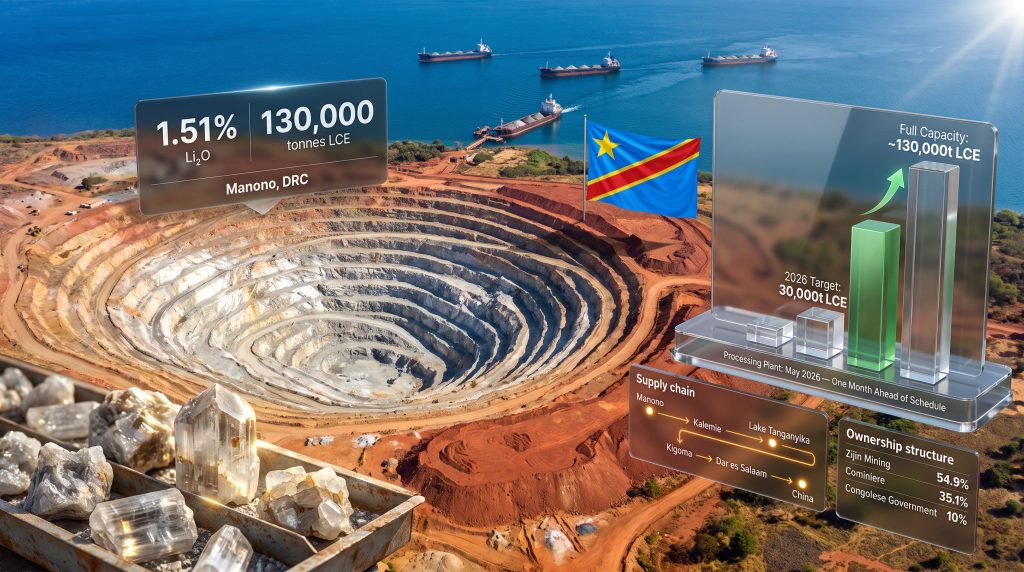
The Manono lithium project in the Democratic Republic of Congo sits at the premium end of the hard-rock grade spectrum. Its lithium oxide (Li₂O) content of 1.51% compares favourably against the global hard-rock average of approximately 1.2% Li₂O — a differential that carries outsized economic significance at the scale Zijin is targeting. Higher ore grades translate directly into lower tonnage requirements per unit of product output, reducing both energy consumption and reagent costs across the processing circuit.
Mineralogical Advantages at Manono
A less commonly understood aspect of the Manono geology is the deposit's mineralogical character. Manono's lithium is hosted within a rare type of granite pegmatite known for exceptionally coarse crystal structures. These large spodumene crystals are easier to liberate during comminution, which means the ore responds favourably to conventional flotation processing without requiring exotic or expensive beneficiation techniques. This metallurgical simplicity is a meaningful operational advantage that differentiates Manono from deposits where fine-grained or complex mineralogy demands more intensive processing.
Zijin Congo Lithium Exports: A Commissioning Timeline That Beat Expectations
The operational milestones at Manono have unfolded faster than most industry observers anticipated. According to Reuters, Zijin confirmed through a company notice dated July 9, 2026 that its Manono processing plant entered production in May 2026, arriving one full month ahead of the original commissioning schedule. Lithium concentrate exports to China commenced in June 2026, making the DRC a lithium-exporting nation for the first time in its history.
The current export product is crude lithium sulfate, an intermediate material sitting between raw spodumene concentrate and fully refined battery-grade lithium carbonate. The downstream smelting and refining facilities required to produce finished battery-grade compounds are targeted for commissioning by December 2026, at which point the project's export profile will shift toward higher-value output.
The production and ramp-up parameters for Manono are substantial:
| Metric | Detail |
|---|---|
| Processing Plant Start | May 2026 (one month ahead of schedule) |
| First Exports | June 2026 |
| 2026 LCE Production Target | 30,000 tonnes |
| Annual Ore Processing Capacity | 5 million tonnes |
| Designed Spodumene Concentrate Output | ~1 million tonnes per year |
| Annualised Crude Lithium Sulfate Potential | ~95,170 tonnes |
| Full-Capacity LCE Equivalent | ~130,000 tonnes per year |
| Downstream Smelter Target | December 2026 |
Early export volumes remain modest, as would be expected during a commissioning phase. Independent trade sources estimate initial consignments at a few thousand metric tonnes, while a second market source indicated that tens of thousands of tonnes of concentrate had already been produced on-site by mid-2026, with significant volumes still in transit and not expected to reach Chinese facilities until approximately October 2026.
The Multi-Modal Logistics Chain Moving Manono Concentrate to China
One of the least discussed but most operationally significant aspects of the Zijin Congo lithium exports story is the logistics architecture required to move material from a landlocked Central African mine to Chinese refineries. This is not a straightforward rail-to-port operation. It is a genuinely complex multi-modal supply chain with five distinct legs.
- Mine to Kalemie: Truck convoys transport lithium concentrate from the Manono processing facility to Kalemie, a port city positioned on the western shore of Lake Tanganyika.
- Lake Tanganyika Crossing: Zijin has deployed four dedicated cargo vessels on Lake Tanganyika to ferry material across the water body, which spans approximately 670 kilometres in length and represents one of Africa's deepest lakes.
- Kigoma Arrival (Tanzania): Vessels dock at Kigoma on the Tanzanian shore, transferring cargo into Tanzania's inland logistics network.
- Overland Transit to Dar es Salaam: Concentrate moves overland through Tanzania to Dar es Salaam, the country's primary Indian Ocean port.
- Ocean Freight to China: Final shipment by ocean vessel from Dar es Salaam to Chinese processing and refining facilities.
The cumulative lead time across this corridor explains why material produced in early 2026 may not arrive at Chinese refineries until the fourth quarter of the year. Zijin's decision to commission four dedicated lake vessels rather than relying on shared or chartered capacity signals a long-term infrastructure commitment that goes beyond the economics of a single production cycle.
"The multi-stage nature of this logistics corridor creates a meaningful production-to-delivery lag that obscures near-term supply figures in commodity trade data, making Manono's true market impact difficult to assess from export statistics alone."
Ownership Structure and the Commercial Control Question
The Manono joint venture's equity architecture involves three parties, but commercial authority is concentrated in a way that deserves careful examination. Zijin Mining holds a 54.9% controlling interest, the DRC state mining entity Cominiere holds 35.1%, and the Congolese government directly holds the remaining 10%.
What distinguishes this arrangement from a standard joint venture is that Zijin manages all sales activity across the entire venture, including the portions attributable to Cominiere's state-owned equity share. This means export volumes, customer selection, pricing terms, and downstream allocation are effectively determined by Zijin's corporate priorities. The practical consequence is that the DRC state entity's economic participation is financial rather than operational, with Cominiere receiving revenue but exercising no independent commercial agency.
Zijin secured its controlling position following the DRC government's revocation of Australian miner AVZ Minerals' exploration permit in 2023, subsequently committing approximately $1 billion USD to develop the project. The capital deployment timeline from permit acquisition to first exports spans roughly three years, a pace that reflects Zijin's considerable execution capacity in complex jurisdictions.
China's Battery Metal Trifecta in the DRC
The commencement of Zijin Congo lithium exports completes a strategic pattern that has been building for over a decade. The DRC already hosts two of China's most significant critical mineral operations outside its own borders:
| Company | Primary Commodity | Operational Status |
|---|---|---|
| CMOC | Cobalt and Copper | Active major producer |
| Huayou Cobalt | Cobalt | Active major producer |
| Zijin Mining (Manono) | Lithium | Exports commenced June 2026 |
With Zijin's Manono operation now exporting, Chinese companies effectively hold dominant positions across cobalt, copper, and lithium in the DRC simultaneously. These three metals constitute the core battery chemistry inputs for lithium-iron-phosphate (LFP) and nickel-manganese-cobalt (NMC) cells. The geographic concentration of this exposure in a single country, directed entirely toward Chinese refining infrastructure, is a supply chain configuration that Western battery manufacturers and governments have repeatedly identified as a systemic vulnerability.
The next major ASX story will hit our subscribers first
The AVZ Minerals Dispute and KoBold's Development Moratorium
The Manono project's legal history introduces a layer of complexity that distinguishes it from straightforward greenfield development stories. The AVZ legal dispute stems from AVZ Minerals, an Australian junior miner, having held exploration rights over the Manono deposit before the DRC government revoked its permit and redirected the licence to the Manono Lithium venture. AVZ Minerals has pursued remedies through international arbitration, and those proceedings remain unresolved as of mid-2026.
KoBold's Strategic Caution
The ongoing arbitration has not halted Zijin's development and export activities, but it does introduce title risk that sophisticated investors and offtake partners cannot easily dismiss. More telling is the position adopted by KoBold Metals, the US-backed exploration company that holds the exploration licence for the concession adjoining the Manono project. KoBold, whose backers include prominent technology-sector figures, has publicly stated it will not advance development of its adjacent licence until all legal disputes over the broader Manono project area reach full resolution.
"This stance reflects the legal risk premium that Western-aligned capital is applying to DRC lithium assets with contested title histories, and it effectively places a development moratorium on what could otherwise be a complementary Western-accessible lithium source adjacent to Manono."
KoBold's caution is arguably the most honest signal available about how international arbitration risk is being priced by sophisticated actors in this specific geography. The longer the AVZ arbitration remains unresolved, the longer KoBold's adjacent resource sits dormant, and the more completely Zijin's Manono operation defines the DRC's lithium export profile.
What Manono's Full-Capacity Output Means for Lithium Price Formation
The 2026 production target of 30,000 tonnes of LCE represents a commissioning-year figure, deliberately conservative given the ramp-up dynamics of a new processing circuit. The more consequential number is Manono's design-capacity output of approximately 130,000 tonnes LCE annually, which positions the project as one of the largest single-source lithium operations globally once it reaches steady state.
Context matters here. Global lithium supply additions have been closely watched since the dramatic price compression that followed the 2022–2023 peak, when lithium carbonate prices in China fell from historic highs above $80,000 per tonne toward levels below $10,000 per tonne. The introduction of large-scale new supply from a high-grade, relatively low-cost African deposit into an already-recovering market has price formation implications that extend well beyond the DRC itself.
Furthermore, for Australian spodumene producers and South American brine operations, the Manono ramp-up represents a structural supply addition that competes on grade and potentially on cost once the logistics corridor matures. The transition from crude lithium sulfate exports to refined battery-grade output, expected once the December 2026 smelter commissioning is complete, will further compress the processing margin currently captured by Chinese refiners.
Disclaimer: This article contains forward-looking projections regarding production targets, market pricing, and supply chain developments. These projections are subject to material uncertainty including operational risks, legal disputes, commodity price volatility, and geopolitical factors. Nothing in this article constitutes financial or investment advice.
Strategic Implications for Western Supply Chain Planners
The architecture of Zijin Congo lithium exports illustrates why Western supply chain diversification efforts face structural rather than merely logistical challenges. Redirecting even a portion of Manono's output toward non-Chinese destinations would require renegotiating the joint venture's commercial framework, developing alternative logistics pathways, and resolving the AVZ Minerals legal dispute — none of which are near-term possibilities.
The more realistic near-term pathway for Western-accessible DRC lithium lies with KoBold Metals' adjacent concession, but that development is explicitly conditional on legal resolution. This places Western battery supply chain planners in a position of observing a world-class lithium deposit ramping to full production while having no viable mechanism to access its output.
The policy response to this dynamic is already visible in the accelerating pace of critical mineral partnership agreements and alternative geography development that Western governments and manufacturers have pursued since 2023. Consequently, as Bloomberg has reported, Manono's scale and trajectory are being closely scrutinised by industry analysts and policymakers alike. Manono's export commencement does not cause this strategic shift, but it crystallises its urgency in ways that trade data alone cannot.
Frequently Asked Questions
When Did Zijin Begin Exporting Lithium from the DRC?
Zijin commenced lithium concentrate exports from the Manono deposit in June 2026, marking the DRC's first-ever lithium export activity. Initial volumes were consistent with commissioning-phase trial shipments.
What Form of Lithium Is Currently Being Exported?
Current exports consist of crude lithium sulfate, an intermediate processed form. Transition to battery-grade refined lithium carbonate is expected following commissioning of downstream smelting infrastructure targeted for December 2026.
How Does the Manono Logistics Route Work?
Material travels by truck to Kalemie on Lake Tanganyika, crosses the lake by dedicated cargo vessel to Kigoma in Tanzania, moves overland to Dar es Salaam, and then travels by ocean freight to Chinese processing facilities. The full corridor creates significant transit lead times between production and delivery.
How Large Is Manono's Production Potential?
At full design capacity, Manono is engineered to process 5 million tonnes of ore annually, producing approximately 1 million tonnes of spodumene concentrate equivalent to roughly 130,000 tonnes LCE per year. The 2026 target is 30,000 tonnes LCE during the commissioning ramp-up phase.
Is There Ongoing Legal Uncertainty Over the Project?
Yes. AVZ Minerals' international arbitration over the revocation of its original exploration permit remains unresolved. US-backed KoBold Metals, which holds the adjacent licence, has stated publicly it will not proceed with development until all legal matters affecting the Manono project area are fully resolved.
Want to Stay Ahead of the Next Major Battery Metal Discovery?
Discovery Alert's proprietary Discovery IQ model delivers real-time alerts on significant ASX mineral discoveries — cutting through complex geological and market data to surface actionable investment opportunities the moment they are announced. Explore historic discoveries and their market-moving returns, then begin your 14-day free trial at Discovery Alert to position yourself ahead of the next major shift in critical mineral supply chains.