June 19, 2026
The Commodity Trap That Billions in Mining Investment Cannot Escape
There is a well-documented pattern in resource-rich developing economies: the more a country exports raw materials, the less it earns per unit of effort. This is not a paradox — it is the arithmetic of commodity dependence. When a nation ships unprocessed ore or partially refined concentrate, it exports not just the material but the employment, the technical know-how, and the downstream margins that flow from turning that material into something industrially useful.
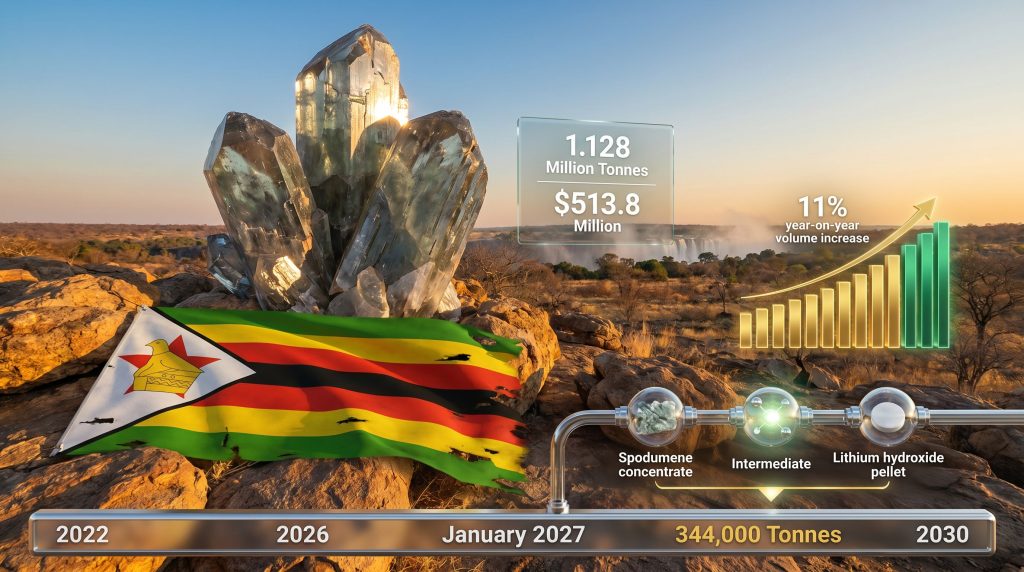
Zimbabwe is now living this reality in real time. Despite shipping 11% more lithium-bearing spodumene concentrate in 2025 than the prior year, its total lithium export earnings remained essentially flat at approximately $513.8 million. The culprit was a sustained collapse in global lithium prices, which erased the revenue benefit of higher shipment volumes entirely. This data point sits at the heart of Zimbabwe's increasingly assertive beneficiation policy and the growing tension between its regulatory ambitions and the physical realities of industrial infrastructure construction.
The question facing investors, supply chain strategists, and policymakers in mid-2026 is not whether Zimbabwe's beneficiation logic is sound — it clearly is. The question is whether the regulatory timeline and the construction calendar can be brought into alignment before the Zimbabwe lithium export ban delay becomes either a political liability or a supply chain event with global consequences.
When big ASX news breaks, our subscribers know first
Zimbabwe's Lithium Geology: Why This Country Is Worth Fighting Over
Before understanding the policy dimensions, it helps to appreciate why Zimbabwe occupies such a strategically significant position in the global lithium market landscape.
Zimbabwe holds the largest lithium reserves on the African continent, concentrated primarily in the country's granite pegmatite geology. Pegmatites are coarse-grained igneous rock formations that form during the final stages of magma crystallisation, and they are the primary host rock for spodumene — the lithium-bearing mineral that is crushed, processed, and refined into battery chemicals. Zimbabwe's pegmatite belts, particularly in the Masvingo and Midlands provinces, contain lithium grades that compare favourably with major producing regions globally.
Spodumene concentrate — the product Zimbabwe currently exports at scale — typically grades between 5% and 6% lithium oxide (Li₂O) when processed to commercial specification. Understanding spodumene extraction basics helps clarify why this is the standard feedstock that Chinese lithium chemical refiners have built their processing infrastructure around. It is not battery-ready material; it requires further hydrometallurgical processing to become lithium sulphate, and then additional refining to reach the lithium hydroxide or lithium carbonate grades used in EV cathode manufacturing.
This multi-stage processing chain is precisely why Zimbabwe's government views the current export structure as economically inefficient. Each stage of processing that occurs outside Zimbabwe transfers margin, employment, and technical capability to another jurisdiction — overwhelmingly China.
A Four-Year Regulatory Escalation: How the Policy Architecture Was Built
Zimbabwe's current export framework did not emerge overnight. It represents a deliberate, multi-phase regulatory strategy that has tightened progressively over four years:
-
2022: A prohibition on the export of raw, unprocessed lithium ore takes effect, establishing the precedent that unprocessed materials will not be permitted to leave the country indefinitely.
-
2023: Global lithium prices enter a severe downturn, reducing the commercial incentive for domestic processing investment. Enforcement of processing mandates softens temporarily as the economics of building lithium sulphate plants deteriorate.
-
Announced timeline: The government locks in January 2027 as the terminal date for lithium concentrate exports, giving industry a multi-year runway to build the required processing infrastructure.
-
February 2026: Authorities enact an immediate ban on exports of all raw minerals and lithium concentrate, citing documented concerns about export malpractices and mineral leakage — specifically, the suspected underreporting or misclassification of shipments to reduce tax and regulatory obligations.
-
April 2026: The government transitions from an outright suspension to a structured export quota framework, imposing stricter shipment documentation, tax compliance requirements, and processing investment commitments as conditions for continued concentrate exports.
-
June 2026: The Zimbabwe Lithium Producers' Association formally requests an extension of the concentrate export deadline to approximately mid-2027, citing incomplete processing infrastructure as the primary justification.
Each phase of this regulatory sequence has narrowed the conditions under which unprocessed lithium can exit the country. The February 2026 suspension demonstrated that the government was prepared to act ahead of its own announced timeline when compliance concerns arose — a signal that should not be discounted by investors modelling policy risk.
The Processing Infrastructure Gap: One Plant Operational, Several Under Construction
The central tension behind the Zimbabwe lithium export ban delay request is straightforward: the policy deadline has arrived faster than the construction timeline. As of mid-2026, only one lithium sulphate processing facility is confirmed as fully operational in Zimbabwe.
| Facility / Operator | Status | Notes |
|---|---|---|
| Zhejiang Huayou Cobalt | Operational | Only confirmed operational lithium sulphate plant in Zimbabwe as of mid-2026 |
| Sinomine / Bikita Minerals | Under construction | Construction phases ongoing; timeline unconfirmed |
| Yahua Group / Kamativi Project | Under construction | Commissioning date not yet confirmed |
| Sandawana Mine (State-linked) | Feasibility assessment | Government-affiliated operation in planning stage |
The structural mismatch here is significant. Zimbabwe exported approximately 1.128 million tonnes of spodumene concentrate in 2025. A single operational lithium sulphate plant cannot absorb anything close to that volume. If the January 2027 deadline were enforced with current processing capacity, producers would face an immediate export ceiling — unable to ship concentrate and lacking sufficient domestic processing capacity to redirect production.
This is why the Lithium Producers' Association, whose members are the companies building these plants, raised the extension request at a mining industry conference in Victoria Falls, as reported by Reuters. The ask is relatively modest in timeline terms — approximately six additional months to reach mid-2027 — but the request carries significant implications for how Zimbabwe balances investor relations against policy credibility.
Understanding Lithium Sulphate's Role in the Battery Value Chain
For investors and analysts less familiar with lithium processing chemistry, it is worth understanding exactly where lithium sulphate sits in the production sequence. Furthermore, knowing how lithium mining works provides essential context for appreciating the complexity of each stage:
- Spodumene ore: Mined from pegmatite deposits; contains lithium in mineral form but is not chemically accessible for battery use
- Spodumene concentrate: Produced by crushing and flotation; typically 5-6% Li₂O; the current primary export product from Zimbabwe
- Lithium sulphate: An intermediate chemical compound produced by roasting and leaching spodumene concentrate with sulphuric acid; water-soluble and suitable for further refining
- Lithium hydroxide / Lithium carbonate: Battery-grade chemicals produced from lithium sulphate; the materials actually used in EV cathode formulations such as NMC and LFP chemistries
Each step up this chain adds substantial value per tonne of lithium processed. Zimbabwe's policy aims to capture at least the lithium sulphate stage domestically — a meaningful leap up the value chain compared to concentrate exports, though still not the final battery-grade product.
China's Exposure: How Zimbabwe's Export Restrictions Ripple Through Battery Supply Chains
The geopolitical stakes of this situation extend well beyond Zimbabwe's borders. In 2025, Zimbabwe shipped approximately 1.13 million tonnes of spodumene concentrate to China, representing roughly 15% of China's total lithium concentrate imports for that year. That is a material supply position in a market where Chinese battery manufacturers have limited short-term flexibility to source equivalent volumes from alternative jurisdictions.
Chinese companies have collectively deployed billions of dollars into Zimbabwe's lithium sector, with major operators including:
- Zhejiang Huayou Cobalt (the only currently operational lithium sulphate producer in Zimbabwe)
- Sinomine Resource Group (operator of the Bikita Minerals project)
- Yahua Group (developer of the Kamativi lithium project)
- Chengxin Lithium Group
- Tsingshan Holding Group
These investments were structured with the expectation of a managed transition — continued concentrate exports during a construction ramp-up period, followed by a gradual shift to domestic processing. An abrupt enforcement of the January 2027 deadline before sufficient processing capacity exists would threaten the return profile of these investments and potentially strain the diplomatic and commercial relationships that underpin Zimbabwe's attractiveness as a mining destination.
| Scenario | Assessment | Supply Chain Impact |
|---|---|---|
| Extension granted to mid-2027 | High likelihood based on industry preference | Transitional continuity; manageable disruption |
| January 2027 deadline enforced as planned | Medium risk | Short-term concentrate supply gap; possible upward pressure on lithium chemical prices |
| Multiple further delays beyond mid-2027 | Lower probability | Policy credibility erosion; potential investor recalibration |
| Full processing capacity by 2030 | Conditional on construction completion | Zimbabwe transitions to lithium sulphate exporter; structural shift in regional supply |
Disclaimer: The scenario assessments above are analytical projections based on available information as of mid-2026 and do not constitute investment advice. Actual outcomes may differ materially from any forward-looking assessments.
The Indonesia Precedent: What Resource Nationalism Looks Like When It Works
Zimbabwe's beneficiation strategy does not exist in isolation. It is part of a broader global trend toward resource nationalism and critical minerals value-chain capture, and Indonesia's nickel sector offers the most instructive comparison available.
Indonesia banned the export of raw nickel ore in 2020, over the strenuous objections of trading partners and despite initial industry resistance. Within three years, the policy had catalysed an estimated $30 billion in downstream smelting and battery materials processing investment, transforming Indonesia from a raw ore exporter into a significant producer of nickel-based battery precursor materials.
Zimbabwe appears to be drawing on this model deliberately. The parallels are notable:
- A staged approach beginning with raw ore bans before progressing to concentrate restrictions
- Domestic processing mandates tied to investment commitments from foreign operators
- Government willingness to enforce ahead of announced timelines when compliance concerns arise
- Long-term ambitions to become a mid-stream chemical producer rather than a raw materials supplier
The critical difference is that Indonesia's nickel sector operated in a rising price environment when the ban was implemented, whereas Zimbabwe's lithium sector has been navigating a significant price downturn since late 2022. Lithium carbonate prices fell from highs above $80,000 per tonne in late 2022 to below $10,000 per tonne by mid-2024, dramatically compressing the economics of new processing plant investment. This price context explains much of the infrastructure lag Zimbabwe is now trying to resolve.
The next major ASX story will hit our subscribers first
What Zimbabwe's Value-Addition Ambitions Mean for Africa's Broader Minerals Strategy
The outcome of Zimbabwe's beneficiation transition carries implications that extend across the African continent. Several other resource-rich nations are watching closely, and the China battery recycling outlook adds yet another layer of complexity to how downstream demand will evolve:
| Country | Resource | Policy Approach | Development Stage |
|---|---|---|---|
| Zimbabwe | Lithium | Staged export ban + domestic processing mandate | Implementation (2022-2027) |
| Indonesia | Nickel | Raw ore export ban with downstream investment incentives | Advanced |
| DR Congo | Cobalt | Progressive local processing requirements | Early-stage |
| Chile | Lithium | State partnership model with domestic value-addition conditions | Evolving |
| Namibia | Multiple critical minerals | Emerging processing frameworks | Developing |
If Zimbabwe successfully executes this transition — moving from concentrate exporter to lithium sulphate producer at meaningful scale — it will serve as a proof of concept for African resource nations seeking to capture more value from their mineral endowments. Industry executives project that, if all planned processing investments are completed on schedule, Zimbabwe could achieve annual lithium sulphate output of approximately 344,000 tonnes by 2030. At that scale, Zimbabwe would represent a genuinely significant mid-stream chemical producer in the global battery materials landscape.
Conversely, a stumbling transition — marked by repeated deadline extensions, enforcement inconsistencies, or investor departures — would set back the case for African minerals beneficiation and reinforce narratives that resource nationalism carries execution risks that undermine its theoretical economic logic. Emerging technologies such as direct lithium extraction could also reshape the competitive dynamics of this space in ways that policymakers have yet to fully account for.
The stakes of Zimbabwe's lithium transition are not confined to one country's export earnings. They are a test case for whether African nations can credibly climb the battery minerals value chain in time to capture meaningful share of the energy transition economy.
FAQ: Zimbabwe Lithium Export Ban Delay
Has the January 2027 lithium export ban been officially delayed?
As of mid-2026, no official government announcement has confirmed a postponement. The Zimbabwe Lithium Producers' Association submitted a formal extension request to approximately mid-2027, but the January 2027 deadline remains the operative government position pending any formal response.
Why are producers requesting only a six-month extension?
The request reflects the specific commissioning timelines of plants already under construction. Producers are not seeking an indefinite delay but rather sufficient time for facilities that are already being built to reach operational readiness. A six-month window to mid-2027 represents the minimum additional runway the industry believes it needs.
What is the difference between lithium concentrate and lithium sulphate?
Spodumene concentrate is a partially processed ore product requiring substantial further refining before it is usable in battery manufacturing. Lithium sulphate is an intermediate chemical produced from concentrate via roasting and leaching processes. It can then be further refined into battery-grade lithium hydroxide or lithium carbonate. Zimbabwe's policy goal is to retain the economic value of at least the sulphate conversion step within the country.
How significant is Zimbabwe's lithium supply to China?
In 2025, Zimbabwe supplied approximately 1.13 million tonnes of spodumene concentrate to China, representing roughly 15% of China's total lithium concentrate imports. This is a material supply position that cannot be replaced from alternative sources at short notice without disruption. Analysts examining Zimbabwe's delayed export ban have noted that the right policy at the wrong time could carry its own significant costs.
What are the risks of enforcing the Zimbabwe lithium export ban delay before processing capacity is adequate?
Premature enforcement could create a temporary export ceiling for producers with insufficient domestic processing capacity, potentially reducing output, straining Chinese investment relationships, and generating upward pressure on lithium chemical prices in the near term. It would also risk production curtailments that would directly impact Zimbabwe's export revenues.
This article is intended for informational purposes only and does not constitute financial or investment advice. Forward-looking projections regarding processing capacity, production volumes, and policy outcomes involve inherent uncertainty and may not materialise as described.
Want to Track the Next Major Mineral Discovery Before the Market Does?
Discovery Alert's proprietary Discovery IQ model delivers real-time alerts on significant ASX mineral discoveries — cutting through complex commodity data to surface actionable opportunities the moment they are announced. Explore historic discoveries and the returns they generated, then begin your 14-day free trial to position yourself ahead of the market.