July 23, 2026
The Economics of Mineral Nationalism: Why Raw Exports Are No Longer Enough
Across the developing world, a quiet but powerful shift is reshaping how resource-rich nations think about their mineral endowments. The old model, digging up ore and shipping it abroad for processing, is giving way to a more assertive framework: one where governments insist that the economic complexity of refining, upgrading, and chemically transforming raw materials happens within their own borders. The Zimbabwe lithium export ban processing plants debate is one of the most pointed expressions of this philosophy currently playing out anywhere in the world.
As the battery metals supercycle continues to reshape global supply chains, Zimbabwe finds itself holding a strategically significant hand. The country sits atop Africa's largest lithium reserves, with mineralogically diverse deposits that have attracted billions of dollars in foreign capital over the past several years. However, the government's position is clear: raw spodumene concentrate leaving Zimbabwean soil is no longer acceptable as a long-term economic model.
When big ASX news breaks, our subscribers know first
Understanding the Value Chain Gap in Lithium Processing
To appreciate why Zimbabwe is pushing so hard on this issue, it helps to understand what happens to lithium between the mine and the battery. Understanding how lithium mining works is essential context for grasping the scale of value being left on the table.
Spodumene is a lithium-bearing mineral that forms in pegmatite rock. When it is mined and crushed, it becomes a concentrate, typically grading between 5% and 7.5% lithium oxide (Li₂O). This concentrate is a relatively low-value commodity compared to what it becomes after further processing.
Lithium beneficiation refers to the downstream chemical conversion of spodumene concentrate into battery-grade compounds such as lithium sulphate, lithium hydroxide, or lithium carbonate. Each processing step adds substantial value to the material:
- Spodumene concentrate (exported raw): Minimal domestic value capture, highly commoditised pricing
- Lithium sulphate (intermediate chemical): Significantly higher value per tonne, requires chemical processing infrastructure
- Lithium hydroxide / carbonate (battery-grade end products): Premium pricing tier, directly usable by battery cell manufacturers
The revenue difference between selling raw spodumene and refined lithium chemicals can be transformative for a producing nation's fiscal position. Furthermore, spodumene extraction economics make it clear why Zimbabwe has spent years watching the majority of that value creation occur in China, which has historically been the dominant importer of its raw concentrate.
Zimbabwe's Lithium Export Ban: How the Policy Took Shape
The Zimbabwe lithium export ban processing plants policy did not emerge suddenly. It evolved through a sequence of escalating measures that reflect both economic ambition and political urgency.
A Timeline of Policy Escalation
| Date | Policy Action | Key Impact |
|---|---|---|
| February 2026 | Immediate suspension of lithium concentrate exports, including in-transit shipments | Short-term supply disruption; Chinese processors affected |
| Early-Mid 2026 | Introduction of a 16% export tax on lithium concentrates | Increased cost burden on miners exporting unprocessed material |
| Mid 2026 | Export quota system introduced as a transitional measure | Conditional resumption tied to demonstrated processing progress |
| January 1, 2027 | Full ban on all lithium concentrate exports | Hard deadline for processing capacity to be in place |
| June 2027 | Industry-requested extension deadline | Formally appealed by Zimbabwe's Lithium Producers' Association |
The February 2026 temporary halt was notable for its scope: even shipments already in transit were caught by the order, signalling that the government was willing to absorb short-term disruption to send an unambiguous message. The stated rationale centred on concerns about mineral leakage and underreporting of export volumes, suggesting that the revenue Zimbabwe believed it was owed was not being fully captured under the existing framework.
The subsequent introduction of a 16% export tax further tightened the economic case for continued raw exports. Combined with operating costs and the capital expenditure required to build processing infrastructure, this tax layer compresses margins significantly for any operator still relying on concentrate sales.
The cumulative policy architecture — export halts, taxation, quotas, and a hard deadline — is designed to make raw concentrate exports economically unattractive and eventually illegal, removing any rational business case for deferring processing investment.
The Industry's Appeal: A Formal Request for More Time
Speaking at a mining conference in Victoria Falls in June 2026, the chairperson of Zimbabwe's Lithium Producers' Association made a formal appeal to regulators for a six-month extension to the January 2027 deadline, pushing the compliance date to June 2027.
The core of the argument was not opposition to beneficiation itself. Rather, it acknowledged that major operators were at various stages of plant construction, and that the capital-intensive nature of building lithium sulphate processing facilities meant that responsible timelines could not always be compressed to meet a politically set date.
The Lithium Producers' Association indicated it was prepared to provide written timelines for plant completion as a condition of any extension. As of the time of the conference, Zimbabwe's mines ministry had not formally responded to the appeal.
This dynamic reveals an important tension that resource-nationalist policies frequently encounter: the gap between the political timeline for economic transformation and the engineering reality of infrastructure construction.
Which Processing Plants Are Being Built? A Mine-by-Mine Assessment
The processing landscape in Zimbabwe is uneven, with one facility already operational and others at varying stages of development.
Processing Infrastructure Status
| Operation | Owner | Current Status | Estimated Investment |
|---|---|---|---|
| Unnamed facility | Zhejiang Huayou Cobalt (China) | Operational, exporting chemicals | ~$400 million |
| Bikita Minerals | Sinomine (China) | Lithium sulphate plant under construction | ~$500 million |
| Kamativi Lithium Mine | Sichuan Yahua (China) | Lithium sulphate plant under construction | Not publicly disclosed |
| Sandawana Mine | Mutapa Energy Resources (State) | Processing feasibility study underway | Not yet determined |
Zhejiang Huayou Cobalt holds the distinction of being the only operator currently meeting the government's beneficiation mandate. With approximately $400 million invested in its processing facility, Huayou's operation serves as the benchmark that other producers must replicate. Its status as a functioning lithium chemicals exporter gives it a competitive and regulatory advantage over peers still in construction.
Bikita Minerals, operated by Sinomine, is one of Zimbabwe's most historically significant lithium assets. Bikita's deposit is notable for its mineralogical diversity, containing not just spodumene but also petalite, lepidolite, and eucryptite, making it one of the more complex and potentially valuable lithium pegmatite systems in Africa. The lithium sulphate plant under construction there represents a commitment of approximately $500 million.
Kamativi, operated by Sichuan Yahua, represents a newer node in Zimbabwe's emerging lithium geography. Yahua's strategic interest in upstream supply security, linked to its position in China's battery chemicals manufacturing chain, provides a clear commercial rationale for the processing investment.
Sandawana, the state-owned operation under Mutapa Energy Resources, presents the most uncertain compliance outlook. Still at feasibility study stage, it faces a significantly longer path to processing capacity than its private sector peers. Consequently, the gap between feasibility and construction means the state-owned player is furthest from meeting the January 2027 requirement.
China's $2 Billion Footprint: Strategic Dependency or Mutual Interest?
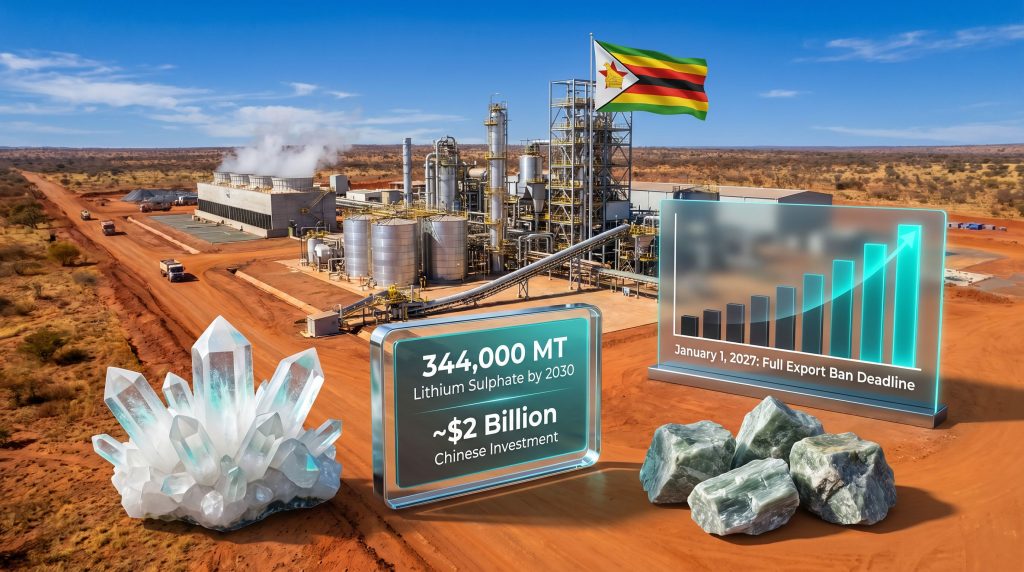
The ownership map of Zimbabwe's lithium sector is striking in its concentration. All three major private lithium operations are controlled by Chinese companies, which have collectively invested approximately $2 billion in the sector since 2021. This investment wave reflected China's strategic imperative to secure upstream control over battery metals as its electric vehicle industry scaled rapidly.
In 2025, Zimbabwe exported approximately 1.13 million tonnes of lithium-bearing spodumene concentrate to China, representing roughly 15% of China's total lithium concentrate imports for that year. That is a material dependency for Chinese lithium processors, and it explains why the export ban carries supply chain implications well beyond Zimbabwe's borders.
Zimbabwe's share of China's lithium concentrate import mix in 2025 was large enough that a hard export ban, without equivalent processing capacity coming online simultaneously, creates a structural near-term supply gap that both governments have strong incentives to manage carefully.
The question of whether Chinese firms will accelerate construction to meet the January 2027 deadline, or seek regulatory relief through diplomatic channels, remains one of the most consequential uncertainties in the sector. The extension appeal by the Lithium Producers' Association effectively gives Beijing-aligned operators political cover to push for more time.
Does Heavy Chinese Concentration Create Risk?
The near-total Chinese ownership of private lithium operations creates a specific kind of policy risk that Zimbabwe must navigate carefully:
- Export restrictions that reduce return on Chinese capital already deployed may chill future investment appetite
- Conversely, Chinese firms have demonstrated in other jurisdictions that they will build domestic processing capacity when export bans make raw exports unviable
- The question is whether Zimbabwe's sovereign risk profile, including infrastructure constraints, power reliability, and policy predictability, is sufficient to retain Chinese capital through the transition period
- Future non-Chinese investment may be deterred if the regulatory environment is perceived as abrupt or inconsistently enforced
The next major ASX story will hit our subscribers first
The Indonesia Parallel: What Zimbabwe Can Learn from Nickel
Zimbabwe's policy architecture bears a strong structural resemblance to Indonesia's nickel model, which was implemented in stages from 2014 and hardened in 2020. Indonesia's approach forced Chinese and Korean firms to build nickel processing facilities domestically, ultimately transforming Indonesia into a major global hub for nickel refining and battery-grade nickel chemicals.
Comparing Resource Export Restriction Frameworks
| Country | Commodity | Policy Approach | Outcome |
|---|---|---|---|
| Zimbabwe | Lithium | Concentrate export ban (Jan 2027) | Processing investment underway |
| Indonesia | Nickel | Ore export ban (fully implemented 2020) | Major downstream investment; WTO dispute filed by EU |
| Chile | Lithium | Nationalisation framework | Strategic partnership model evolving |
| Mexico | Lithium | Nationalisation decree | Investment uncertainty; legal challenges |
In addition, Chile's lithium strategy offers a parallel lesson: state-led frameworks can attract significant capital when policy certainty is maintained. The key difference between Indonesia and Zimbabwe lies in scale, institutional capacity, and sovereign risk. Indonesia had a larger domestic market, more diversified foreign investment, and stronger infrastructure to underpin the transition.
That said, the Indonesian precedent is broadly encouraging for Zimbabwe's long-term ambitions: the strategy of using export restrictions to force downstream investment can work, provided the policy is implemented with sufficient consistency.
Infrastructure and Operational Constraints: The Hidden Bottlenecks
Beyond capital investment and policy timelines, Zimbabwe faces a set of structural challenges that do not receive enough attention in policy discussions:
- Power reliability: Lithium sulphate processing is energy-intensive. Zimbabwe's electricity grid has historically suffered from chronic shortfalls, and ensuring reliable power supply to processing plants is a non-trivial operational challenge
- Logistics infrastructure: Shipping refined lithium chemicals requires different handling, packaging, and transport standards than bulk concentrate. The country's road and rail infrastructure must be capable of supporting this shift
- Technical workforce: Operating a chemical processing facility demands a different skills profile than running a mine. Building domestic technical capacity for lithium sulphate production is a medium-term human capital challenge
- Water availability: Chemical processing operations typically require significant water inputs, raising questions about resource management in some of Zimbabwe's more arid lithium-bearing regions
Furthermore, innovations such as direct lithium extraction technologies may eventually offer Zimbabwe alternative processing pathways that reduce some of these infrastructure dependencies, though widespread adoption remains a medium-term prospect.
Production Outlook: The 2030 Target and What It Requires
Zimbabwe's Lithium Producers' Association has projected 344,000 metric tonnes of annual lithium sulphate output by 2030. Achieving this target requires the near-simultaneous commissioning of multiple processing facilities, all of which are currently either under construction or at feasibility stage. Industry analysts assessing Zimbabwe's export conditions note that the timeline remains ambitious given current construction progress.
The scenario analysis below illustrates how different policy outcomes could affect Zimbabwe's trajectory:
| Scenario | Zimbabwe Outcome | Global Supply Chain Impact |
|---|---|---|
| January 2027 deadline held | Potential export disruption if plants incomplete | Short-term spodumene supply tightness |
| Extension to June 2027 granted | Smoother transition; reduced production gap risk | More orderly supply chain adjustment |
| Plants commissioned ahead of schedule | Full beneficiation mandate met; significant revenue uplift | New lithium sulphate supply enters market |
| Policy reversal or prolonged delay | Credibility damage; investment environment uncertainty | Downstream buyers face planning uncertainty |
Disclaimer: The above scenario analysis is illustrative and forward-looking. Actual outcomes will depend on regulatory decisions, construction timelines, commodity prices, and macroeconomic conditions. This article does not constitute financial or investment advice.
FAQ: Zimbabwe Lithium Export Ban and Processing Plants
What is Zimbabwe's lithium export ban?
The Zimbabwe lithium export ban processing plants policy is a phased framework that began with a temporary export halt in February 2026, followed by a 16% export tax on lithium concentrates, a quota system, and a hard deadline of January 1, 2027, after which all exports of unprocessed lithium concentrate will be prohibited.
Why is Zimbabwe banning lithium concentrate exports?
- To capture more economic value through in-country processing rather than raw material exports
- To address concerns about mineral leakage and underreporting of export volumes
- To develop a domestic lithium chemicals industry capable of supplying battery-grade inputs to global markets
Which companies are building lithium processing plants in Zimbabwe?
- Zhejiang Huayou Cobalt: Plant completed and operational
- Sinomine / Bikita Minerals: Lithium sulphate plant under active construction
- Sichuan Yahua / Kamativi: Lithium sulphate plant under construction
- Mutapa Energy Resources / Sandawana: Processing feasibility study underway
When is Zimbabwe's lithium export ban deadline?
The current deadline is January 1, 2027. Zimbabwe's Lithium Producers' Association has formally requested an extension to June 2027, pending government response.
How much lithium does Zimbabwe export to China?
In 2025, Zimbabwe exported approximately 1.13 million tonnes of spodumene concentrate to China, representing roughly 15% of China's total lithium concentrate imports for that year.
What is Zimbabwe's lithium sulphate production target?
The Zimbabwe Lithium Producers' Association projects 344,000 metric tonnes of annual lithium sulphate output by 2030, contingent on all major processing plants being completed and commissioned on schedule.
Want to Track the Next Major Lithium Discovery Before the Broader Market Does?
Discovery Alert's proprietary Discovery IQ model scans ASX announcements in real time, instantly identifying significant mineral discoveries — including lithium — and translating complex data into actionable investment insights for both short-term traders and long-term investors. Explore historic examples of major discovery returns and begin your 14-day free trial at Discovery Alert to position yourself ahead of the market.