August 14, 2026
What Strategic Objectives Drive Zimbabwe's New Lithium Export Framework?
Africa's lithium landscape faces unprecedented transformation as resource-rich nations reassess their mineral governance strategies in response to shifting global supply dynamics. Zimbabwe's post-embargo lithium policy represents a sophisticated approach to maximising value from strategic resources essential to the global energy transition, with lithium brine market insights revealing similar trends across international markets.
The continent's approach to critical battery metals reflects broader economic sovereignty movements, with countries seeking to capture greater value from resources that power modern technology. Zimbabwe's emerging regulatory framework represents a sophisticated attempt to balance immediate economic needs with long-term strategic positioning.
The policy architecture establishes three interconnected pillars designed to transform the country's role in global lithium supply chains: mandatory domestic value addition requirements, controlled market re-entry protocols, and binding industrial capacity development commitments.
The strategic transformation targets Zimbabwe's evolution from raw material supplier to processed chemical producer, focusing on higher-margin products including lithium sulfate and battery-grade compounds. This repositioning mirrors successful resource nationalism strategies implemented across Africa's critical mineral sectors.
Value Chain Integration Requirements
Companies seeking export licence restoration must demonstrate concrete commitments to domestic processing infrastructure development. The regulatory framework mandates detailed construction timelines for lithium sulfate facilities, creating binding agreements that directly correlate export quotas with processing capacity milestones.
Current processing developments include operational facilities targeting 50,000 tonnes annually of lithium sulfate production. Major Chinese operators including Sinomine Resource, Zhejiang Huayou Cobalt, and Sichuan Yahua Industrial are advancing facility construction projects.
Huayou Cobalt is preparing to commission a battery-grade lithium refinery at the Arcadia mine. Meanwhile, Sinomine and Yahua have announced their own processing facility developments.
The value integration requirements extend beyond simple processing mandates to encompass technology transfer expectations. Furthermore, they include local employment targets and skills development programming, ensuring that processing investments generate broader economic benefits.
Market Access Control Mechanisms
The new framework introduces individual company export quotas, replacing Zimbabwe's previous open-access system. This quota allocation mechanism enables government control over global supply flows whilst creating direct incentives for compliance with domestic processing requirements.
Export quota distribution will be calibrated against processing facility development progress. This establishes a transparent correlation between value-addition investments and market access privileges.
Companies demonstrating advanced processing commitments receive priority allocation during the transition period, incentivising rapid infrastructure development. The quota system also incorporates graduated re-entry protocols designed to minimise global market disruption.
Priority allocation for companies with concrete processing investments ensures that the most committed operators maintain market access during the transition. This approach reflects broader mining industry evolution trends towards value-added production strategies.
When big ASX news breaks, our subscribers know first
How Does Zimbabwe's Policy Address Global Lithium Market Dynamics?
Zimbabwe's post-embargo lithium policy intervention occurs during a period of significant global lithium market recalibration. The market is characterised by sustained oversupply conditions and price pressures since 2023.
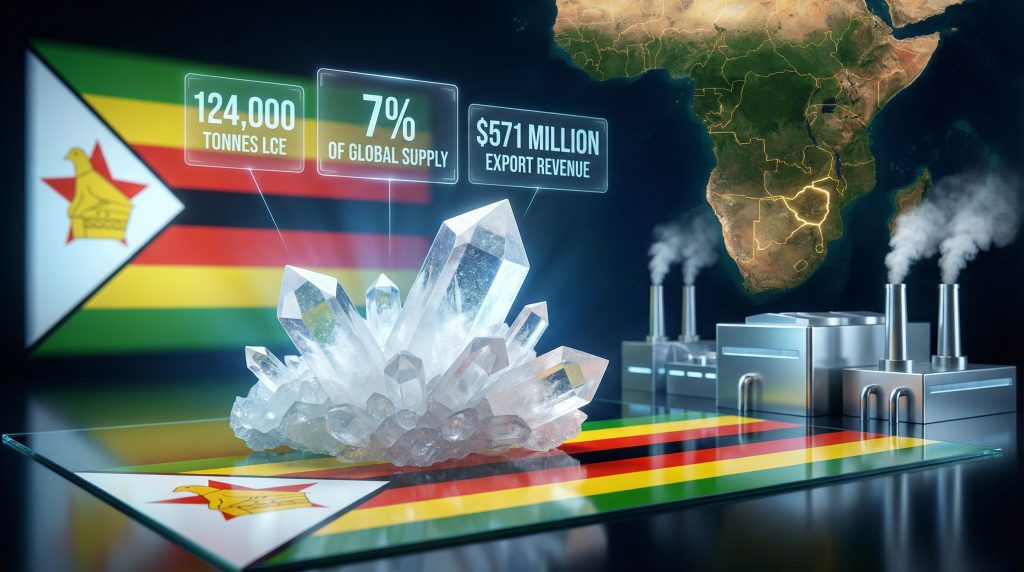
The strategic timing leverages Zimbabwe's 7% global supply share to influence market stability whilst capturing greater value from its lithium resources. The country's position as Africa's leading lithium producer provides sufficient market influence to affect global supply stability.
With annual production capacity reaching 124,000 tonnes LCE (lithium carbonate equivalent), Zimbabwe's export policies directly impact global supply chains. This particularly affects those dependent on African concentrate supplies.
Zimbabwe's Lithium Market Position
| Metric | Value | Global Context |
|---|---|---|
| Annual Production Capacity | 124,000 tonnes LCE | 7% of global supply |
| China Import Dependency | 15% of China's imports | Critical supply position |
| Processing Facilities | 3 operational/planned | Rapid industrialisation |
| Export Revenue (2025) | $571 million | Major economic contributor |
| Mining Sector Share | 80% of total exports | Economic backbone |
| Government Revenue | 19% from mining | Fiscal importance |
Supply Chain Disruption Management
The suspension created immediate disruptions for global spodumene supply chains, particularly affecting Chinese processing facilities. These facilities have established import relationships based on Zimbabwean concentrate.
Zimbabwe sets strict conditions to resume lithium exports, including mandatory domestic processing requirements. The new policy framework includes structured transition mechanisms designed to minimise supply shock whilst establishing sustainable long-term relationships.
Chinese processors face particular adaptation challenges, as their existing operations depend on concentrate imports for domestic processing. The transition to processed product exports requires these facilities to either establish new supply agreements for lithium chemicals or invest in Zimbabwe-based processing capacity.
Alternatively, they must diversify sourcing to alternative suppliers. The policy's graduated approach includes phased quota releases, priority allocation for companies with advanced processing commitments, and coordinated timing to align with global demand cycles.
Regional Resource Nationalism Trends
Zimbabwe's approach reflects broader African strategies for critical mineral governance, with similar frameworks emerging across the continent. The Democratic Republic of Congo implemented comparable cobalt export controls in 2025.
This leveraged its 70% global supply position to address oversupply-driven price pressures and channel production into local processing. Guinea, as the world's leading bauxite exporter, has similarly implemented export management strategies to support commodity prices.
The regional trend reflects sophisticated policy coordination, with African suppliers increasingly leveraging their concentrated market positions. Furthermore, this enables them to influence global commodity flows and capture higher-margin processing opportunities.
However, Zimbabwe introduces lithium export quotas whilst implementing innovative lithium extraction methods that align with global sustainability trends.
What Compliance Standards Must Operators Meet for Market Re-Entry?
The Zimbabwe's post-embargo lithium policy establishes comprehensive compliance frameworks covering financial transparency, operational standards, and environmental governance. Companies must navigate multiple requirement categories to secure export licence restoration and quota allocation.
Compliance Requirements Framework:
- Financial Transparency: Annual financial statement publication for mining operations
- Operational Standards: Labour safety certification and environmental compliance verification
- Processing Commitments: Detailed timelines for lithium sulfate plant construction with binding agreements
- Export Documentation: Quota applications with comprehensive supporting documentation
- Ongoing Monitoring: Regular compliance verification tied to licence renewal
Financial Transparency and Governance Standards
Enhanced financial reporting requirements directly address previous concerns about mineral revenue leakages and transfer pricing practices. These practices reduced government resource capture from mining operations.
The framework requires detailed production reports, revenue declarations, and beneficiation investment commitments. Companies must demonstrate financial transparency through annual statement publication, creating accountability mechanisms for revenue generation and tax compliance.
Enhanced reporting enables government monitoring of actual production volumes, export values, and domestic processing investments. Enforcement mechanisms tie export licence renewals to ongoing financial transparency compliance, creating continuous incentives for accurate reporting.
Environmental and Social Impact Requirements
Operators must demonstrate compliance with enhanced environmental protection standards encompassing waste management protocols. Additionally, they must meet water usage optimisation and community impact mitigation measures.
These requirements align with international best practices for extractive industry operations. Social licence components include local employment targets, skills development programmes, and community benefit-sharing arrangements.
The framework establishes binding commitments for workforce development and community engagement. This ensures mining operations generate broader socioeconomic benefits beyond direct production activities.
How Will the Transition Timeline Affect Global Supply Chains?
The policy establishes a structured transition timeline with specific milestones for processing facility development and export system implementation. The January 2027 complete ban on unprocessed concentrate creates urgent timelines for infrastructure development.
Transition Timeline Framework:
| Phase | Timeline | Key Requirements |
|---|---|---|
| Immediate | April 2026 | Compliance verification and quota allocation |
| Short-term | April 2026-December 2026 | Processing facility construction with 10% export tax |
| Intermediate | 2026-2027 | Operational processing capacity development |
| Long-term | January 2027+ | Complete processed product transition |
Processing Infrastructure Development Acceleration
The compressed timeline requires rapid scaling of domestic processing capacity to accommodate the complete transition. Current facilities must expand significantly whilst new installations advance construction schedules to meet the January 2027 deadline.
Investment requirements include technology transfer agreements, skilled workforce development, and supply chain localisation for processing equipment. Companies must coordinate construction timelines with equipment procurement, workforce training, and operational testing.
The 10% export tax applied during the transition period provides government revenue. Consequently, this creates additional financial incentives for accelerated processing facility development.
Market Adaptation Strategies for Global Buyers
International buyers must fundamentally adapt procurement strategies to accommodate Zimbabwe's processed product focus. This transformation requires establishing new supply agreements for lithium chemicals rather than concentrate.
Additionally, it involves adjusting logistics networks and developing quality assurance protocols for processed materials. Chinese processors, representing Zimbabwe's largest buyer segment, face particular adaptation challenges given their existing concentrate-based operations.
Supply chain adaptation timelines must align with Zimbabwe's processing development schedule to ensure continuity. The lithium industry innovations emerging globally provide frameworks for this transition.
What Economic Impact Will the Policy Generate for Zimbabwe?
The policy framework aims to multiply Zimbabwe's lithium sector economic contribution through strategic value addition, employment creation, and industrial development. Current sector exports of $571 million in 2025 represent substantial potential for expansion through processed product revenue premiums.
Economic modelling suggests processed lithium chemicals can generate 3-5x higher revenues compared to raw concentrate exports. Furthermore, they create significant downstream employment in chemical processing, logistics, and technical support services.
The mining sector's contribution to 80% of total merchandise exports and 19% of government revenue positions lithium policy as critical to national economic strategy. The transformation from raw material exports to processed chemical production targets fundamental economic restructuring.
Revenue Enhancement Through Value Addition
Processed lithium products command substantial price premiums over raw spodumene concentrate. Battery-grade lithium carbonate and lithium sulfate pricing reflects additional processing value, potentially tripling export revenues per tonne.
The policy creates structured incentives for companies to invest in higher-value processing technologies. This includes battery-grade purification facilities and specialised chemical production capabilities.
Value addition also reduces Zimbabwe's exposure to concentrate price volatility whilst establishing more predictable revenue streams. This transition supports broader economic stability objectives whilst maximising resource value capture.
Industrial Development and Employment Creation
Processing facility development generates substantial direct employment in chemical processing, engineering, technical services, and facility management. Indirect employment benefits encompass logistics, maintenance, equipment supply, and specialised support services.
Skills development programmes accompanying processing investments create long-term human capital benefits. These establish Zimbabwe as a regional centre for lithium processing expertise and technology.
The industrial development extends to supporting sectors including chemical supply, equipment maintenance, laboratory services, and technical consulting. This ecosystem development creates multiplier effects that amplify the economic impact of processing investments.
The next major ASX story will hit our subscribers first
What Risks and Challenges Could Affect Policy Implementation?
Implementation faces several critical challenges including technology transfer complexities and international market acceptance of processed products. Policy success depends on effective management of interconnected implementation risks across multiple domains.
Critical Implementation Risk Factors:
- Technology Transfer Complexities: Sophisticated processing technology acquisition and knowledge transfer requirements
- Market Acceptance: International quality certification and customer relationship development for processed products
- Infrastructure Coordination: Processing facility construction, equipment procurement, and workforce development synchronisation
- Market Volatility: Global lithium price fluctuations and demand uncertainty affecting investment viability
- Regulatory Capacity: Government enforcement capabilities and compliance monitoring system effectiveness
Technology Transfer and Capacity Building Challenges
Successful processing facility development requires sophisticated technology transfer arrangements and comprehensive local capacity building initiatives. Zimbabwe must develop technical expertise in lithium chemical processing whilst ensuring technology partners provide genuine knowledge transfer.
Capacity building encompasses workforce training programmes, technical education initiatives, and research and development capabilities. The compressed implementation timeline increases challenges for workforce development and technical skill acquisition necessary for complex chemical processing operations.
Technology transfer agreements must balance intellectual property protection with meaningful knowledge sharing. This ensures Zimbabwean operations develop independent technical capabilities rather than remaining dependent on foreign technical support.
Market Integration and Quality Assurance
Processed product market acceptance requires meeting stringent international quality standards and establishing customer relationships for chemical products. This includes developing comprehensive quality assurance systems, international certification processes, and customer technical support capabilities.
International buyers must adapt to sourcing processed chemicals from Zimbabwe rather than importing concentrate for domestic processing. Market integration success depends on Zimbabwe's ability to consistently meet international quality standards whilst maintaining competitive pricing.
The transition period creates uncertainty for both suppliers and buyers, potentially affecting contract negotiations and pricing arrangements. Successful market integration requires coordinated efforts between Zimbabwean producers and international customers to establish sustainable commercial relationships.
This analysis is based on publicly available information and should not be considered investment advice. Readers should conduct independent research and consult qualified professionals before making investment decisions related to Zimbabwe's post-embargo lithium policy or affected companies.
Are You Tracking the Next Major Lithium Discovery Opportunity?
With Zimbabwe's transformative lithium policy reshaping global supply chains and creating new market dynamics, Discovery Alert's proprietary Discovery IQ model delivers real-time alerts on significant ASX mineral discoveries that could capitalise on these evolving opportunities. Explore Discovery Alert's dedicated discoveries page to understand why historic discoveries have generated substantial returns, then begin your 14-day free trial today to position yourself ahead of the market.