May 20, 2026
Zimbabwe lithium export regulations have emerged as a pivotal force reshaping global supply chains, with the southern African nation implementing comprehensive controls that mandate domestic processing before allowing mineral exports. Resource sovereignty movements across developing nations have fundamentally reshaped global commodity markets over the past decade, with governments increasingly asserting control over critical mineral extraction and processing. This trend reflects a broader recognition that raw material exports generate minimal economic value compared to downstream manufacturing capabilities. The lithium sector, essential for battery production and critical minerals energy transition, has become a focal point for these strategic policy interventions.
Zimbabwe's recent regulatory framework exemplifies this paradigm shift, introducing comprehensive controls that prioritise domestic value addition over traditional export models. These measures represent more than simple trade restrictions; they constitute a systematic restructuring of mineral value chains to capture economic benefits locally rather than transferring them to foreign processing centres.
Zimbabwe's Comprehensive Lithium Export Control Framework
Mandatory Processing Infrastructure Development
Zimbabwe lithium export regulations centre on mandatory processing facility establishment as a prerequisite for export resumption. Mining companies must submit detailed construction timelines for lithium sulphate plants, which serve as intermediate steps toward producing battery-grade lithium hydroxide or carbonate compounds. This requirement transforms Zimbabwe's role from raw material supplier to value-added processor.
The processing mandate extends beyond simple facility construction. Companies must demonstrate concrete progress toward domestic beneficiation through measurable milestones and capacity commitments. This approach ensures that processing requirements represent genuine industrial development rather than superficial compliance measures.
| Compliance Category | Specific Requirements | Timeline |
|---|---|---|
| Processing Facilities | Lithium sulphate plant construction | Before January 2027 |
| Financial Transparency | Annual statement publication | Ongoing |
| Labour Standards | Compliance verification protocols | Continuous monitoring |
| Environmental Impact | Assessment mandate compliance | Pre-construction |
| Safety Regulations | Adherence monitoring systems | Operational phase |
Export Quota Allocation Mechanisms
The quota system operates through individual allocations communicated directly to each producer, with calculations based on processing capacity commitments rather than historical export volumes. This structure incentivises companies to invest in domestic processing infrastructure by linking export permissions to value-addition capabilities.
Monthly reporting requirements ensure continuous monitoring of quota utilisation, creating accountability mechanisms that prevent circumvention of processing requirements. Companies that demonstrate greater processing commitments receive more favourable quota allocations, establishing clear incentives for industrial development.
"Export quotas serve as transitional controls while companies establish domestic processing capabilities, creating structured pathways from raw material extraction to value-added manufacturing."
Financial and Operational Transparency Standards
Zimbabwe's regulatory framework mandates comprehensive transparency across multiple operational dimensions. Annual financial statement publication requirements ensure public accountability for mining operations, while labour standards compliance verification protocols protect worker rights and safety.
Environmental impact assessment mandates create systematic environmental protection mechanisms, while safety regulation adherence monitoring systems establish continuous oversight of operational practices. These requirements reflect international best practices for responsible mining operations.
When big ASX news breaks, our subscribers know first
Comparative Analysis: Global Resource Control Strategies
African Continental Beneficiation Initiatives
Zimbabwe's policy aligns with broader African resource sovereignty trends, where governments increasingly prioritise domestic value addition over raw material exports. Angola's first gold refinery represents parallel diversification efforts beyond traditional export commodities, demonstrating continental movement toward processed product exports.
| Country | Mineral | Policy Type | Implementation | Economic Impact |
|---|---|---|---|---|
| Zimbabwe | Lithium | Processing mandate + quotas | 2026-2027 | Value retention + employment |
| DRC | Cobalt | Value addition requirements | Ongoing | Local processing development |
| Ghana | Gold | Processing mandates | Established | Domestic refining capacity |
| Botswana | Diamonds | Beneficiation policy | Success model | Manufacturing cluster |
Indonesia's Nickel Export Precedent
Indonesia's nickel ore export restrictions between 2014 and 2020 provide instructive precedent for Zimbabwe's lithium strategy. The Indonesian model demonstrated that export bans can successfully force domestic processing investment, though they create short-term supply disruptions and price volatility.
The Indonesian experience showed that global supply chains adapt to processing requirements through foreign investment in domestic facilities. Major nickel consumers ultimately established Indonesian smelting operations rather than sourcing alternative supplies, validating the processing mandate approach.
Economic modelling from Indonesia's policy implementation revealed that domestic value addition generated significantly higher government revenues compared to raw ore exports, despite initial foreign investment reluctance and market disruptions.
China's Rare Earth Control Framework
China's rare earth export quota systems between 2010 and 2015 illustrated both the potential and limitations of export controls for strategic minerals. Furthermore, China's export controls successfully maintained domestic processing advantages, though they also accelerated alternative supply source development globally.
WTO compliance challenges eventually modified China's approach, demonstrating that export restrictions must align with international trade rules to maintain long-term effectiveness. Zimbabwe lithium export regulations may face similar scrutiny if they disproportionately impact specific countries or trading partners.
Economic Transformation Through Processing Requirements
Domestic Value Addition Revenue Analysis
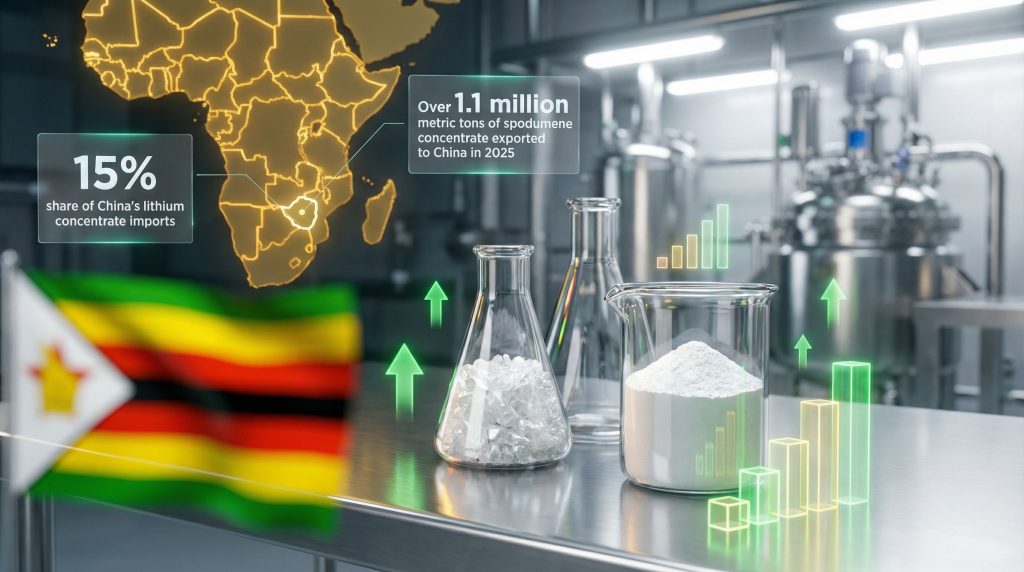
Zimbabwe exported over 1.1 million metric tons of lithium-bearing spodumene concentrate to China in 2025, representing approximately 15% of China's lithium concentrate imports. This substantial market share provides leverage for implementing processing requirements without losing critical export revenue.
Revenue comparison modelling demonstrates significant financial benefits from processed lithium compounds compared to raw concentrate exports. Lithium sulphate commands premium pricing over spodumene concentrate, while battery-grade lithium hydroxide and carbonate generate even higher margins.
| Product Stage | Typical Price Range (USD/ton) | Processing Requirements | Value Addition |
|---|---|---|---|
| Spodumene Concentrate | $800-1,200 | Basic mineral extraction | Baseline |
| Lithium Sulphate | $8,000-12,000 | Chemical processing | 8-10x premium |
| Battery-Grade Hydroxide | $15,000-25,000 | Advanced purification | 15-20x premium |
| Lithium Carbonate | $12,000-20,000 | Refined processing | 12-18x premium |
Employment and Skills Development Potential
Processing facility establishment creates substantial employment opportunities across multiple skill levels, from construction and operations to technical management and quality control. Technology transfer requirements ensure local workforce development accompanies infrastructure investment.
Industrial cluster development around processing facilities generates ancillary employment in logistics, maintenance, equipment supply, and professional services. This multiplier effect amplifies economic benefits beyond direct processing employment.
"The government's objective ensures that more revenue, skills development, and industrial capacity remain on the continent, rather than leaving raw materials for foreign buyers."
Investment Capital and Infrastructure Requirements
Lithium sulphate plant construction requires substantial capital expenditure, typically ranging from $200-500 million depending on capacity and technology specifications. Financing mechanisms available to mining companies include development finance institutions, export credit agencies, and commercial banking facilities.
Return on investment timelines for processing infrastructure extend 10-15 years, requiring long-term strategic commitment from mining companies. Risk assessment frameworks must account for technology evolution, market demand fluctuations, and regulatory stability.
Company-Specific Impact Assessment
Chinese Mining Operations Adaptation
Four major Chinese companies dominate Zimbabwe's lithium mining sector: Zhejiang Huayou Cobalt, Sinomine, Chengxin Lithium, and Yahua. These companies face strategic pressure to align operations with Zimbabwe's beneficiation requirements while maintaining profitability.
Sinomine's reported negotiations with Zimbabwean authorities indicate company-level resistance to processing requirements, reflecting concerns about capital investment requirements and operational complexity. However, Zimbabwe's substantial market position creates limited alternatives for these operators.
| Company | Primary Operations | Investment Requirements | Compliance Strategy |
|---|---|---|---|
| Zhejiang Huayou Cobalt | Large-scale extraction | Processing facility construction | Operational adjustment required |
| Sinomine | Integrated mining operations | Technology sourcing needed | Negotiation with authorities |
| Chengxin Lithium | Concentrate production | Local partnership development | Processing commitments |
| Yahua | Mining and logistics | Environmental permitting | Joint venture structures |
Processing Facility Development Strategies
Construction schedules for lithium sulphate plants typically require 18-24 months from groundbreaking to commercial operations. Technology sourcing and equipment procurement present challenges given specialised requirements for lithium chemical processing.
Local partnership requirements create opportunities for joint venture structures between Chinese operators and Zimbabwean companies. These partnerships facilitate technology transfer while ensuring compliance with local content requirements.
Environmental permitting processes for chemical processing facilities involve comprehensive impact assessments, waste management planning, and community consultation procedures. These requirements extend project development timelines but ensure sustainable operations.
Technical Processing Requirements and Standards
Lithium Sulphate Production Specifications
Battery-grade lithium compounds require precise technical specifications including purity levels exceeding 99.5%, controlled particle size distributions, and minimal impurity concentrations. Quality control requirements encompass continuous monitoring throughout processing stages.
| Processing Stage | Input Material | Technical Process | Output Specifications |
|---|---|---|---|
| Concentrate Preparation | Raw spodumene | Crushing and beneficiation | 6-7% Li2O content |
| Roasting | Prepared concentrate | High-temperature conversion | β-spodumene formation |
| Acid Leaching | Roasted material | Sulphuric acid extraction | Lithium sulphate solution |
| Purification | Raw solution | Impurity removal | Battery-grade purity |
| Crystallisation | Pure solution | Controlled precipitation | Technical grade Li2SO4 |
Infrastructure and Utility Requirements
Processing facilities require substantial utility infrastructure including reliable electricity supply (typically 50-100 MW), consistent water access (2-4 cubic metres per ton processed), and efficient transportation networks for raw materials and finished products.
Waste management systems must handle processing byproducts including tailings, spent acid solutions, and solid waste materials. Environmental standards mandate closed-loop water systems and emissions control technologies.
Safety protocols for chemical processing include specialised personal protective equipment, containment systems for hazardous materials, and emergency response capabilities for potential incidents.
Global Market Dynamics and Supply Chain Implications
Supply Constraint Analysis and Price Effects
Zimbabwe's 10% export tax remains in effect until January 2027, when complete processing requirements take effect according to Zimbabwe's lithium export ban implementation. This timeline creates transitional supply constraints that may trigger price volatility in global lithium markets.
"Zimbabwe's 15% share of China's lithium concentrate imports creates meaningful supply-side impact potential, particularly given China's dominant position in battery manufacturing."
Strategic stockpiling responses by major consumers have already begun, with battery manufacturers securing alternative supply sources and increasing inventory levels to hedge against potential shortages.
Price volatility projections suggest 10-30% premium pricing for lithium compounds during the transition period, though long-term market equilibrium depends on alternative supply development and processing capacity establishment.
Alternative Supply Source Development
Australia's spodumene production capacity expansion provides the most immediate alternative to Zimbabwean supplies, though Australia lithium tax breaks face their own infrastructure and permitting challenges.
| Supply Source | Production Capacity | Development Timeline | Market Position |
|---|---|---|---|
| Australia | 2.5-3.0 million tons/year | Established operations | Primary alternative |
| Chile | 1.8-2.2 million tons/year | Brine expansion ongoing | Stable supply |
| Argentina | 1.2-1.6 million tons/year | Project development | Growth potential |
| Canada | 0.8-1.2 million tons/year | Hard rock acceleration | Emerging source |
Chile and Argentina lithium insights offer different supply characteristics, though brine processing requires distinct technologies compared to hard rock extraction. Canada's hard rock lithium projects provide potential supply diversification, though development timelines extend 3-5 years.
Battery Industry Supply Chain Adaptation
Vertical integration strategies by major battery manufacturers include direct investment in mining operations, processing facilities, and recycling capabilities. These approaches reduce dependency on third-party suppliers while ensuring supply security.
Long-term supply agreement renegotiations increasingly incorporate processing requirements, quality specifications, and sustainability standards. Battery manufacturers prefer suppliers that demonstrate environmental and social responsibility alongside reliable delivery.
Processing facility investment outside Zimbabwe creates alternative value-addition centres, though these investments require substantial capital commitments and technical expertise development.
The next major ASX story will hit our subscribers first
Strategic Implications for African Resource Governance
Continental Resource Sovereignty Evolution
Zimbabwe's policy reflects broader continental trends toward resource sovereignty and value addition across Africa's mining sector. Regional coordination through Southern African Development Community (SADC) frameworks supports synchronised beneficiation policies.
African Union mineral resource development strategies emphasise technology transfer, skills development, and industrial linkage creation. These frameworks provide policy coordination mechanisms for continental resource governance.
"Africa stands to gain from higher domestic value addition, while global buyers face tighter supplies highlighting the continent's growing leverage over critical mineral resources."
Foreign Investment Partnership Models
Partnership structures evolve from traditional extraction models toward processing-focused joint ventures that combine foreign capital and technology with local resources and workforce development.
Local content requirements increasingly emphasise skills transfer, technology sharing, and supply chain localisation rather than simple employment quotas. These approaches create sustainable industrial development.
Risk mitigation strategies for international investors include government partnership agreements, development finance institution support, and comprehensive insurance coverage for political and operational risks.
Economic Diversification Through Industrial Development
Mining sector linkage development connects mineral extraction with downstream manufacturing, creating integrated industrial clusters around processing facilities. However, this reflects a broader critical minerals strategy pivot across the continent.
Export product complexity enhancement moves African economies beyond raw commodity dependence toward manufactured goods exports. This transition requires coordinated industrial policy and infrastructure investment.
Regional value chain integration opportunities within SADC create larger markets for processed minerals while reducing dependency on distant export destinations.
Implementation Timeline and Compliance Framework
Regulatory Milestone Schedule
Current regulatory implementation follows structured timeline with specific compliance deadlines:
| Milestone | Deadline | Compliance Requirement | Enforcement Mechanism |
|---|---|---|---|
| Export tax continuation | Until January 2027 | 10% levy on concentrate exports | Revenue collection |
| Processing facility commitment | Before January 2027 | Written construction timelines | Export licence dependency |
| Quota system operation | Currently active | Individual producer allocations | Monthly reporting |
| Unprocessed export ban | January 2027 | Complete processing requirement | Export prohibition |
Compliance Pathways and Alternatives
Companies demonstrating concrete processing commitments receive favourable treatment in quota allocations and regulatory approvals. Alternative compliance mechanisms may include joint venture partnerships with local processors or technology transfer agreements.
Appeal processes for regulatory decisions involve formal review procedures through mining ministry channels, though specific timelines and criteria remain under development. Moreover, export restrictions impacts continue to evolve as companies adapt to new requirements.
Market Impact Projections
Short-term price volatility expectations range 15-25% above baseline during the transition period, reflecting supply uncertainty and strategic stockpiling activities.
Long-term market equilibrium projections suggest 5-10% permanent price premium for processed lithium products compared to traditional concentrate pricing, reflecting value addition benefits.
Investment opportunity implications favour companies with processing capabilities, technology expertise, and long-term strategic vision for African mineral development. Consequently, Zimbabwe lithium export regulations represent a fundamental shift in how critical minerals are traded globally.
Disclaimer: This analysis is based on publicly available information and should not be considered as investment advice. Mineral processing investments involve substantial risks including commodity price volatility, regulatory changes, and technical operational challenges. Readers should conduct independent research and consult qualified professionals before making investment decisions.
Considering Opportunities in Small-Cap Lithium Companies?
Discovery Alert's proprietary Discovery IQ model delivers real-time alerts on significant lithium discoveries, instantly empowering subscribers to identify actionable opportunities ahead of the broader market. Begin your 14-day free trial today and secure your market-leading advantage.