May 20, 2026
Africa's Battery Metal Value Chain Is Being Rewritten From the Ground Up
For decades, the global lithium supply chain has operated on a fundamentally unequal premise: resource-rich nations in the developing world extract and ship raw materials, while industrialised nations capture the exponentially greater value of processing and manufacturing. This dynamic has been particularly pronounced across Africa, where vast mineral endowments have long translated into modest economic returns relative to the true commercial potential of the resources being extracted. That structural imbalance is now being challenged in a material way, and Zimbabwe's lithium sector is the site of the most significant test yet.
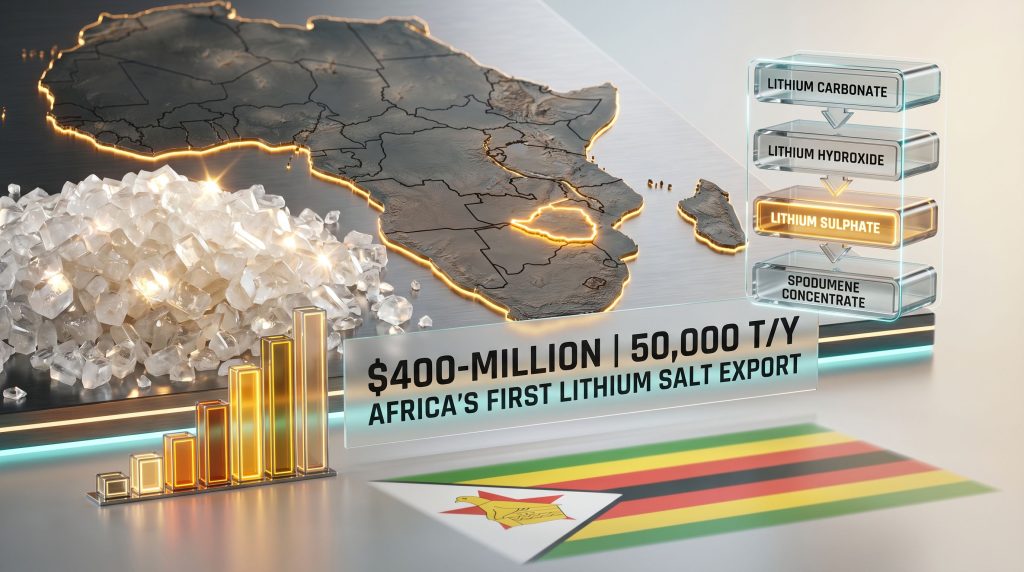
The completion of Huayou lithium salt exports from Zimbabwe in April 2026 represents something more than a corporate milestone for Zhejiang Huayou Cobalt. It marks the first time any African nation has produced and exported a commercially processed lithium salt product at industrial scale, shifting the continent's role in the global battery materials supply chain from purely extractive to genuinely transformative.
When big ASX news breaks, our subscribers know first
Understanding Where Lithium Sulphate Sits in the Battery Supply Chain
The Processing Hierarchy That Determines Who Captures Value
To appreciate why this development carries such significance, it helps to understand how lithium moves through the supply chain before reaching a battery cell. The journey involves multiple conversion stages, each adding meaningful economic value and requiring progressively more sophisticated infrastructure and technical expertise. Understanding spodumene extraction basics is essential context for appreciating how far down the value chain Zimbabwe has now moved.
-
Stage 1: Hard rock spodumene ore is extracted from the ground, typically carrying lithium oxide concentrations of around 1-2% in raw form.
-
Stage 2: The ore is processed into spodumene concentrate, bringing lithium oxide content to approximately 6% Li₂O, which becomes the primary traded commodity in the raw lithium market.
-
Stage 3: Spodumene concentrate is converted through chemical processing into lithium sulphate, an intermediate product sitting between raw mineral extraction and battery-grade material production.
-
Stage 4: Lithium sulphate is further refined into either lithium hydroxide monohydrate (used primarily in high-nickel NMC and NCA battery chemistries favoured by premium electric vehicle manufacturers) or lithium carbonate (used in lithium iron phosphate, or LFP, batteries and grid-scale energy storage systems).
The critical commercial insight here is that each stage upward commands a substantially higher price per unit of lithium content, while also creating more defensible margins for the producer. Nations that host only Stage 2 operations are permanently subject to the volatility of spodumene spot pricing, which has historically been severe. Nations that host Stage 3 or Stage 4 operations insulate themselves partially from that volatility while also retaining a greater share of the final product's economic value. Furthermore, the spodumene-to-lithium salts conversion process is precisely where Zimbabwe is now competing.
| Product | Processing Stage | Primary Use | Relative Value Position |
|---|---|---|---|
| Spodumene Concentrate | Stage 2 | Chemical conversion feedstock | Baseline commodity |
| Lithium Sulphate | Stage 3 | Intermediate refinery input | Moderate premium over concentrate |
| Lithium Hydroxide Monohydrate | Stage 4 | NMC/NCA EV batteries | Significant premium |
| Lithium Carbonate | Stage 4 | LFP batteries, grid storage | Significant premium |
The production of lithium sulphate within Zimbabwe's borders is not simply an incremental upgrade in processing capability. It represents a structurally different economic relationship with the global battery supply chain, one where the country retains the value created during chemical conversion rather than exporting it with the concentrate.
Why Pyrometallurgical Processing Matters for Lithium Sulphate Production
One technically important detail in the Huayou facility story is that the production line commissioned in October 2025 employs pyrometallurgical processing as part of its lithium sulphate conversion method. This distinction matters because it influences both the capital intensity and the operating cost structure of the facility.
Pyrometallurgical approaches involve high-temperature treatment of spodumene concentrate to convert the alpha-spodumene crystal structure into a more chemically reactive beta-spodumene form, which can then be more efficiently processed through sulphuric acid digestion to produce lithium sulphate solution. The subsequent evaporation and crystallisation steps yield the solid lithium sulphate product available for export.
This is a well-established industrial route for lithium sulphate production, and its deployment at commercial scale in Zimbabwe confirms the technical maturity of the operation rather than representing an experimental approach. In contrast to emerging lithium extraction technologies, the pyrometallurgical route offers proven reliability at industrial scale.
The Scale and Significance of Huayou's Zimbabwe Lithium Sulphate Facility
Key Operational Parameters
The numbers associated with the Huayou facility establish it as a genuinely industrial-scale operation rather than a pilot or demonstration project.
-
Total capital investment: $400 million
-
Annual production nameplate capacity: 50,000 metric tons of lithium sulphate
-
Pyrometallurgical line commissioning: October 2025
-
First commercial export shipment: April 2026
-
Location: The ATZ (Huajing Technology Lithium Sulphate Refinery) facility is situated at the Arcadia lithium mining area and operates adjacent to the PLZ lithium concentrate processing plant, which has been operational since 2023. This co-location is operationally significant as it eliminates concentrate transport costs and reduces feedstock handling complexity.
Importantly, Huayou did not disclose the volume of the inaugural April 2026 shipment. The consignment size remains commercially sensitive and was not confirmed at the time of reporting, per Mining Weekly (Reuters, April 28, 2026). This is a common feature of first-shipment announcements where companies wish to confirm the milestone without revealing full commercial details to competitors or counterparties.
A Continental First With No Precedent
The Huayou statement confirmed that this shipment constituted the first lithium salt ever produced in Zimbabwe and across the entire African continent. No prior African nation had exported a commercially produced lithium salt intermediate at industrial scale before this consignment. This establishes Zimbabwe as the benchmark case study for African midstream lithium processing and creates a replicable model that other African lithium-producing nations may seek to follow.
The continental first-mover status carries both commercial and diplomatic weight. Zimbabwe now holds a demonstrated capability that competing African nations with lithium resources, including Namibia, Mali, and Ghana, are likely watching closely as they formulate their own mineral beneficiation frameworks.
Zimbabwe's Regulatory Architecture: Building a Beneficiation Imperative
A Multi-Tool Policy Framework
Zimbabwe's approach to enforcing in-country lithium processing is notable for its use of multiple complementary policy instruments rather than relying on any single mechanism. The regulatory architecture is deliberately designed to create financial incentives, compliance obligations, and structural deadlines that collectively make raw concentrate export increasingly untenable over time.
| Date | Policy Action | Operational Impact |
|---|---|---|
| 2024 | 10% export tax introduced on lithium concentrate | Increased cost burden for raw concentrate exporters |
| February 25, 2026 | Full export freeze on all lithium concentrate shipments | Complete halt to concentrate export operations pending compliance reviews |
| April 2026 | Lithium concentrate export quota system introduced | Conditional resumption for compliant operators only |
| January 2027 | Total prohibition on all lithium concentrate exports | Forces remaining concentrate-only operators to process locally or exit |
The 10% export tax on lithium concentrate is structurally significant because it applies exclusively to raw concentrate and explicitly does not apply to lithium sulphate exports. This differential tax treatment creates a direct and quantifiable financial incentive for operators to invest in processing infrastructure. For an operation exporting hundreds of thousands of metric tons of concentrate annually, the levy represents a substantial recurring cost that processing investment can eliminate.
The February 2026 export freeze was triggered by what Zimbabwean authorities characterised as documented irregularities in mineral export procedures. The official language used described these as malpractices during the exportation of minerals, though specific details of the violations were not publicly disclosed in detail. The freeze effectively halted all concentrate shipments for approximately two months before a quota system was introduced in April 2026. Notably, Zimbabwe's export quota conditions for resumption were among the most stringent yet applied to any African critical mineral sector.
Quota Allocation and Compliance Conditions
When Zimbabwe introduced the quota system in April 2026, resumption of concentrate exports was made conditional on demonstrable compliance with a set of regulatory requirements. Operators seeking quotas were required to:
-
Publish mandatory annual financial statements for their mining operations
-
Demonstrate adherence to applicable labour standards
-
Meet environmental and safety regulatory requirements
Three companies were confirmed to have received quota allocations as of the time of reporting: Sichuan Yahua, Chengxin Lithium, and Sinomine. Huayou's quota status was not disclosed, which is notable given that the company's sulphate export operations are structurally exempt from the concentrate quota framework entirely. The quota system is therefore largely irrelevant to Huayou's current operational posture, as its sulphate output faces neither the export tax nor the quota conditions applied to concentrate.
The January 2027 Deadline as a Structural Forcing Function
Perhaps the most consequential element of Zimbabwe's regulatory framework is the announced total prohibition on lithium concentrate exports effective January 2027. This creates an absolute structural deadline for all operators currently exporting concentrate from Zimbabwe. Remaining concentrate-only producers face a binary choice: invest in processing infrastructure capable of converting their output into lithium sulphate or higher-value products before the deadline, or exit the Zimbabwean market.
Given the capital intensity and lead times associated with building processing facilities at scale, the January 2027 date is effectively already past the practical decision horizon for major new investments. Operators that have not already initiated construction of processing facilities are running out of time to comply.
Chinese Corporate Strategy and Zimbabwe's Role in the Global Lithium Supply Architecture
The Scale of Chinese Dominance
Chinese firms collectively dominate Zimbabwe's lithium sector in a manner that has few parallels in any other African critical minerals industry. The key operators active in Zimbabwe's lithium mining and processing landscape include:
-
Zhejiang Huayou Cobalt (operator of the Arcadia mine and the ATZ lithium sulphate refinery)
-
Sinomine Resource Group
-
Chengxin Lithium Group
-
Sichuan Yahua Industrial Group
-
Tsingshan Holding
The aggregate commercial relationship between Zimbabwe and China is substantial. In 2025, Zimbabwe exported 1.13 million metric tons of lithium-bearing spodumene concentrate to China, a volume that represented approximately 15% of China's total lithium concentrate imports for that calendar year, according to Mining Weekly (Reuters, April 28, 2026). This single southern African nation therefore accounts for a material share of China's upstream lithium security.
For context, Huayou alone exported approximately 400,000 metric tons of lithium concentrate from Zimbabwe in 2024, before the sulphate plant reached operational status. The transition from concentrate export to sulphate production at 50,000 metric tons per year represents a fundamental shift in the type of product flowing to China, even as the underlying supply relationship remains intact.
A Nuanced Evolution of Chinese Resource Strategy in Africa
The Huayou sulphate facility model illustrates an important and underappreciated evolution in how Chinese resource companies are approaching their African operations. Earlier phases of Chinese investment in African mining were characterised primarily by extraction: secure access to raw materials, export them to China for processing, and capture the full downstream value within the Chinese industrial system.
The Zimbabwe sulphate model is structurally different. Processing now occurs within the host nation, satisfying local beneficiation requirements and generating employment and economic linkages within Zimbabwe. However, the processed intermediate product flows directly into Chinese battery manufacturing supply chains, meaning end-product control remains with Chinese industrial actors.
This represents a genuinely hybrid model: host-nation beneficiation requirements are satisfied in form, while Chinese companies retain the commercial relationship with the downstream battery materials ecosystem. Whether this constitutes genuine industrialisation for Zimbabwe or a sophisticated form of maintained supply chain control for China depends considerably on one's analytical framework and the specific economic value capture metrics applied.
What is not speculative is that Zimbabwe gains processing employment, tax revenue from operations, and a more sophisticated industrial base. What remains an open question is whether the processing premium captured locally is proportionate to the full commercial value of the lithium supply chain that flows through Zimbabwe's territory.
Economic Implications for Zimbabwe's Minerals Revenue
From Commodity Pricing to Processing Premiums
The economic logic of Zimbabwe's beneficiation push rests on a straightforward premise: every ton of lithium that leaves Zimbabwe as sulphate rather than concentrate generates more domestic economic value than it would have as raw material. The processing premium embedded in lithium sulphate relative to spodumene concentrate reflects the capital, labour, energy, and technical expertise required to execute the chemical conversion. This is particularly timely given the ongoing lithium market downturn, which has placed additional pressure on concentrate-only exporters with shrinking margins.
For Zimbabwe specifically, the differential becomes even more pronounced when the 10% export tax on concentrate is factored in. Operators exporting concentrate pay the levy; operators exporting sulphate do not. At export volumes measured in hundreds of thousands of metric tons, the avoided tax burden alone provides a substantial financial incentive for processing investment, independent of the market premium on the processed product itself.
The 50,000 t/y nameplate capacity of the Huayou facility, operating at full utilisation, represents a meaningful uplift in Zimbabwe's mineral export revenue relative to the equivalent lithium content exported as concentrate. Precise revenue modelling requires current lithium sulphate spot pricing data, which fluctuates with global lithium market conditions and has been subject to significant volatility in recent years.
Employment, Infrastructure, and Industrial Linkages
Processing facilities create a qualitatively different employment base than mining operations alone. Chemical and metallurgical processing requires:
-
Skilled process engineering and operations personnel
-
Laboratory and quality control technicians for product specification compliance
-
Maintenance engineers with expertise in industrial chemical processing equipment
-
Logistics and supply chain professionals managing reagent inputs and product export
Beyond direct employment, the infrastructure investment associated with a $400 million processing facility generates broader economic effects through power infrastructure upgrades, water supply systems, road and logistics improvements, and the development of local supply chains for maintenance services, reagents, and packaging materials. In addition, the broader surge in critical minerals demand globally means Zimbabwe is well positioned to benefit from sustained long-term interest in its lithium output.
The next major ASX story will hit our subscribers first
Risk Assessment: What the Regulatory Transition Means for Operators
Differentiated Exposure Across Operator Types
The regulatory transition underway in Zimbabwe creates fundamentally different risk profiles for concentrate exporters versus sulphate producers. The operational risk landscape breaks down as follows:
| Risk Factor | Concentrate Exporters | Lithium Sulphate Producers |
|---|---|---|
| Export tax exposure (10%) | Applies to all concentrate volumes | Exempt from levy |
| February 2026 export freeze | Full operational halt | Unaffected |
| Quota compliance requirements | Mandatory; ongoing | Not applicable |
| January 2027 export ban | Critical strategic threat | Not applicable |
| Financial disclosure requirements | Mandatory for quota allocation | Standard regulatory compliance |
| Investment timeline pressure | Extreme; decision horizon passed | Investment already deployed |
Concentrate-only operators that have not yet initiated processing infrastructure construction face the most acute strategic risk. The January 2027 deadline is a hard regulatory constraint, not a negotiating position, and the lead times associated with commissioning processing facilities of meaningful scale make compliance through new builds increasingly difficult within the remaining timeframe.
Africa's Emerging Midstream Lithium Capability: Scenarios for the Decade Ahead
Three Trajectories Worth Considering
Zimbabwe's experience is being observed across Africa's lithium-producing landscape. The policy model, combining export taxes, compliance-linked quotas, and an absolute export prohibition, represents one of the most assertive beneficiation frameworks yet implemented on the continent. How this model propagates, or fails to propagate, across other African lithium producers will substantially influence the continent's long-term position in the global battery materials supply chain.
Scenario A: Accelerated Continental Beneficiation
Multiple African lithium producers, encouraged by Zimbabwe's demonstrated success, implement similar regulatory frameworks. Chinese and Western firms respond by investing in processing facilities to maintain market access. Africa captures a meaningfully larger share of lithium midstream value within five to seven years. This scenario requires both regulatory continuity in Zimbabwe and a sustained lithium price environment that supports processing investment economics.
Scenario B: Incremental and Uneven Transition (Base Case)
Zimbabwe's model demonstrates proof of concept but adoption across the continent is slow and geographically uneven. Nations with weaker institutional frameworks or greater dependence on royalty revenue from concentrate exports are slower to implement comparable policies. Processing capacity grows incrementally as operators respond to localised tax incentives. Africa's share of lithium midstream value increases but falls short of transformative rebalancing within this decade.
Scenario C: Policy Reversal Under Price Pressure
A sustained period of low lithium prices, which the market has experienced acutely in the 2023-2025 period, reduces investor appetite for the capital-intensive processing facilities required for beneficiation. Operators lobby for concentrate export exemptions or delays to the January 2027 ban. Political or governance changes in Zimbabwe create regulatory uncertainty. The beneficiation agenda stalls or reverses, and the structural gap between extraction and processing value remains concentrated outside Africa.
Disclaimer: The scenario projections presented above are analytical frameworks intended to illustrate potential trajectories and are not investment advice or financial forecasts. Actual outcomes will depend on numerous variables including global lithium price dynamics, geopolitical developments, regulatory continuity, and capital market conditions. Readers should conduct their own independent research before making any investment decisions related to the lithium sector or companies operating within it.
Frequently Asked Questions
What is lithium sulphate and why does it matter for Zimbabwe?
Lithium sulphate is a chemically processed intermediate product derived from spodumene concentrate. It occupies Stage 3 of the lithium processing hierarchy and can be further refined into battery-grade lithium hydroxide or carbonate. Its production in Zimbabwe means the country is capturing additional economic value before export rather than shipping raw material at a lower price point.
How large is Huayou's lithium sulphate facility at Arcadia?
The facility carries an annual production capacity of 50,000 metric tons of lithium sulphate and required total capital investment of approximately $400 million. The pyrometallurgical processing line was commissioned in October 2025, with the first export shipment achieved in April 2026, per Mining Weekly (Reuters, April 28, 2026).
Why did Zimbabwe freeze lithium concentrate exports in February 2026?
Zimbabwean authorities suspended all lithium concentrate exports on February 25, 2026, citing documented irregularities in export procedures characterised as malpractices during the exportation of minerals. A quota-based resumption framework was introduced in April 2026 with conditions including mandatory financial statement publication and regulatory compliance demonstration.
When will Zimbabwe ban lithium concentrate exports entirely?
Zimbabwe has announced a complete prohibition on lithium concentrate exports effective January 2027. This regulatory deadline compels all remaining concentrate-only operators to either transition to in-country processing or exit the Zimbabwean market.
Does Zimbabwe's export tax apply to lithium sulphate?
No. The 10% levy on lithium exports applies exclusively to lithium concentrate. Lithium sulphate and other processed products are exempt, creating a direct and quantifiable financial advantage for operators that invest in processing infrastructure.
Which Chinese companies are the primary operators in Zimbabwe's lithium sector?
The sector is dominated by Chinese firms including Zhejiang Huayou Cobalt, Sinomine Resource Group, Chengxin Lithium Group, Sichuan Yahua Industrial Group, and Tsingshan Holding. These companies collectively control the majority of Zimbabwe's lithium mining and processing operations, according to Mining Weekly (Reuters, April 28, 2026). However, as reported by the South China Morning Post, Tianqi's Africa strategy suggests not all Chinese firms view African lithium operations with equal enthusiasm, with some preferring domestic salt lake resources amid growing resource nationalism concerns.
Want to Track the Next Major Lithium Discovery Before the Market Does?
Discovery Alert's proprietary Discovery IQ model delivers real-time alerts on significant ASX mineral discoveries — including lithium and other battery metals — instantly translating complex geological data into actionable investment insights for both short-term traders and long-term investors. Explore how historic mineral discoveries have generated substantial returns and begin your 14-day free trial today to position yourself ahead of the market.