June 26, 2026
Africa's Mineral Wealth Is Bigger Than Any Single Commodity
The history of African resource economics is littered with cautionary tales about commodity concentration. Nations that tied their economic fortunes to a single mineral discovered, often painfully, how quickly global price cycles could unravel decades of fiscal planning. Understanding Zimbabwe mining investment beyond lithium requires stepping back from the lithium narrative that dominates headlines and examining a far more textured story: a country sitting on more than 60 commercially viable minerals, quietly attracting billions in foreign capital across multiple commodity categories, and pursuing an industrialisation agenda that could fundamentally reshape its economic structure over the coming decade.
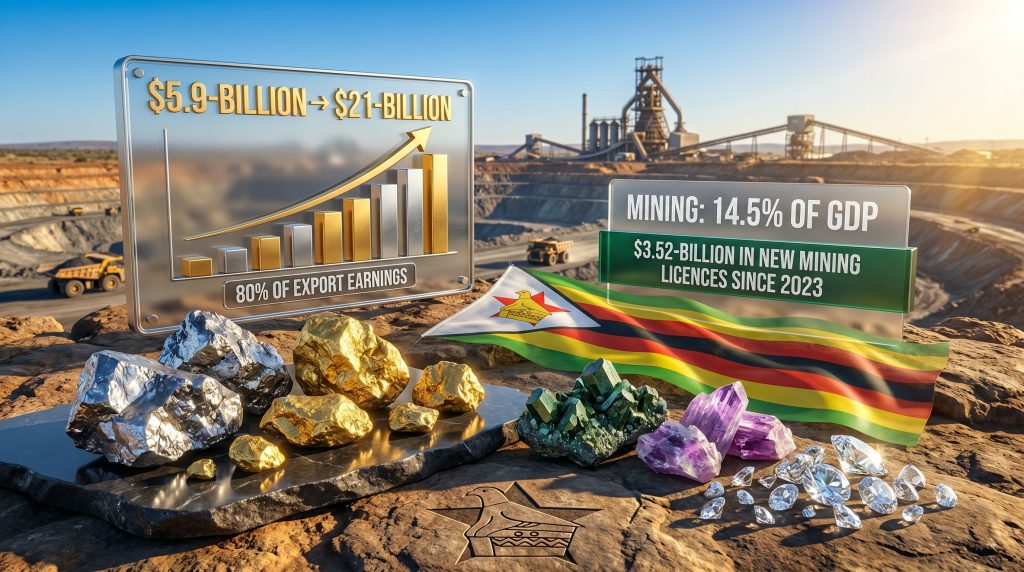
The scale of what is unfolding is frequently underappreciated. Zimbabwe's mining sector contributes 14.5% of GDP, generates approximately 80% of total export earnings, and accounts for close to 19% of government revenue. These are not the metrics of a peripheral frontier play. They are the structural hallmarks of a genuine resource economy in transition, one where the investment calculus extends well beyond battery minerals.
When big ASX news breaks, our subscribers know first
Zimbabwe Mining Investment Beyond Lithium: The Full Picture
A Mineral Portfolio That Defies Simple Classification
Zimbabwe's geological endowment is genuinely exceptional in a continental context. The Great Dyke, a layered intrusion stretching roughly 550 kilometres through the centre of the country, contains one of the world's most significant platinum group metals (PGMs) reef systems. Greenstone belts across Mashonaland and Midlands provinces host substantial gold mineralisation. Carbonate-hosted lithium pegmatites in Manicaland and other provinces have attracted intense Chinese investment interest. Furthermore, chrome, nickel, diamonds, coal, and rare earth elements round out a portfolio that few African nations can match in terms of breadth.
| Mineral Category | Key Minerals | Strategic Role | Global Demand Driver |
|---|---|---|---|
| Platinum Group Metals | Platinum, Palladium, Rhodium | Automotive catalysts, hydrogen tech | Green hydrogen economy |
| Lithium | Spodumene, Petalite | Battery manufacturing | EV transition |
| Gold | Alluvial and hard rock | Export earnings, currency stability | Safe-haven demand |
| Chrome | Chromite ore | Ferrochrome, stainless steel | Industrial manufacturing |
| Nickel | Sulphide deposits | EV battery supply chains | Clean energy transition |
| Diamonds | Gem and industrial | Luxury exports, industrial use | Global gem markets |
| Coal | Thermal coal | Domestic power generation | Energy security |
| Rare Earth Elements | Various REEs | Advanced technology supply chains | Defence and electronics |
The diversity of this portfolio matters enormously for investors conducting risk-adjusted analysis. While lithium prices are subject to significant cyclical volatility driven by EV adoption curves and battery chemistry evolution, the platinum and palladium markets are increasingly tied to hydrogen fuel cell demand, gold safe-haven investment functions as a monetary hedge, and chrome is anchored in stainless steel manufacturing cycles. A country with exposure across all of these demand drivers occupies a structurally different investment position than a single-commodity jurisdiction.
The Foreign Direct Investment Numbers That Tell the Real Story
Since 2023, the Zimbabwe Investment and Development Centre has issued new mining licences valued at $3.52 billion, a figure that signals the pace at which capital is committing to the jurisdiction. However, the headline number understates the depth of the investment wave, because it excludes expansion capital from operators already embedded in the country.
In the PGMs sector alone, Zimplats, a subsidiary of South Africa's Impala Platinum, has deployed more than $750 million across expansion, beneficiation, and energy infrastructure. Mimosa, another South African-linked PGM operator, has separately allocated over $200 million. Together, these two operators represent a non-lithium capital commitment exceeding $950 million in a single commodity sub-sector, a figure rarely cited in coverage that fixates on Chinese lithium investment.
The lithium sector itself has attracted substantial Chinese capital. Zhejiang Huayou Cobalt spent $422 million acquiring the Arcadia lithium project near Harare in April 2022, then committed a further $300 million for a 400,000 tonne-per-year lithium concentrate plant. A subsequent $400 million investment produced a 50,000 tonne-per-year lithium sulphate plant, completed in 2025. Sinomine Resources Group acquired the Bikita lithium mine for $180 million in January 2022 and spent an additional $300 million on expansion before announcing a planned $500 million smelter in October 2024.
Chengxin Lithium Group and Canmax Technologies paid $77 million for the Sabi Star mine in 2021, then invested $130 million in mine development and concentrator construction. Zimbabwe currently produces approximately 9% of global lithium supply, according to Benchmark Mineral Intelligence, positioning it among the world's most significant producers of this critical battery material. The broader context of critical minerals demand globally makes this positioning increasingly strategic.
The PGM Opportunity: Capital Depth in a Non-Lithium Sector
Tharisa's Karo Project: A Case Study in Long-Horizon Commitment
Among the most instructive examples of non-lithium foreign investment is Tharisa plc's Karo Mining project, located 85 kilometres south-west of Harare. Through Karo Mining, Tharisa has deployed $241 million to date in developing what management describes as a project with a ten-year initial production horizon and an additional 50-year upside, meaning the infrastructure capital being deployed now will be amortised across a genuinely long-duration asset.
When assessed on a capital-intensity-per-ounce-of-production basis, the project is reported to be tracking in line with original projections. Tharisa's operational philosophy mirrors its approach at its South African operations: pursuing full vertical integration across the value chain rather than simply extracting and exporting ore. The company has flagged plans for further downstream investment in Zimbabwe replicating its beneficiation model, which transforms raw PGM concentrate into higher-value refined products.
Tharisa executives have drawn explicit comparisons between the Karo project's development profile and the company's South African operations in terms of executability and technical skills availability. Zimbabwe's mining workforce, shaped by decades of exploration and extraction activity, retains a technical knowledge base that newer mineral jurisdictions often lack.
Zimbabwe's skills base in mining and technical disciplines is a frequently overlooked competitive advantage. Unlike some frontier jurisdictions where capital can be deployed but local execution capacity is constrained, Zimbabwe has a depth of experienced mining professionals that reduces certain categories of operational risk.
Structural Policy Drivers Behind the Investment Surge
Regulatory Reforms and Their Real-World Impact
The transition of political leadership in late 2017 triggered a wave of regulatory reform that has materially altered the investment environment. Key changes include:
- Licence processing timelines reduced from 21 days to just 7 days, directly lowering administrative friction for new entrants
- The Zimbabwe Investment and Development Centre actively issuing new mining approvals across commodity categories
- Statutory Instrument 5 of 2023 repealing export restrictions on base minerals, though this has since been modified
- ZIDA streamlining foreign investor onboarding procedures
- A broader policy framework, Vision 2030, anchoring medium-term economic planning to mining-led industrialisation
The improvement in investor confidence resulting from these reforms is measurable in the surge of licence issuance and capital deployment since 2023. Economics professor Gift Mugano, executive director of the Harare-based think-tank Africa Economic Development Strategies, has identified these regulatory changes as a key driver of the mining sector's resurgence, noting that the period between 2000 and 2017 saw policy inconsistency significantly constrain Zimbabwe's business environment. For further context on how Zimbabwe mining development intersects with broader fiscal pressures, the international debt dispute remains a relevant backdrop.
The Beneficiation Imperative: Converting Extraction Into Industry
Perhaps the most strategically significant shift in Zimbabwe's mining policy is the push toward in-country beneficiation across all mineral categories. The government's position is that raw mineral exports represent a structural failure to capture value, and that the long-term objective must be converting extraction into manufacturing.
The priority downstream sectors identified include:
- Lithium processing into battery-grade chemicals including lithium sulphate, lithium hydroxide, and lithium carbonate
- Platinum refining leveraging the country's substantial Great Dyke PGM resource base
- Ferrochrome production from Zimbabwe's significant chromite reserves
- Gold refining and jewellery manufacturing creating higher-value export products
- Iron and steel processing from domestic ore resources
However, the beneficiation strategy carries its own analytical complexity. While the principle of downstream value capture is sound, the economics of in-country processing are not uniformly favourable. Zimbabwe's spodumene lithium extraction and subsequent sulphate production, while technically achieved, faces structural cost competition from China, where existing chemical infrastructure, scale, and integrated supply chains make intermediate battery material production significantly cheaper.
The Mines-to-Energy Park: Ambition at Scale
The Zimbabwean government's most comprehensive industrialisation initiative is the Mines-to-Energy Park concept, which attempts to address both the energy deficit constraining mining operations and the value-addition imperative simultaneously. Its core infrastructure components include:
- Two 300 MW power stations targeting the critical electricity shortage
- A lithium salt production facility with 130,000 tonne-per-year capacity
- Graphite processing infrastructure
- A nickel sulphide production facility
- An alloy smelting complex serving multiple mineral streams
The energy component is particularly significant. Without reliable grid power, beneficiation, smelting, and processing operations cannot function economically. The Mines-to-Energy Park concept attempts to solve this constraint by generating dedicated power within the industrial complex itself, reducing exposure to Zimbabwe's chronically unreliable national grid.
Economies including Botswana, Australia, Chile, and Indonesia demonstrate that mineral wealth can be systematically converted into industrial capacity through sustained beneficiation investment and infrastructure commitment, providing reference points that Zimbabwe is actively studying. According to research published by Boston University's Global Development Policy Center, the country's lithium pivot holds considerable promise but also significant structural pitfalls that require careful navigation.
Key Risks That Could Derail the Investment Momentum
Infrastructure Deficits: The Systemic Growth Constraint
| Infrastructure Challenge | Quantified Impact | Consequence for Mining |
|---|---|---|
| Electricity demand surge | ~20% increase in 2024 due to expansion | Processing and beneficiation operations at risk |
| Diesel consumption spike | 35% rise in 2024 compensating for grid failure | Elevated operating costs, reduced competitiveness |
| Railway system dysfunction | Absence of functional rail network | Higher transport costs, logistics bottlenecks |
| Power shortage trajectory | Expected to worsen as new projects come online | Smelting and refining viability threatened |
The energy situation deserves particular attention from investors. Mining executives surveyed through the State of the Mining Sector Survey report that power shortages are expected to intensify as new projects enter production phases. The combination of grid unreliability and the absence of a functioning national railway network creates a dual cost burden: elevated diesel expenditure for power generation and higher road transport costs that erode competitiveness relative to peer jurisdictions.
Policy Unpredictability: The Investor Confidence Fault Line
Despite the reform progress since 2017, several structural policy concerns remain unresolved:
- Royalty and tax structures described as opaque and subject to sudden revision
- Foreign currency retention policies creating operational uncertainty for mining companies
- Black economic empowerment rules lacking sufficient clarity for long-term investment planning
- Constitutional questions surrounding potential extension of presidential and parliamentary terms beyond 2028
The sudden imposition of export restrictions on lithium concentrate illustrates the policy volatility risk that remains inherent to the jurisdiction. Al Jazeera's reporting on Zimbabwe's lithium boom raises important questions about who ultimately benefits from the sector's rapid expansion, and these concerns are relevant to any comprehensive investor assessment.
The Chinese Capital Concentration Question
A structural feature of Zimbabwe's lithium investment landscape that receives insufficient analytical attention is the concentration of Chinese capital across multiple projects. Zhejiang Huayou Cobalt, Sinomine Resources Group, Chengxin Lithium Group, Canmax Technologies, and Yahua collectively represent the dominant investor class in the lithium sector. Consequently, while this concentration has accelerated capital deployment, it also creates strategic dependency questions for Zimbabwe and limits the diversity of investment perspectives shaping the sector's development.
The next major ASX story will hit our subscribers first
Measuring Success: The 2030 Economic Development Scorecard
| Success Metric | Current Baseline | Five-Year Target |
|---|---|---|
| Annual mineral export revenue | $6.2 billion (2025 est.) | $21 billion |
| Mining jobs created | Current baseline | 100,000 direct mining jobs |
| GDP contribution from mining | 12% to 14.5% | Materially higher share |
| Local procurement share | ~15% | Significantly expanded |
| Fiscal revenue contribution | ~19% of government revenue | Strengthened |
Mineral export revenue grew from $5.9 billion in 2024 to an estimated $6.2 billion in 2025, with the sector expanding by 7% in 2025 and 10% growth projected for 2026. These are credible near-term numbers. The long-term target of $21 billion in annual mineral export revenue is contingent on the successful completion of the pipeline of projects currently under development, the resolution of the energy deficit, and the delivery of beneficiation infrastructure being planned across multiple commodity streams.
Professor Mugano frames the ultimate measure of success not in production volumes but in structural transformation: a Zimbabwe mining investment beyond lithium landscape that creates 100,000 direct jobs and many more in linked manufacturing and services, raises local procurement well beyond the current 15% share, and becomes the foundation of industrialisation rather than simply an export sector. A scenario in which Zimbabwe continues exporting predominantly raw or minimally processed minerals while importing higher-value manufactured goods would represent a failure of the beneficiation strategy and a missed generational economic opportunity.
Frequently Asked Questions: Zimbabwe Mining Investment Beyond Lithium
Is Zimbabwe's mining sector dependent on lithium?
No. While lithium has attracted the most media attention and significant Chinese capital, Zimbabwe's mining sector is broadly diversified across gold, PGMs, chrome, nickel, diamonds, coal, and rare earth elements. PGM investment from South African-linked operators alone exceeds $950 million in combined commitments.
Which minerals offer the strongest non-lithium investment case in Zimbabwe?
PGMs, given their Great Dyke resource base and hydrogen economy demand outlook, and gold, which anchors export earnings and has significant refining and manufacturing upside, represent the most developed non-lithium investment cases. Chrome and ferrochrome offer industrialisation-linked opportunity, while nickel is gaining momentum as EV battery supply chain interest grows.
What are the biggest risks for foreign investors?
Energy infrastructure deficits, policy unpredictability around royalties and foreign currency retention, the absence of a functioning railway network, and constitutional political uncertainty around the period beyond 2028 are the primary risk factors requiring careful due diligence.
How does Zimbabwe's downstream beneficiation strategy work in practice?
The strategy requires mining companies to process minerals domestically rather than export raw or minimally processed materials. The economics of this approach vary significantly by mineral: lithium sulphate production has been achieved but faces cost competition from China, while platinum refining and ferrochrome production offer stronger economic rationale given existing infrastructure and skills.
Disclaimer: This article is intended for informational purposes only and does not constitute financial or investment advice. Projections, targets, and forecasts referenced throughout are drawn from publicly available sources and expert commentary. Actual outcomes may differ materially from projections based on policy changes, commodity price movements, infrastructure development timelines, and broader macroeconomic conditions. Investors should conduct independent due diligence before making investment decisions related to any jurisdiction or commodity discussed.
Want To Stay Ahead of Significant Mineral Discoveries Across Multiple Commodities?
Discovery Alert's proprietary Discovery IQ model delivers real-time alerts on significant ASX mineral discoveries — spanning gold, PGMs, lithium, and beyond — instantly transforming complex data into actionable insights for investors at every level. Explore historic discoveries and their exceptional returns, then begin your 14-day free trial to position yourself ahead of the broader market.