August 8, 2026
The Global Battery Revolution Is Rewriting Africa's Mining Map
When the global energy transition shifted from ambition to industrial reality, the economic geography of natural resources changed with it. Nations sitting atop deposits of lithium, platinum group metals, and chrome suddenly found themselves occupying strategic positions in supply chains worth trillions of dollars. Few countries on earth are better positioned to capitalise on this structural shift than Zimbabwe, a nation whose Zimbabwe mining jobs and mineral export boom story is unfolding against a backdrop of exceptional geological endowment, yet whose economic potential has historically been constrained by instability, underinvestment, and raw commodity dependence.
That equation is changing rapidly. Zimbabwe's mining sector is undergoing a transformation that goes well beyond cyclical commodity price recovery. What is unfolding is a deliberate, policy-driven pivot from extraction toward industrialisation, supported by rising foreign investment, an increasingly sophisticated workforce development agenda, and a beneficiation mandate that is reshaping how the country captures value from its mineral wealth.
The scale of the opportunity, and the complexity of the challenge, demands a rigorous analytical framework rather than simple optimism.
When big ASX news breaks, our subscribers know first
Zimbabwe's Mining Sector at a Glance: The Numbers Behind the Growth Story
Before examining the forces driving Zimbabwe's mining jobs and mineral export boom, it is worth establishing the current dimensions of the sector. The numbers reveal an industry that is already substantial, growing quickly, and structurally central to national economic performance.
| Indicator | Figure | Context |
|---|---|---|
| Mining share of GDP | ~14.5% | Among the highest mineral-to-GDP ratios in Sub-Saharan Africa |
| Annual sector output | ~$7.7 billion | Core pillar of national fiscal stability |
| Share of foreign currency inflows | >45% | Mining is Zimbabwe's dominant forex earner |
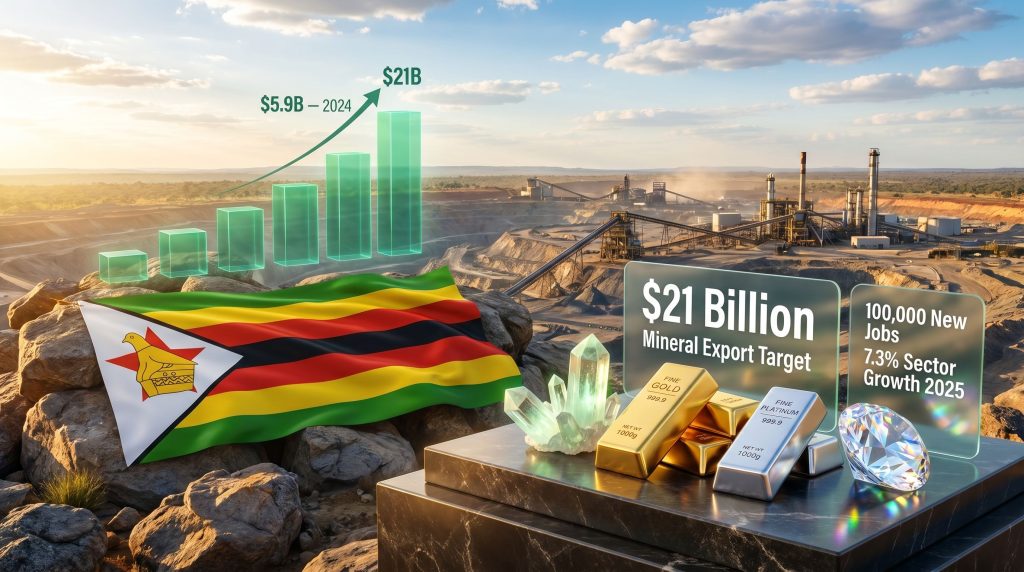
| Mineral export value (2024) | $5.9 billion | Up from $5.4 billion in 2023 |
| Q1 2026 mineral sales | ~$983.85 million | Driven by lithium and PGMs across 1,288,761 tonnes |
| Formal mining employment | ~60,000 workers | Target: more than double within five years |
| Minerals produced commercially | ~40 | Reflects exceptional geological diversity |
| Sector output growth (2025) | 7.3% | Ahead of most Sub-Saharan African mining economies |
| Projected sector growth (2026) | ~10% | Supported by new project commissioning |
Sector context: Zimbabwe's mining industry already accounts for more than 75% of national exports. This level of concentration means the sector's operational performance is directly tied to macroeconomic stability, exchange rate management, and fiscal revenue generation, making its growth trajectory a matter of national economic consequence, not merely sectoral interest.
Zimbabwe's geological diversity is itself a competitive advantage that is frequently underappreciated in mainstream coverage. The country produces approximately 40 minerals on a commercial basis, including lithium, gold, platinum group metals, chrome, coal, nickel, diamonds, and iron ore. This multi-mineral base differentiates Zimbabwe structurally from single-commodity dependent economies, providing natural revenue diversification and a broader investment surface area for capital deployment.
What Is Driving the Zimbabwe Mining Jobs Boom?
The Critical Minerals Demand Cycle as Primary Catalyst
Understanding why Zimbabwe's mining sector is generating so much investor and employment momentum requires contextualising it within the global energy transition. Furthermore, the critical minerals demand cycle has become one of the most significant structural forces reshaping global resource markets. The International Energy Agency has consistently highlighted that clean energy technologies require vastly larger quantities of critical minerals than conventional energy systems.
An electric vehicle contains roughly six times more mineral inputs than a traditional internal combustion engine vehicle, while offshore wind installations require approximately nine times more mineral content per unit of electricity produced compared to gas-fired power plants.
This structural demand shift has created a sustained, long-horizon pull for exactly the minerals Zimbabwe holds in abundance:
- Lithium is the foundational material for lithium-ion battery cells used in electric vehicles and grid-scale energy storage systems
- Platinum group metals (PGMs) serve as critical catalysts in hydrogen fuel cells, automotive catalytic converters, and industrial chemical processes
- Chrome feeds stainless steel manufacturing, which underpins construction, industrial equipment, and consumer goods production globally
- Gold functions as a monetary reserve asset and has growing applications in electronics and medical technologies
Zimbabwe holds meaningful reserves across all four of these categories. The Arcadia and Bikita lithium projects, alongside established PGM operations in the Great Dyke geological formation, position the country as a genuine multi-mineral supplier to global technology supply chains rather than a peripheral commodity exporter.
The Great Dyke: Zimbabwe's Geological Crown Jewel
One aspect of Zimbabwe's mineral story that deserves deeper examination is the Great Dyke itself, a layered igneous intrusion running approximately 550 kilometres through the heart of the country. This geological formation is one of the world's most significant repositories of platinum group metals, hosting resources comparable in scale and grade to South Africa's Bushveld Complex, which is the dominant global PGM province.
The Great Dyke contains platinum, palladium, rhodium, ruthenium, iridium, and osmium in commercially viable concentrations. Rhodium in particular commands extraordinary market premiums due to its scarcity and irreplaceable role in automotive emission control systems. In addition, the platinum and palladium markets are experiencing structural shifts driven by hydrogen economy applications and tightening automotive emissions standards globally.
What makes Zimbabwe's PGM geology distinct from a technical standpoint is the relatively shallow depth of economic mineralisation in certain portions of the Great Dyke, which reduces the capital intensity of early-stage extraction compared to deeper South African reef operations. This geological characteristic has historically attracted junior mining companies and exploration-stage investors seeking lower entry-cost exposure to PGM assets.
Foreign Direct Investment Activating Dormant Potential
The hiring surge projected for Zimbabwe's mining sector is inseparable from the capital flows entering the country to develop new and expanded operations. Investment is entering across several distinct categories:
- Greenfield development at new lithium, gold, and PGM projects that are commissioning for the first time
- Brownfield expansion at existing chrome, coal, and platinum operations scaling production capacity
- Processing infrastructure investment in refining facilities, smelters, and chemical processing plants required by Zimbabwe's beneficiation mandate
- Enabling infrastructure including power, water, and transport capacity supporting new mine development
Each investment category generates employment at different stages and skill levels, which helps explain why the Chamber of Mines of Zimbabwe (CoMZ) projects that nearly half of the anticipated 100,000 new positions will require engineers and highly skilled technical specialists. Processing and refining operations are significantly more technically intensive than raw extraction, creating demand for metallurgists, chemical engineers, process control specialists, and laboratory analysts that would not otherwise exist.
How Many Jobs Could Zimbabwe's Mining Sector Create?
Zimbabwe's mining industry is on a trajectory to generate up to 100,000 new positions over a five-year period, which would represent more than a doubling of the current formal workforce of approximately 60,000 employees. According to the Chamber of Mines of Zimbabwe, close to half of these roles will require engineering qualifications or equivalent technical expertise, a composition that reflects the sector's increasing operational sophistication driven by beneficiation requirements. Consequently, Zimbabwe's export ban drives lithium and PGM revenues toward the $1 billion mark, underscoring the momentum building across the sector.
Breaking Down the 100,000 Job Projection
Direct Mining and Processing Employment
- New mine commissioning across lithium, gold, platinum, chrome, and coal projects
- Expansion of production capacity at existing operations with additional shift crews and equipment operators
- Formalisation of artisanal and small-scale mining activity as a supplementary employment channel
Downstream Beneficiation and Value Chain Roles
- Metallurgists and process engineers managing refinery and smelting operations
- Processing plant operators and maintenance technicians for lithium carbonate conversion facilities
- Quality assurance specialists and laboratory analysts supporting export-grade product certification
- Coke battery and steel facility workers linked to chrome and iron ore value chains
Enabling Sector and Indirect Employment
- Engineering, equipment supply, and maintenance services
- Logistics, haulage, and export facilitation
- Financial services, insurance, legal, and project management roles supporting mine operators
- Catering, security, and accommodation services at remote mine sites
Employment multiplier perspective: For every formal mining position created in Zimbabwe's expanding sector, downstream and enabling sector employment can amplify the total economic impact by a factor of two to four, depending on the degree to which local content requirements capture supply chain spending within the domestic economy. This multiplier effect makes the headline 100,000 figure potentially conservative as a measure of total employment impact.
The Vision 2030 framework underpinning Zimbabwe's national economic strategy establishes industrialisation and beneficiation as the twin engines of employment quality improvement. The policy architecture explicitly targets the creation of higher-wage technical positions rather than simply maximising headcount in low-skill extraction roles, a distinction that has direct implications for household income levels, skills development investment, and long-term economic resilience.
Zimbabwe's $21 Billion Mineral Export Target: Credible or Aspirational?
Tracing the Revenue Trajectory
The projection that Zimbabwe's mineral export revenues could approach $21 billion within a two-year horizon represents a substantial multiple of current performance. Understanding whether this figure is analytically credible requires examining the growth path that connects current reality to that target.
- Mineral exports reached $5.9 billion in 2024, up from $5.4 billion the prior year
- Sector output expanded by 7.3% in 2025, demonstrating sustained operational momentum
- A further 10% expansion is projected for 2026, supported by new project commissioning
- Q1 2026 data shows $983.85 million in mineral sales across 1,288,761 tonnes processed and sold
At these growth rates, reaching $21 billion within two years would require a step-change acceleration beyond the current trajectory, implying either a significant commodity price uplift, rapid commissioning of large-scale new processing capacity, or both. The $21 billion figure appears to represent an optimistic scenario contingent on sustained investment execution and favourable market conditions rather than a base-case forecast.
Investors and analysts should treat the $21 billion projection as a scenario boundary rather than a committed target. The underlying growth fundamentals are real, but the gap between current revenues and that figure is substantial and cannot be closed through organic expansion alone.
Commodity-by-Commodity Export Contribution
| Mineral | Primary Growth Driver | Export Value Significance |
|---|---|---|
| Lithium | Global battery demand; domestic processing mandate enforcement | Fastest-growing category; processing premium captures additional value |
| Platinum Group Metals | Automotive catalysts; hydrogen economy applications | High per-unit value; strong Q1 2026 contribution |
| Gold | Central bank demand; monetary reserve function | Consistent and reliable forex contributor |
| Chrome | Global stainless steel manufacturing demand | High-volume export with downstream steel linkages |
| Coal and Coke | Regional energy and steel industry demand | Industrial commodity with meaningful multiplier effects |
| Diamonds | Gem and industrial applications | Facing structural headwinds from lab-grown competition |
The Beneficiation Multiplier: How Processing Amplifies Per-Tonne Revenue
The single most important concept for understanding how Zimbabwe could realistically close the gap between current export revenues and longer-term targets is the beneficiation value premium. Raw ore and unprocessed concentrate commands significantly lower per-tonne prices than refined or chemically processed outputs.
Consider the lithium value chain specifically. Unprocessed spodumene concentrate, the raw mineral output from hard-rock lithium mines, typically trades at a fraction of the price commanded by battery-grade lithium carbonate equivalent (LCE) or lithium hydroxide monohydrate. The conversion process from concentrate to battery-grade chemical product can multiply the revenue captured per tonne of original ore by a factor of five to ten, depending on prevailing market prices.
This value amplification is the core economic logic behind Zimbabwe's export restriction policies. By requiring that minerals undergo domestic processing before leaving the country, the government is effectively mandating that the processing margin accrues to Zimbabwe-based operations and their workers instead of offshore refiners.
How Is Zimbabwe's Beneficiation Policy Reshaping the Sector?
The Export Restriction Framework in Practice
Zimbabwe has implemented bans on the export of unprocessed minerals, most significantly covering raw lithium concentrates. The policy rationale is straightforward: exporting unprocessed minerals transfers significant economic value to the destination country's refining industry rather than retaining it within Zimbabwe's economy.
The immediate practical consequence has been an acceleration of domestic processing infrastructure investment. Mining companies seeking to continue operating in Zimbabwe must either build or contract access to in-country processing capacity, which in turn creates capital expenditure cycles, construction employment, and ultimately ongoing operational roles that would not otherwise exist. The beneficiation mineral export boom is already being reported in local media as a tangible outcome of these policy settings.
Indonesia's Nickel Ban as the Comparable Playbook
Zimbabwe's approach finds its closest comparable precedent in Indonesia's nickel strategy, which involved a 2020 ban on raw nickel ore exports. The results of that policy intervention provide a useful evidence base for what Zimbabwe might realistically achieve:
| Country | Policy Intervention | Outcome |
|---|---|---|
| Indonesia | Nickel ore export ban (2020) | Rapid domestic smelting industry development; export revenues multiplied as processed nickel products replaced raw ore |
| Zimbabwe | Raw lithium and mineral export ban | Processing investment accelerating; refinery and conversion facility development underway |
| DRC | Cobalt processing incentives | Mixed results; infrastructure constraints have limited domestic value capture |
| South Africa | Mineral beneficiation charter requirements | Partial implementation; downstream processing development ongoing but slower than targeted |
Indonesia's experience demonstrates that export restriction policies, when supported by sufficient domestic infrastructure investment and a stable enough investment climate to attract processing capital, can meaningfully accelerate industrial development and export revenue growth. The critical variables for Zimbabwe's version of this strategy are the pace at which processing infrastructure can be completed and the consistency of the policy environment over the investment horizon required to justify capital commitment.
The next major ASX story will hit our subscribers first
Risks That Could Derail Zimbabwe's Mining Expansion
Structural and Operational Vulnerabilities
No analysis of Zimbabwe's mining growth story is complete without a candid assessment of the risks that could impede execution. These risks are material and should be weighted carefully by any investor or analyst evaluating the sector's prospects.
Infrastructure and Energy Constraints
- Ageing mining equipment across legacy operations limits the productivity gains achievable from expansion plans
- Power supply consistency is critical for energy-intensive processing and refining operations, and grid reliability remains a structural challenge
- Fuel supply logistics to remote mine sites create operational vulnerability during supply disruptions
Revenue Leakage and Illicit Mineral Flows
- Mineral smuggling, particularly affecting gold and diamonds, represents a structural drain on both official export statistics and government royalty collection
- The scale of illicit flows means that official sector data may understate actual production while overstating the government's fiscal capture of mineral revenues
- Artisanal mining formalisation programmes are identified as a priority mechanism for reducing smuggling and improving revenue transparency
Diamond Market Structural Disruption
- The rapid scaling of laboratory-grown diamond production is compressing natural diamond prices globally
- This headwind is independent of Zimbabwe's domestic policy choices and represents a structural rather than cyclical challenge for the country's diamond export revenues
- Diversification away from diamond dependence toward higher-growth mineral categories is an implicit strategic priority
Macroeconomic and Currency Risk
- Zimbabwe's documented history of currency instability creates long-horizon investment uncertainty
- Exchange rate management credibility is a critical factor for sustaining the foreign investor confidence required to fund new project development
- The Reserve Bank of Zimbabwe's monetary policy posture directly influences the risk premium that international capital requires to deploy into Zimbabwean mining projects
Investor caution: The risks outlined above are not theoretical. They reflect structural challenges that have historically constrained Zimbabwe's ability to fully monetise its mineral endowment. The current positive trajectory does not eliminate these risks; it creates a window of opportunity during which their impact can be reduced if policy consistency and investment execution are maintained.
How Zimbabwe Compares to Peer African Mining Economies
Structural Differentiation Within the African Minerals Landscape
Zimbabwe's multi-mineral geological profile provides a structural differentiation from most African mining economies, which tend toward single or dual commodity dependence. This diversification provides natural revenue stability across commodity price cycles and a broader surface area for investment deployment. Furthermore, the battery metals outlook for 2025 and beyond reinforces Zimbabwe's competitive positioning as a supplier of multiple critical inputs to the global energy transition.
| Country | Mining % of GDP | Primary Mineral Export | Employment Model |
|---|---|---|---|
| Zimbabwe | ~14.5% | Lithium, Gold, PGMs | Beneficiation-led job creation targeting technical roles |
| Zambia | ~12% | Copper | Copper belt expansion and refinery investment |
| DRC | ~25%+ | Cobalt, Copper | Combination of artisanal and large-scale operations |
| Tanzania | ~8% | Gold | Gold mining expansion and royalty reform |
| Botswana | ~20%+ | Diamonds | High-value gem export with processing partnerships |
Zimbabwe's geographic position within Southern Africa's established mining infrastructure corridor also provides practical advantages in terms of equipment supply chains, technical expertise availability, and export logistics connectivity that frontier mineral provinces in less developed regions cannot match.
Step-by-Step: How Zimbabwe's Mining Value Chain Creates Jobs Across the Economy
-
Geological Exploration and Resource Definition involves geologists, geophysicists, drilling crews, and data analysts identifying and quantifying mineral deposits through systematic sampling and modelling
-
Mine Development and Construction generates broad-based employment for civil engineers, construction workers, electricians, and equipment operators during the capital expenditure phase before production begins
-
Extraction Operations creates ongoing employment for mining engineers, equipment operators, blasting specialists, ventilation technicians, and mine safety officers throughout the operational life of the mine
-
On-Site Processing and Beneficiation requires metallurgists, processing plant operators, laboratory technicians, and chemical engineers to convert raw ore into saleable concentrate or refined product
-
Logistics and Export Facilitation employs transport operators, customs agents, freight specialists, and trade finance professionals to move product from mine gate to end market
-
Enabling Services supports all stages through financial services, legal, insurance, catering, security, maintenance, and information technology contractors whose revenue is directly dependent on mining sector activity
-
Downstream Industrial Manufacturing at steel plants, battery material processors, and chemical refineries converts processed minerals into higher-value industrial inputs, representing the furthest downstream point of Zimbabwe's emerging mineral value chain
Frequently Asked Questions: Zimbabwe Mining Jobs and Mineral Exports
How many people currently work in Zimbabwe's formal mining sector?
Approximately 60,000 workers are formally employed in Zimbabwe's mining industry based on the most recent available Chamber of Mines of Zimbabwe data. This figure does not include artisanal miners, who represent an additional significant but less formally quantified segment of the total mining workforce.
What is the $21 billion mineral export target?
Industry analysts project that Zimbabwe's mineral export revenues could approach $21 billion within a two-year period if current investment trajectories, production growth rates, and commodity price conditions are sustained. This is an optimistic scenario figure representing substantial growth from the $5.9 billion in mineral exports recorded in 2024. It should not be treated as a guaranteed outcome.
Which minerals are driving Zimbabwe's export growth fastest?
Lithium and platinum group metals are the fastest-growing contributors to Zimbabwe's mineral export revenues, directly supported by global demand from the electric vehicle manufacturing and clean energy sectors. Gold, chrome, coal, and diamonds provide additional volume, though diamonds face structural pricing pressure from the lab-grown stone market.
What is Zimbabwe's beneficiation policy and why does it matter?
Zimbabwe has banned the export of unprocessed minerals including raw lithium concentrates, requiring that value-adding processing occur within the country before export. This policy is designed to retain more economic value domestically, create downstream technical employment, and multiply per-tonne export revenues by capturing the processing premium that would otherwise accrue to offshore refiners.
What are the main risks to Zimbabwe's mining growth outlook?
Key risks include infrastructure and power supply constraints, fuel logistics reliability, mineral smuggling and revenue leakage, currency instability, structurally declining natural diamond prices due to lab-grown competition, geopolitical investment concentration risks, and global commodity price volatility across the relevant mineral categories.
Key Takeaways: Understanding Zimbabwe's Mining Transformation
-
Zimbabwe's mining sector is executing a structural pivot from raw extraction toward value-added mineral processing, with profound implications for employment quality, export revenues, and long-term economic resilience
-
The 100,000 new job target over five years reflects both the scale of greenfield and brownfield investment pipelines and the downstream employment multiplier generated by beneficiation policy requirements
-
Mineral export revenues of $21 billion represent an ambitious scenario boundary rather than a base-case forecast, anchored in demonstrated growth of 7.3% in 2025 with a projected further 10% expansion in 2026
-
Zimbabwe's Great Dyke PGM formation and diversified lithium and chrome endowment provide a structurally differentiated geological foundation compared to most African mining peers
-
The beneficiation export restriction framework is the single most consequential policy variable shaping Zimbabwe's mining trajectory, with Indonesia's nickel export ban providing the closest comparable evidence of potential outcomes
-
Risks including currency instability, infrastructure constraints, and mineral smuggling remain material and should be factored into any investment or economic assessment of the sector's growth prospects
Disclaimer: This article is intended for informational and analytical purposes only. It does not constitute financial or investment advice. All projections, forecasts, and scenario figures referenced are subject to material uncertainty and should not be relied upon as predictions of future outcomes. Readers should conduct independent due diligence before making any investment decisions related to the mining sector or Zimbabwean assets.
Want To Stay Ahead of the Next Major Mineral Discovery on the ASX?
Discovery Alert's proprietary Discovery IQ model delivers real-time alerts on significant ASX mineral discoveries across lithium, platinum group metals, and other critical minerals driving the global energy transition — instantly turning complex data into actionable investment insights. Explore how historic discoveries have generated extraordinary returns for early investors, and begin your 14-day free trial at Discovery Alert to secure your market-leading advantage before the broader market catches on.