July 13, 2026
When the Price Goes Negative: Understanding the Structural Inversion in Zinc Concentrate Markets
Commodity markets occasionally produce conditions that appear to defy economic logic. One of the most striking examples is when a processing fee — charged by a refiner to a miner for converting raw ore into sellable metal — turns negative. This is precisely what has unfolded in global zinc concentrate markets through mid-2026, and it signals something far deeper than a temporary pricing quirk. The inversion of zinc concentrate treatment charges into deeply negative territory reflects a rare convergence of geological, geopolitical, regulatory, and operational forces that has fundamentally shifted negotiating power away from smelters and toward miners, at least for now.
When big ASX news breaks, our subscribers know first
How Zinc Concentrate Treatment Charges Actually Work
The Concentrate-to-Metal Value Chain
To understand why negative zinc concentrate treatment charges matter, it helps to trace the journey of zinc from the ground to the market. Mining operations extract zinc-bearing ore, which is then processed on-site into a zinc concentrate — typically a powder containing between 45% and 60% zinc by weight — alongside various byproduct metals such as silver, lead, germanium, and sometimes copper. This concentrate is then sold to smelters, who apply pyrometallurgical or hydrometallurgical processes to produce refined zinc metal ready for industrial use.
The TC is the fee a miner pays a smelter for this refining service, denominated in US dollars per dry metric tonne (DMT) of concentrate. In a well-supplied market, smelters hold pricing power because multiple miners compete for limited processing capacity. When concentrate supply tightens, however, that dynamic reverses. Understanding base metal pricing dynamics is therefore essential when interpreting TC movements.
TCs as a Market Barometer
Few instruments in the zinc supply chain communicate market conditions as clearly as TC levels. They function as a real-time signal of who holds commercial leverage at any point in the cycle.
| TC Direction | Market Signal | Who Benefits |
|---|---|---|
| High / Rising | Concentrate surplus; smelters in demand | Smelters |
| Low / Falling | Concentrate scarcity emerging | Miners |
| Negative | Extreme tightness; smelters subsidise feed procurement | Miners |
"When spot TCs fall below zero, the commercial logic of the smelting business inverts. Processors are no longer paid to refine ore; they are paying to secure it. Every tonne processed at deeply negative TCs erodes margin unless byproduct revenues provide sufficient offset."
Benchmark vs. Spot TCs: A Critical Distinction
Industry participants navigate two distinct TC pricing frameworks. Annual benchmark TCs are established once per year through bilateral negotiations between a major miner and a leading smelter, setting a reference price the broader industry uses as a foundation for its own contracts. Spot TCs, assessed on a cost, insurance, and freight (CIF) basis for Chinese imports by price reporting agencies including Fastmarkets, reflect real-time market dynamics and can diverge dramatically from the annual benchmark during periods of supply stress.
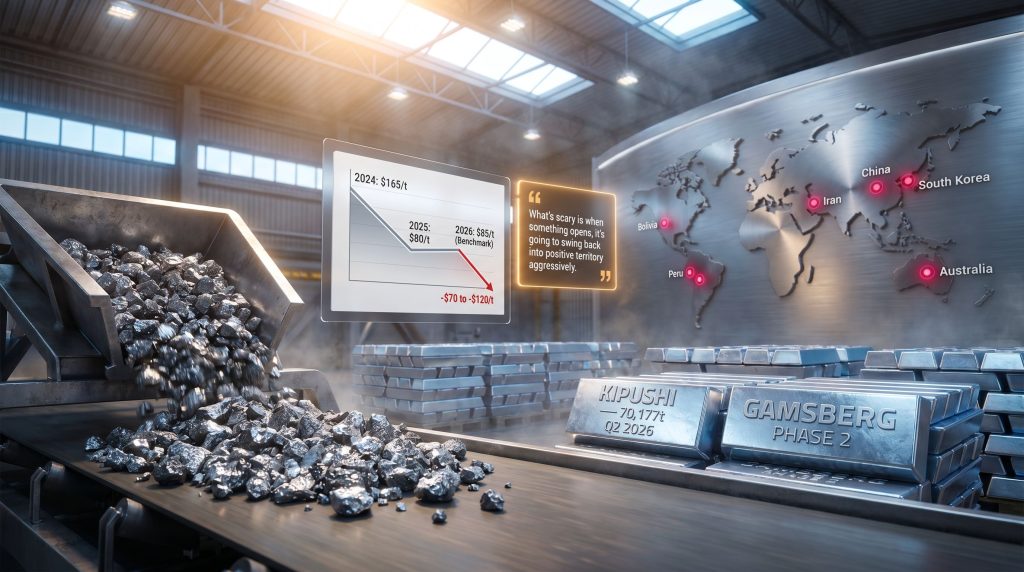
The 2026 annual benchmark of $85 per tonne, agreed between Teck Resources and Korea Zinc, sits in almost surreal contrast to where spot TCs have actually traded in mid-2026.
The Benchmark Timeline and the Collapse of Spot Markets
A Three-Year Repricing of Zinc Concentrate
The trajectory of annual benchmark TCs over recent years tells a story of accelerating tightness:
| Year | Annual Benchmark TC | Key Context |
|---|---|---|
| 2024 | $165/t | Relatively balanced market conditions |
| 2025 | $80/t | Record low; roughly 50% single-year decline |
| 2026 | $85/t | Modest recovery; Teck Resources / Korea Zinc agreement |
The 2025 benchmark collapse from $165/t to $80/t represented one of the most dramatic single-year reductions in recent memory, driven by the early stages of what would become a structural concentrate deficit. The 2026 slight recovery to $85/t reflected cautious optimism that incremental new supply — particularly from projects like Kipushi and Gamsberg Phase 2 — would provide some relief. Consequently, the spot market offered a very different verdict.
The Spot TC Deterioration: A Step-by-Step Decline
- October 2024: China spot TCs were assessed in the range of $100 to $120 per tonne, with some individual transactions clearing above $130/t.
- Q1 2026: Quarterly guidance for spot TCs remained positive but was compressing rapidly.
- Q2 2026: Quarterly guidance dropped to $35 to $70 per tonne, a decline of approximately $60/t from Q1 guidance.
- Late May 2026: Spot TCs crossed into negative territory for the first time in the current cycle, reaching approximately -$50 per tonne.
- Late June to early July 2026: Fastmarkets assessed the zinc spot concentrate TC, CIF China, at -$70 to -$120 per tonne, deepening further from the June 12 assessment of -$50 to -$80 per tonne.
This trajectory reflects not a single disruption but a cascade of overlapping supply shocks arriving simultaneously across multiple geographies.
The Multi-Front Supply Disruption Driving the 2026 Zinc Squeeze
A Global Disruption Map
What makes the 2026 zinc concentrate tightness structurally significant is the breadth of simultaneous disruptions. No single event explains the current pricing environment; instead, a cluster of unrelated shocks has compounded into a systemic shortage. Furthermore, broader zinc production trends had already been signalling tightening conditions well before these disruptions crystallised.
| Region / Source | Disruption Type | Estimated Impact |
|---|---|---|
| Bolivia | Export blockades (~50 active) persisting ~6 weeks | Significant seaborne flow interruption |
| China | Nationwide mine-safety inspections post-fatal accident | 40-50% output reduction at some operations |
| Peru | 60-day state of emergency across 22 regions | Precautionary; no confirmed output losses |
| South Korea | Smelter fire at Seokpo facility (acid plant) | Operational impact unconfirmed |
| Iran | Geopolitical uncertainty; flows exclusively to China | Potential tightening risk if disrupted |
| Australia | Ongoing disruptions noted by market participants | Unspecified volume impact |
China's Mine-Safety Crackdown: More Than a Temporary Headwind
Following a fatal coal-mine accident in late May 2026, Chinese regulators extended safety inspections across all metal and non-metal mining operations nationwide. The practical consequences for zinc production were substantial. Canada-based, China-focused producer Silvercorp Metals disclosed in a June 29 statement that operations at its Ying and GC mining districts would be slowed to comply with the new measures.
Silvercorp projected output reductions of 40 to 50% at its Ying district during the July to September quarter, with GC facing approximately 50% curtailment and the current quarter already affected by 10 to 15%.
The broader implication extends well beyond any single producer. When China's regulatory apparatus triggers simultaneous operational slowdowns across dozens of mining operations, the aggregate impact on domestic concentrate availability is substantial, even if no individual site represents a globally significant source of supply.
Bolivia's Blockades: A Six-Week Chokepoint with Global Consequences
Bolivia ranks among the world's meaningful zinc concentrate exporters. From mid-2026, approximately 50 active blockades disrupted export logistics for around six weeks, preventing material from reaching port and effectively removing a non-trivial volume of seaborne concentrate from the market. For a market already operating with thin buffers, this kind of logistical disruption carries outsized pricing consequences.
Market participants speaking to Fastmarkets described the Bolivian situation as one component of a broader global absence of new mine supply, noting that the coincidence of multiple disruptions across Bolivia, Iran, Australia, and China created a uniquely compressed supply environment. In addition, geopolitical mining risks of this nature are increasingly being factored into long-term supply modelling.
New Supply Arriving: Can Kipushi and Gamsberg Shift the Balance?
Ivanhoe's Kipushi: Record Grade, Record Output
Against this backdrop of supply disruption, Ivanhoe Mines' Kipushi operation in the Democratic Republic of Congo has emerged as one of the more significant incremental supply additions to the global zinc market. The mine's Q2 2026 production results were exceptional across every operational metric:
| Operational Metric | Q2 2026 Performance |
|---|---|
| Zinc-in-concentrate produced | 70,177 tonnes (record) |
| Quarter-on-quarter change | +8% |
| Ore milled | 200,774 tonnes (record) |
| Feed grade | 38.7% zinc (record) |
| Concentrator recovery | 92% (record) |
| Annualised run rate | ~280,000 tonnes/year |
| 2026 full-year guidance | 240,000-290,000 tonnes |
Kipushi's 38.7% feed grade is exceptionally high by global standards. Most operating zinc mines process ore with zinc grades well below 10%, making Kipushi's high-grade ore body a significant operational advantage. Higher feed grades reduce the volume of rock that must be processed per unit of zinc recovered, lowering unit processing costs and improving concentrate quality. Production tracking toward the upper end of full-year guidance suggests continued volume contributions through H2 2026.
Vedanta's Gamsberg Phase 2: Incremental Volume, Commercial Complexity
Vedanta's Gamsberg Phase 2 in South Africa was scheduled to begin commissioning in July 2026, adding incremental seaborne concentrate to the market. Phase 1 delivered 45,000 tonnes of mined metal in Q1 FY2027 (three months ended June 30, 2026), up 10% quarter-on-quarter. An active tender for approximately 40,000 tonnes of Gamsberg material was circulating in the market, with shipments scheduled across Q3 2026 through Q2 2027, priced on a discount-to-index basis.
One commercially important nuance is Gamsberg's low silver content. Silver payables form a meaningful component of the value equation when Chinese smelters evaluate concentrate purchases. Because silver credits enhance the effective economics of processing a given parcel, concentrates with limited silver carry less inherent value to Chinese buyers, creating placement challenges even when the headline zinc grade is acceptable.
This is a less commonly understood dynamic in zinc concentrate trading: the marketability of a concentrate parcel is not determined by zinc content alone. Byproduct payables for silver, germanium, copper, and sulfuric acid collectively shape how smelters rank competing supply options.
Scenario Analysis: Supply vs. Disruption
- Bear case: Bolivian blockades persist through Q3; Chinese safety inspections remain in place; Gamsberg Phase 2 ramp-up is slower than scheduled; spot TCs remain at -$70 to -$120/t or worse.
- Base case: Gamsberg Phase 2 begins contributing seaborne volume by Q4 2026; Chinese inspections gradually ease; spot TCs recover toward the -$30 to -$50/t range.
- Bull case (for smelters): Multiple disruptions resolve simultaneously; Iranian flows continue uninterrupted; TC levels swing back sharply into positive territory, potentially rapidly given the compressed starting point.
"Market participants have explicitly flagged the potential for an aggressive reversal in TC levels when disruptions begin to resolve, noting that the current compression creates the conditions for a sharp pendulum swing back toward smelter-favourable pricing."
Mid-Year Tenders and the Pricing Mechanics of a Negative TC Market
How Tenders Reveal Real Market Pricing
Annual benchmarks and quarterly guidance ranges provide a framework, but individual tender outcomes reveal where the market is actually clearing. The mid-2026 tender round produced a series of deeply negative awards across multiple origins:
- Volcan (Peru): Approximately 100,000 tonnes in total, with shipments from October onward
- Dugald River (Australia): Approximately 10,000 tonnes for August shipment
- Raura (Peru): Concluded at negative TCs
- Gamsberg (South Africa): Priced on a discount-to-index basis; low silver content a commercial constraint
- Bisha (Eritrea): Heard at a comparatively lower TC relative to peers, attributed to elevated copper content in the concentrate
The Bisha situation illustrates an important technical nuance. High copper content in a zinc concentrate can be either a credit or a complication depending on the smelter's configuration and the terms of the contract. When copper payables are included, effective TCs improve from the smelter's perspective.
When they are excluded — as occurred with a recent Antamina zinc tender that was ultimately concluded without a copper payable at a deeply negative TC — the smelter absorbs the full cost of processing without the byproduct offset.
The Bid-Ask Spread: A Market in Structural Disagreement
One of the more revealing dynamics in mid-2026 zinc concentrate trading was the wide bid-ask spread between what smelters were willing to pay and where traders were offering material. Smelters were reportedly seeking to acquire concentrate at approximately -$80 per tonne but could not secure supply at those levels.
Traders, recognising the depth of demand-side desperation, were selling at wider (more negative) levels, reflecting their own cost structures and the reality that purchasing at -$150/t and selling at -$80/t produces a loss rather than a margin. This kind of bid-ask dislocation is characteristic of markets experiencing genuine structural imbalance rather than temporary sentiment-driven volatility.
The next major ASX story will hit our subscribers first
The Young Poong Seokpo Fire and Its Implications for Zinc Processing
Why an Acid Plant Fire Matters in Smelter Economics
On July 9, 2026, a fire broke out at Young Poong's Seokpo smelter in South Korea, with local authorities issuing a Level 1 emergency response. Reports indicated the fire originated near the smelter's sulfuric acid plant. Seokpo is classified as the sixth-largest refined zinc producer globally, with reported annual production capacity of 325,000 to 400,000 tonnes per year.
The significance of the acid plant location is not immediately obvious to observers outside the zinc processing industry. During zinc smelting, roasting of zinc sulfide concentrate produces sulfur dioxide gas, which is captured and converted into sulfuric acid. This acid is a major revenue-generating byproduct for smelters.
In an environment where TC income has been eliminated or inverted, sulfuric acid revenues become one of the primary economic justifications for maintaining smelter run rates. Damage to acid plant infrastructure therefore compounds the margin pressure created by negative TCs. Korean smelters were already reported to be short of raw material concentrate prior to the incident, meaning the Seokpo fire landed in an already stressed operational context.
Why Chinese Smelters Keep Running Despite Negative Economics
The Competitive Prisoner's Dilemma
Perhaps the most counterintuitive aspect of the current zinc concentrate market is that Chinese smelters have not responded to deeply negative TCs with widespread production shutdowns. Understanding why requires appreciating the competitive dynamics of the Chinese processing sector.
Chinese zinc smelting is characterised by a large number of domestic producers operating within a competitive domestic market. A smelter that voluntarily curtails production to protest negative TCs cedes market share to competitors who continue operating. If those competitors remain profitable — even marginally — through byproduct revenues and operational efficiencies, the curtailing smelter loses both volume and market position without necessarily triggering the market rebalancing it was hoping to induce.
As Fastmarkets reported, one European zinc concentrate market participant articulated this logic plainly: if a smelter continues to make money, it will not stop production, because stopping means a competitor captures the incremental benefit instead.
What Keeps Smelter Economics Viable Under Negative TCs?
Several factors partially offset the impact of deeply negative zinc concentrate treatment charges:
- Silver payables: Silver recovered during zinc smelting contributes meaningful revenue, particularly for high-silver-content concentrates.
- Germanium payables: Notably, the 2026 annual benchmark introduced germanium payables for the first time, representing a structural shift in how byproduct value is allocated between miners and smelters.
- Copper credits: Some concentrates carry copper content that generates additional payable income for smelters, improving effective TCs.
- Sulfuric acid revenues: Acid byproduct sales provide a significant revenue stream that operates independently of TC income.
- Inventory drawdown: Some smelters are processing stockpiled concentrate purchased at earlier, more favourable TC levels, deferring the full impact of spot market pricing on their cost base.
A subset of Chinese smelters had trimmed run rates by approximately 5 to 10% as of mid-2026, though industry participants characterised these as care-and-maintenance adjustments rather than structural shutdowns. The threshold for more widespread curtailments would likely require a sustained deterioration in both TCs and byproduct pricing simultaneously. For a broader perspective on how these dynamics affect producers, commodity price impacts on mining company performance remain a critical consideration.
Key Takeaways for Market Participants Tracking Zinc Concentrate Treatment Charges
The zinc concentrate market in mid-2026 represents a genuinely unusual configuration of simultaneous supply-side stress across multiple geographies. For a fuller picture of where this fits within the broader sector, a detailed metals and mining analysis provides valuable context. Several structural observations are worth retaining:
- The gap between the 2026 annual benchmark TC of $85/t and spot assessments of -$70 to -$120/t highlights how far real-time conditions have diverged from contracted reference prices.
- Kipushi's seventh consecutive quarterly production record and Gamsberg Phase 2's imminent commissioning represent meaningful incremental supply, but are unlikely to fully offset aggregate disruption volumes in the near term.
- Byproduct economics — particularly the first-ever inclusion of germanium payables in the 2026 benchmark — are becoming increasingly central to smelter viability assessments under negative TC conditions.
- The speed and trajectory of TC recovery will depend heavily on the resolution timeline for Bolivian export blockades, Chinese mine-safety inspections, and geopolitical developments affecting Iranian concentrate flows.
- When disruptions do begin to resolve, market participants have flagged the potential for a rapid and aggressive swing back toward positive TC territory, given the compressed starting point.
Furthermore, ING's analysis of the wide gap in zinc TCs suggests this moment may represent a broader industry turning point, rather than a temporary dislocation that will simply self-correct.
Disclaimer: This article contains forward-looking statements, market assessments, and scenario projections based on publicly available information and market participant commentary reported by Fastmarkets as of July 2026. Commodity markets are subject to rapid change, and past pricing dynamics are not necessarily indicative of future outcomes. This content is intended for informational purposes only and does not constitute financial or investment advice. Readers should conduct their own due diligence before making any investment or commercial decisions based on the information presented here.
For zinc price data, spot TC assessments, and market analysis, Fastmarkets publishes regular pricing assessments including the zinc spot concentrate TC, CIF China assessment. Further methodology documentation is available at Fastmarkets.
Want to Capitalise on the Next Major ASX Zinc Discovery Before the Broader Market?
Discovery Alert's proprietary Discovery IQ model scans ASX announcements in real time, instantly identifying significant mineral discoveries — including zinc and other base metals — and translating complex data into actionable insights for investors at every experience level. Explore Discovery Alert's dedicated discoveries page to understand how historic mineral discoveries have generated substantial market returns, and begin your 14-day free trial today to position yourself ahead of the market.