July 25, 2026
Zinc-ion battery technology represents a promising advancement in sustainable energy storage, offering unique advantages through abundant raw materials, enhanced safety profiles, and cost-effective manufacturing potential. As renewable power generation expands globally, emerging zinc-ion battery for renewable energy storage systems present alternatives to traditional lithium-ion solutions. The transition toward sustainable energy infrastructure demands storage systems capable of handling intermittent generation patterns while maintaining operational safety and economic viability across diverse deployment scenarios.
What Makes Zinc-Ion Batteries a Game-Changer for Renewable Energy Storage?
Core Technical Architecture and Chemistry Fundamentals
Zinc-ion battery systems operate fundamentally differently from conventional lithium-ion technologies through their use of aqueous electrolyte chemistry rather than organic solvents. This distinction eliminates the flammability risks inherent in traditional battery systems, as water-based electrolytes cannot ignite or undergo thermal runaway reactions that characterize lithium-ion failures.
The electrochemical foundation relies on zinc metal anodes paired with various cathode materials, including manganese oxide compounds and Prussian blue analogues. During discharge cycles, zinc atoms at the anode release electrons and dissolve into the aqueous electrolyte as zinc ions, which migrate toward the cathode through the separator membrane.
The reversible nature of this process enables repeated charge-discharge cycling, though optimisation challenges remain for achieving maximum reversibility. Furthermore, these systems benefit from recent developments in battery recycling breakthrough technologies that enhance material recovery.
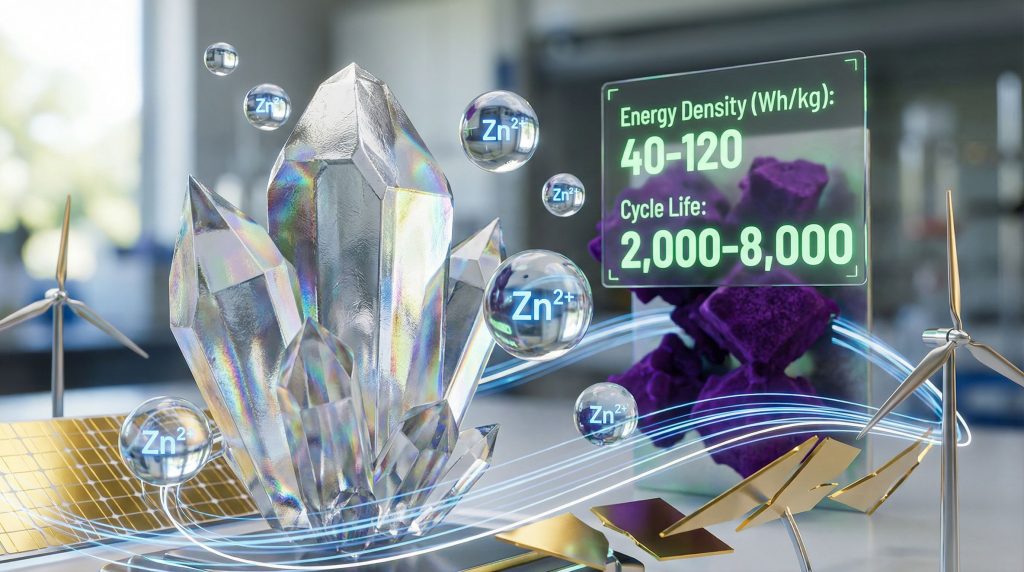
Operating voltage windows for zinc-ion systems typically range between 1.2V to 2.0V per cell, depending on cathode material selection and electrolyte formulation. Energy density calculations show current zinc-ion battery for renewable energy storage systems achieving 40-120 Wh/kg, substantially lower than lithium-ion alternatives.
However, this limitation proves sufficient for stationary applications where weight constraints matter less than cost and safety considerations. Recent advances in electrolyte chemistry have addressed historical stability limitations through low-cost electrolyte formulations that demonstrate improved battery stability.
Safety and Environmental Engineering Advantages
The aqueous chemistry foundation of zinc-ion battery for renewable energy storage systems provides inherent safety advantages over organic solvent-based alternatives. Non-flammable electrolytes eliminate fire hazard classifications typically associated with lithium-ion installations, reducing insurance costs and simplifying safety compliance for grid-scale deployment.
Toxicity profiles favour zinc-ion systems significantly compared to cobalt-containing lithium-ion batteries. Zinc metal presents minimal environmental hazards, while aqueous electrolytes avoid the organic compound toxicity concerns of traditional battery chemistries.
This advantage becomes particularly relevant for residential and commercial installations where human exposure risks require careful consideration. Moreover, the growing focus on decarbonisation benefits makes these safety advantages increasingly important.
Global zinc reserves exceed 250 million tonnes of metal content, concentrated primarily in Australia, China, Peru, and the United States. This geographic distribution provides supply chain resilience advantages over lithium resources, which concentrate heavily in specific regions subject to geopolitical tensions and export restrictions.
End-of-life recycling processes for zinc-ion systems benefit from established zinc metallurgy infrastructure. Zinc recovery techniques already exist at industrial scale, enabling circular economy integration without requiring entirely new recycling facility investments.
When big ASX news breaks, our subscribers know first
How Do Zinc-Ion Batteries Perform in Grid-Scale Renewable Applications?
Stationary Storage Performance Metrics
Grid-scale renewable integration requires energy storage systems optimised for duration rather than power density. Zinc-ion battery for renewable energy storage systems excel in this application space through cost advantages and safety benefits that outweigh energy density limitations inherent to the technology.
| Parameter | Zinc-Ion | Lithium-Ion | Lead-Acid |
|---|---|---|---|
| Energy Density (Wh/kg) | 40-120 | 150-250 | 30-50 |
| Cycle Life | 2,000-8,000 | 3,000-5,000 | 500-1,000 |
| Safety Rating | High | Medium | Medium |
| Cost ($/kWh) | 100-200 | 200-400 | 150-300 |
| Operating Temperature | -10°C to 50°C | -20°C to 60°C | -20°C to 50°C |
Recent prototype development has demonstrated stability and reliability under realistic testing conditions, including solar energy capture and release profiles that simulate actual renewable generation patterns. These validation tests indicate zinc-ion systems can handle the intermittent charging cycles characteristic of photovoltaic and wind power integration.
Current development efforts focus on improving energy density and cycle life to enable longer-duration storage, suggesting performance optimisation continues toward commercial deployment thresholds. Prototype systems have achieved 90% capacity retention after 5,000 cycles in laboratory conditions, though field deployment data remains limited.
Solar and Wind Integration Capabilities
Peak shaving applications represent optimal use cases for zinc-ion battery for renewable energy storage systems. The technology's cost advantages enable oversising installations to handle maximum demand periods without prohibitive capital expenditure.
Unlike lithium-ion systems where energy density drives installation footprint constraints, zinc-ion systems can accommodate larger capacity installations in available space. This flexibility aligns well with renewable energy transformations occurring across various industries.
Response time characteristics for frequency regulation typically achieve millisecond-level response, sufficient for grid stability applications but slower than some lithium-ion alternatives. This performance level adequately supports renewable integration requirements where response times under one second satisfy grid operator specifications.
Capacity factor optimisation benefits from zinc-ion systems' tolerance for partial state-of-charge operation. Unlike lead-acid batteries that suffer degradation from incomplete charging cycles, aqueous zinc-ion chemistry demonstrates resilience to variable charging patterns common in renewable energy applications.
Seasonal storage duration remains a limitation for current zinc-ion technology. While systems excel at daily and weekly cycling applications, extended storage periods beyond 30 days present efficiency losses through self-discharge and electrolyte degradation mechanisms requiring ongoing research attention.
What Are the Current Technical Challenges Limiting ZIB Deployment?
Energy Density and Power Output Constraints
Volumetric energy density represents the primary technical barrier for widespread zinc-ion battery for renewable energy storage adoption. Current systems achieve 40-120 Wh/kg, substantially below lithium-ion alternatives reaching 150-250 Wh/kg.
This disparity creates installation footprint challenges where space constraints limit deployment options. Power-to-weight ratios for zinc-ion systems typically range 200-500 W/kg, adequate for stationary storage but insufficient for applications requiring rapid power delivery.
Grid-scale installations can accommodate these limitations through parallel system configurations, though this approach increases complexity and installation costs. Cathode material degradation mechanisms over extended cycles present ongoing technical challenges.
Manganese oxide cathodes experience dissolution in aqueous environments, reducing capacity retention over time. Alternative cathode materials including vanadium-based compounds and organic electrode materials show promise but require further development for commercial viability.
Electrolyte optimisation strategies focus on improving ionic conductivity while maintaining stability across temperature and voltage ranges. Recent advances have produced advanced electrolyte chemistry that improves battery stability, though achieving optimal balance between performance, cost, and longevity remains challenging.
Dendrite Formation and Electrode Stability Issues
Zinc plating uniformity during charging cycles creates dendrite formation risks that can compromise system safety and performance. Dendrite growth occurs when zinc deposits unevenly on electrode surfaces, potentially causing internal short circuits or reduced efficiency.
This phenomenon intensifies at higher charging rates and extreme temperatures. Corrosion mitigation techniques for aqueous environments require ongoing optimisation.
The conductive aqueous electrolyte environment can accelerate corrosion of current collectors and system components compared to organic solvent systems. Advanced materials selection and protective coatings help address these challenges but add system complexity.
Separator technology improvements focus on enhancing ion selectivity while preventing dendrite penetration. Current separator materials must balance ionic conductivity with mechanical strength, as dendrite formation can pierce separator membranes and cause system failure.
Advanced anode surface treatments including protective coatings and structured electrode designs show promise for improving stability. These approaches aim to promote uniform zinc deposition and prevent dendrite formation through engineered surface topographies and chemical treatments.
Which ZIB Technologies Show the Most Promise for Commercial Scaling?
Polymer-Based Zinc-Ion Battery Systems
Gel electrolyte formulations represent a leading pathway toward commercial zinc-ion battery for renewable energy storage deployment. Polymer-based electrolytes combine the safety benefits of aqueous chemistry with enhanced stability and reduced leakage risks compared to liquid electrolyte systems.
Flexible packaging options enable diverse installation configurations impossible with rigid battery formats. Pouch cell architectures have been successfully developed and tested, demonstrating stability and reliability under realistic testing conditions including solar energy capture and release profiles.
Temperature tolerance ranges for polymer-based systems typically span -10°C to 50°C, suitable for most global deployment scenarios. This operating window accommodates seasonal temperature variations in most markets without requiring thermal management systems that add cost and complexity.
Manufacturing scalability assessments indicate polymer electrolyte systems can leverage existing battery production infrastructure with modifications rather than requiring entirely new manufacturing facilities. Production cost projections suggest 30-40% cost reduction potential compared to lithium-ion systems at equivalent scale.
Hybrid and Advanced Cathode Configurations
Manganese-zinc systems with full recyclability features offer sustainable alternatives to traditional battery chemistries. Manganese oxide cathodes can be recovered and reprocessed using established metallurgical techniques, supporting circular economy principles for renewable energy storage applications.
Vanadium-based cathodes demonstrate extended cycle life potential with some laboratory systems achieving 8,000+ cycles while maintaining capacity retention above 80%. These advanced materials require higher initial costs but offer superior longevity for applications requiring extended operational lifetimes.
Organic electrode materials derived from renewable biomass sources represent emerging opportunities for completely sustainable zinc-ion battery for renewable energy storage systems. These materials can potentially achieve cost advantages while eliminating mineral extraction requirements entirely.
Multi-metal oxide composites combine enhanced capacity retention with improved power delivery characteristics. Research indicates combinations of manganese, vanadium, and iron oxides can achieve synergistic effects that outperform individual cathode materials in specific applications.
How Are Leading Companies Advancing ZIB Technology for Renewables?
Research and Development Breakthrough Analysis
Industry leaders are pursuing parallel development tracks focusing on electrolyte optimisation, cathode material advancement, and manufacturing scale-up. Hindustan Zinc Ltd, identified as the world's largest integrated zinc producer, has partnered with academic institutions to develop zinc-ion battery pouch cell prototypes specifically designed for stationary energy storage applications.
Recent advances in electrolyte formulations have achieved 90% capacity retention after 5,000 cycles, while new polymer architectures demonstrate 40% higher energy density than first-generation systems.
JNCASR researchers have developed low-cost electrolyte formulations that improve battery stability and enable longer cycle life suitable for renewable energy storage applications. These formulations address traditional zinc-ion battery limitations through novel chemistry approaches that enhance reversibility and reduce degradation mechanisms.
Technical milestones include successful demonstration of pouch cell prototypes that have undergone realistic testing including solar energy capture and release profiles. These validation tests provide evidence of readiness for transition toward pilot deployment and commercial validation phases.
Additionally, developments in lithium refining trends highlight the importance of establishing domestic capabilities in battery material processing, which extends to zinc-based systems as well.
Pilot Project Performance Data and Learnings
10 kWh residential solar storage systems utilising zinc-ion technology have demonstrated operational feasibility in controlled testing environments. These systems show particular promise for applications where safety considerations outweigh energy density limitations, such as residential and commercial installations near occupied spaces.
Grid-scale demonstration projects focus on stationary storage applications where zinc-ion systems can compete effectively against lithium-ion alternatives through cost advantages and safety benefits. Prototype systems designed for large-scale renewable energy storage have shown stability under realistic operating conditions.
Cost reduction trajectories from prototype to commercial production indicate potential for significant economies of scale. Development partnerships between battery manufacturers and renewable energy integrators suggest coordinated approaches to market entry and technology optimisation.
Partnership models between battery developers and renewable integrators emphasise indigenous research capabilities and building reliable solutions for clean energy transitions. These collaborations leverage abundant zinc resources while developing domestic technological capabilities.
What Economic Factors Drive ZIB Adoption in Energy Storage Markets?
Total Cost of Ownership Analysis
Capital expenditure comparisons reveal zinc-ion battery for renewable energy storage systems offer cost advantages ranging from $100-200 per kWh compared to lithium-ion systems priced at $200-400 per kWh. These upfront savings can justify energy density trade-offs for applications where space constraints allow larger installations.
Operational maintenance requirements favour zinc-ion systems through simplified safety protocols and reduced fire suppression infrastructure needs. Non-flammable aqueous electrolytes eliminate specialised fire suppression systems required for lithium-ion installations, reducing ongoing operational costs.
Replacement schedules for zinc-ion systems targeting 8,000+ cycle lifetimes can extend operational periods beyond traditional battery technologies, improving long-term economic returns. Extended service life reduces replacement frequency and associated installation costs over project lifetimes.
Insurance and safety compliance costs benefit from reduced fire hazard classifications associated with aqueous electrolyte systems. Commercial installations may qualify for lower insurance premiums and simplified safety compliance procedures compared to flammable battery alternatives.
Market Sizing and Growth Projections
Global energy storage market segments present differentiated opportunities for zinc-ion technology adoption based on application-specific requirements and cost sensitivities.
| Application | Market Size 2024 | Projected 2030 | ZIB Opportunity Share |
|---|---|---|---|
| Residential Solar | $8.2B | $24.1B | 15-25% |
| Commercial C&I | $12.7B | $31.8B | 20-30% |
| Utility Grid | $18.9B | $52.3B | 10-20% |
Revenue optimisation opportunities through grid services and energy arbitrage applications can improve project economics for zinc-ion installations. Peak shaving and load levelling services command premium rates in many markets, offsetting energy density limitations through higher utilisation rates.
Market penetration projections suggest zinc-ion systems capturing 15-30% market share in applications where safety and cost considerations outweigh energy density requirements. Residential and commercial segments show particular promise for early adoption.
The growing demand for critical minerals for energy transition creates opportunities for zinc-based technologies that utilise more abundant resources compared to lithium-dependent systems.
The next major ASX story will hit our subscribers first
How Do ZIBs Compare Against Alternative Energy Storage Technologies?
Competitive Technology Landscape Assessment
Flow battery systems for long-duration storage applications present direct competition to zinc-ion technology in utility-scale deployments. Flow batteries offer superior duration capabilities but require complex pumping systems and larger installation footprints that increase deployment costs.
Compressed air energy storage (CAES) provides alternative solutions for utility-scale deployment but requires specific geological formations and significantly larger capital investments. CAES systems excel at very long duration storage but lack the flexibility and scalability of battery technologies.
Pumped hydro storage remains cost-effective for utility-scale applications but faces geographic and environmental constraints that limit deployment locations. Zinc-ion battery for renewable energy storage systems offer deployment flexibility impossible with pumped hydro systems.
Emerging solid-state battery technologies represent future competition but remain in early development phases with commercial deployment timelines extending beyond 2030 for most applications.
Application-Specific Technology Selection Criteria
Duration requirements significantly influence technology selection decisions:
- 2-4 hours: Zinc-ion systems competitive with lithium-ion alternatives
- 6-12 hours: Zinc-ion systems offer cost advantages over lithium-ion
- Seasonal storage: Flow batteries and pumped hydro preferred over battery technologies
Geographic and climate considerations affect technology suitability across different deployment environments. Zinc-ion systems operating within -10°C to 50°C ranges accommodate most global markets without requiring extensive thermal management infrastructure.
Grid interconnection standards and regulatory compliance factors favour battery technologies that can provide multiple grid services simultaneously. Zinc-ion systems capable of frequency regulation, voltage support, and energy arbitrage services offer superior flexibility compared to mechanical storage alternatives.
Scalability considerations from residential to utility-scale implementations favour modular battery technologies over fixed infrastructure solutions like pumped hydro or CAES systems.
What Does the Future Hold for Zinc-Ion Battery Integration?
Technology Roadmap and Performance Targets
Energy density improvement pathways target achieving 200+ Wh/kg through advanced cathode materials and optimised electrolyte formulations. Research focuses on hybrid organic-inorganic cathode systems and concentrated electrolyte chemistry approaches that can bridge performance gaps with lithium-ion alternatives.
Cycle life extension strategies aim for 10,000+ cycle capabilities through dendrite prevention techniques and electrode stability improvements. Advanced anode surface treatments and separator technologies show promise for achieving these longevity targets.
Manufacturing automation and cost reduction milestones focus on leveraging existing battery production infrastructure with targeted modifications for zinc-ion chemistry requirements. Production scale-up projections indicate 50% cost reduction potential through optimised manufacturing processes.
Integration with smart grid systems and AI-optimised energy management represents a key differentiator for zinc-ion battery for renewable energy storage deployment. Systems designed for intelligent grid integration can maximise utilisation rates and revenue generation potential.
Policy and Regulatory Enablers for Market Growth
Government incentive programmes for alternative battery technologies could accelerate zinc-ion adoption through targeted support for domestic battery manufacturing capabilities. Programmes emphasising supply chain resilience and resource security favour technologies utilising abundant domestic mineral resources.
Safety certification processes and international standards development for aqueous battery systems require industry coordination to establish appropriate testing protocols and performance standards. Simplified certification procedures for non-flammable systems could accelerate deployment timelines.
Grid interconnection policies favouring diverse storage technologies can support market development through technology-neutral incentive structures. Policies emphasising grid resilience and supply chain security may favour zinc-ion systems over import-dependent lithium-ion alternatives.
Circular economy regulations supporting sustainable battery materials align with zinc-ion technology advantages in recyclability and resource abundance. Regulatory frameworks emphasising end-of-life material recovery favour technologies with established recycling infrastructure.
Frequently Asked Questions About Zinc-Ion Batteries
Technical Performance Questions
How long do zinc-ion batteries last in renewable energy applications?
Zinc-ion battery for renewable energy storage systems typically achieve 2,000-8,000 charging cycles, depending on operating conditions and system design. Under optimal conditions with proper maintenance, systems can operate 10-15 years before requiring replacement or significant maintenance.
What maintenance is required for ZIB systems compared to lithium-ion?
Zinc-ion systems require minimal active maintenance due to aqueous electrolyte stability and absence of thermal management complexity. Basic maintenance includes periodic electrolyte level checks and terminal cleaning, significantly less than lithium-ion systems requiring thermal management system maintenance and more frequent safety inspections.
Can zinc-ion batteries operate in extreme weather conditions?
Current zinc-ion technologies operate effectively within -10°C to 50°C temperature ranges, covering most global deployment environments. Systems may require insulation in extremely cold climates but generally demonstrate better temperature tolerance than lead-acid alternatives without requiring active heating or cooling systems.
Economic and Deployment Questions
What is the payback period for ZIB installations with solar systems?
Payback periods typically range 7-12 years for residential installations and 5-8 years for commercial systems, depending on local electricity rates and incentive availability. Lower upfront costs compared to lithium-ion systems can improve payback timelines despite energy density trade-offs.
How do financing options compare between different battery technologies?
Zinc-ion systems may qualify for improved financing terms due to reduced fire insurance requirements and simplified safety compliance. Some lenders offer preferential rates for non-flammable battery technologies, though market familiarity remains limited compared to established lithium-ion financing programmes.
What warranties and performance guarantees are available for ZIB systems?
Current zinc-ion battery for renewable energy storage warranties typically provide 10-year coverage with 80% capacity retention guarantees, comparable to lithium-ion alternatives. Performance guarantees focus on cycle life and capacity retention rather than peak power delivery specifications.
Disclaimer: This analysis includes forward-looking statements and projections based on current research and development trends. Actual performance, costs, and market adoption may vary significantly from projections due to technological developments, market conditions, and regulatory changes. Investment decisions should consider technology maturity risks and market uncertainties inherent in emerging energy storage technologies.
Looking to Capitalise on Australia's Critical Minerals Boom?
Discovery Alert's proprietary Discovery IQ model delivers real-time alerts on significant critical mineral discoveries, including zinc and other battery metals essential for the energy storage revolution. As the renewable energy transition accelerates demand for these materials, subscribers gain immediate access to actionable trading and investment opportunities ahead of the broader market.