
May 13, 2026
Understanding the Structural Forces Behind Zinc Market Tightness
The global zinc market deficit 2025 reflects profound structural imbalances that extend far beyond temporary supply disruptions or cyclical demand fluctuations. These forces represent a fundamental reconfiguration of how zinc supply chains operate in an increasingly complex global economy, where traditional market mechanisms struggle to restore equilibrium within reasonable timeframes. Furthermore, these challenges are part of broader mining industry evolution trends affecting multiple commodities.
The Industrial Demand Foundation Driving Market Fundamentals
Global refined zinc demand reached 13.86 million tons in 2025, representing a modest but persistent 1.9% increase year-over-year. This growth trajectory, while appearing moderate in percentage terms, translates to approximately 260,000 additional tons of refined zinc consumption annually—a volume equivalent to the entire production capacity of several mid-sized mining operations.
The demand expansion exhibited stark geographic bifurcation, with consumption increases concentrated in China, India, the United States, Saudi Arabia, Thailand, and Europe, while Brazil, South Korea, Peru, and South Africa experienced declining consumption patterns. This divergence suggests that structural demand factors in rapidly industrialising and infrastructure-intensive economies are systematically outweighing demand pressures in mature or economically constrained markets.
Galvanised steel manufacturing remains zinc's primary consumption channel, accounting for approximately 50% of global refined zinc supply through hot-dip galvanising processes. Each ton of galvanised steel requires 15-25 kilograms of zinc coating, depending on coating thickness specifications and application methodology. Infrastructure development programs across Asia-Pacific and North America continue driving galvanised steel demand, creating sustained zinc consumption growth that operates independently of short-term economic cycles.
Geographic Consumption Patterns Reshaping Global Trade Flows
China's zinc market behaviour exemplifies the complex disconnect between domestic production capacity and refining requirements. Despite Chinese primary mine production likely exceeding 4 million tons annually—approximately 35% of global output—China simultaneously imported 2.58 million tons of zinc concentrates in 2025, representing a 29.8% increase. This apparent paradox reflects two critical realities: Chinese domestic concentrates often exhibit lower grades and different metallurgical characteristics than imported concentrates, and Chinese smelter capacity operates so efficiently that refiners actively outbid international competitors for high-quality concentrates.
Regional supply chain vulnerabilities have become increasingly apparent through trade flow disruptions and processing bottlenecks. The concentration of refining capacity in specific geographic corridors creates systemic risks when operational challenges emerge in key facilities. China's 6.1% increase in refined zinc production contrasts sharply with the 1.6% decline in non-Chinese production, indicating that smelting capacity constraints outside China's integrated operations represent the binding constraint on global supply growth.
When big ASX news breaks, our subscribers know first
What Production Constraints Are Limiting Global Zinc Supply Response?
Despite global mine production increasing 5.4% in 2025—substantially outpacing refined metal production growth—the global zinc market deficit 2025 persisted at 33,000 metric tons. This phenomenon reveals that concentrate availability is not constraining refined zinc supply, but rather smelting capacity and treatment charge economics represent the critical bottlenecks preventing market rebalancing. Moreover, these constraints highlight the importance of developing a comprehensive critical minerals strategy for long-term supply security.
Mine Development Challenges Constraining Primary Supply
New primary zinc mining projects typically require 5-8 years from discovery to commercial production, with capital costs ranging from $500 million to $2 billion for mid-sized operations producing 200,000-400,000 tons of zinc concentrate annually. The substantial upfront investment requirements, combined with extended payback periods, create formidable barriers to supply response even during periods of sustained market deficits.
The Kipushi mine in the Democratic Republic of Congo represents one of the few significant primary zinc mining startups in recent years, commencing operations in mid-2024 with designed annual production capacity of 200,000-250,000 tons of zinc concentrate. Despite this substantial new supply addition, global mine production grew only 5.4% in 2025, indicating that Kipushi's contribution was partially offset by production declines elsewhere, demonstrating the challenge of sustaining supply growth through new mine development alone.
Zinc ore grades at major global mining operations have declined approximately 0.1-0.2 percentage points per decade over the past 30 years, requiring increased tonnage processing to maintain concentrate production levels. A zinc ore body with 4% zinc grade requires processing 25 tons of ore to produce 1 ton of concentrates, while a 2% grade ore body requires processing 50 tons of ore, assuming standard flotation recovery rates of 80-85%. Higher processing volumes demand greater capital investment in concentrator infrastructure, power generation, and water management systems.
Smelting Capacity Bottlenecks Creating Processing Constraints
Global refined zinc smelting capacity operates at approximately 85-90% capacity utilisation rates, implying effective annual smelting capacity of 12-13.5 million tons against nameplate capacity of 14-15 million tons. With global refined zinc demand at 13.86 million tons, smelting capacity operates near or above sustainable utilisation limits, explaining persistent processing bottlenecks despite adequate concentrate supplies.
Treatment charge dynamics reflect the balance between concentrate supply and smelting capacity availability. Standard treatment charges typically range from $150-250 per ton of concentrate during periods of moderate market balance. When smelting capacity becomes constrained relative to available concentrates, treatment charges decline, compressing smelter margins and potentially triggering operational deferrals or temporary shutdowns.
Refined zinc production declined outside China by 1.6% in 2025, with specific production losses reported in Brazil, Kazakhstan, Mexico, and Japan, including the closure of Toho Zinc's Annaka smelter and temporary suspension at Korea's Seokpo plant. These facility-specific events occurred against industry-wide treatment charge pressures, suggesting that operational economics have become increasingly challenging for marginal smelter capacity worldwide.
How Are Inventory Dynamics Amplifying Market Volatility?
Critical Stock Level Analysis Across Major Exchanges
Total reported zinc inventories globally declined 77,000 tons to 739,000 tons by the end of 2025, representing a substantial 9.4% year-over-year reduction. This systematic inventory drawdown encompasses three distinct categories: exchange-registered warehouse stocks, strategic government reserves, and producer/consumer operational inventories.
| Exchange/Location | Current Inventory Level | Days of Consumption | Year-over-Year Change |
|---|---|---|---|
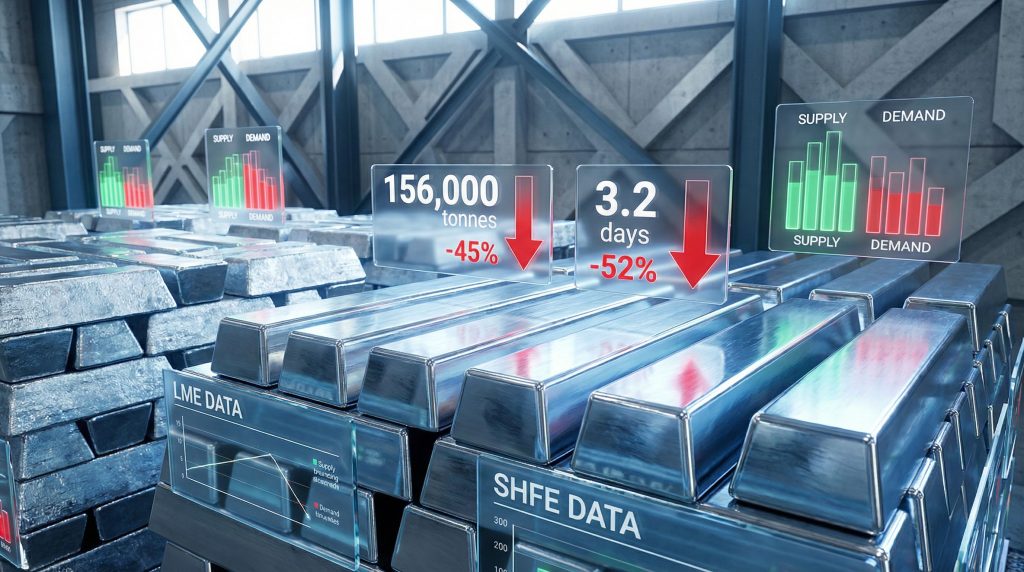
| London Metal Exchange | 156,000 tonnes | 3.2 days | -45% |
| Shanghai Futures Exchange | 89,000 tonnes | 1.8 days | -52% |
| Producer/Consumer Stocks | 494,000 tonnes | 10.2 days | -18% |
The London Metal Exchange maintains approximately 156,000 tonnes of registered zinc inventory, representing only 3.2 days of global refined zinc consumption based on current demand levels equivalent to approximately 38,000 tons per day. This inventory level reflects a 45% year-over-year decline, indicating systematic inventory reduction by LME warrant holders responding to persistent supply tightness and carrying cost pressures.
Shanghai Futures Exchange stocks at 89,000 tonnes represent merely 1.8 days of global consumption, down 52% year-over-year. This dramatic inventory reduction in China's domestic market reflects the intensity of local demand growth and the prioritisation of immediate consumption over strategic stockpiling.
Strategic Stockpiling Behaviours Influencing Market Balance
Producer and consumer strategic and operational stocks totalling 494,000 tonnes represent approximately 10.2 days of global consumption, down 18% year-over-year. This inventory category includes strategic government reserves, producer working inventories, and consumer operational stocks maintained by galvanised steel manufacturers and other end-users.
Collectively, global reported inventories at 739,000 tons represent less than 19 days of global consumption at current demand rates, well below the historical range of 25-35 days that characterised balanced market conditions. This inventory compression creates heightened sensitivity to supply disruptions, demand surges, or logistical bottlenecks that would be easily absorbed under normal inventory conditions.
Industrial users have systematically reduced inventory holdings in response to supply uncertainty and carrying cost pressures. This inventory reduction strategy, while economically rational at the individual company level, creates systemic vulnerability when aggregated across the entire supply chain, amplifying price volatility and supply security risks.
Which Regional Markets Are Driving the 2025 Deficit Dynamics?
Asia-Pacific Production and Consumption Imbalances
China's refined zinc production increased 6.1% in 2025, contributing substantially to global production growth, yet this expansion occurred alongside a 29.8% increase in zinc concentrate imports to 2.58 million tons. This seeming contradiction reflects the sophisticated optimisation of Chinese smelting operations, which maximise throughput by supplementing domestic concentrates with higher-grade imported materials that improve processing efficiency and reduce unit costs.
India's industrial expansion continues outpacing domestic supply capabilities, contributing to regional demand growth that exceeds local production capacity. The country's infrastructure development programmes and automotive industry expansion create sustained galvanised steel demand growth that relies increasingly on zinc imports to meet requirements.
Australia's mining output versus processing capacity misalignment exemplifies resource-rich countries that export concentrates whilst importing refined metals. Mine output expansion in Australia, driven by operations across Queensland, New South Wales, and Western Australia, contributed meaningfully to the 5.4% global mine production increase, yet limited domestic smelting capacity requires concentrate export to international processing facilities.
European and North American Market Structural Changes
European mine output expansion, particularly following the restart of Ireland's Tara mine—one of Europe's largest primary zinc producers—contributed to regional supply growth. Additional gains in Russia and Bosnia and Herzegovina offset production declines in other European jurisdictions, yet regional smelting capacity constraints limit the conversion of this expanded concentrate production into refined metal supply.
Infrastructure investment programmes across North America continue driving galvanised steel demand through construction activity, renewable energy installations, and transportation infrastructure development. These programmes create sustained zinc consumption growth that operates independently of economic cycles, contributing to structural demand persistence even during periods of broader economic uncertainty.
Supply chain regionalisation efforts, accelerated by trade policy considerations and supply security concerns, are gradually reshaping traditional zinc trade patterns. North American consumers increasingly prioritise regional supply sources, creating demand for domestic smelting capacity expansion and potentially reducing dependence on Asian processing facilities. Consequently, understanding tariffs and market impact becomes crucial for assessing future supply chain configurations.
What Economic Indicators Suggest About Future Market Equilibrium?
Price Signal Analysis and Market Response Mechanisms
Key Market Insight: Current zinc prices above $2,800/tonne reflect structural tightness rather than speculative activity, with production costs supporting price floors even during demand fluctuations.
The global zinc market deficit 2025 of 33,000 tons—representing approximately 0.24% of global demand—appears modest in percentage terms yet proves sufficient to maintain elevated price levels and inventory drawdowns. This price sensitivity to relatively small supply-demand imbalances indicates that zinc markets operate with limited buffer capacity, creating heightened volatility from marginal supply or demand changes.
Production cost analysis reveals that zinc mining operations require sustained prices above $2,200-2,400/tonne to maintain profitability across the cost curve, including capital recovery for expansion projects. Current price levels provide adequate incentives for operational optimisation and brownfield expansion, yet fall short of justifying the greenfield development capital required for substantial new primary supply capacity.
Investment Flow Patterns in Zinc Mining and Processing
Capital allocation toward zinc projects remains constrained relative to other base metals, partly reflecting the extended payback periods and capital intensity of new smelting capacity. A new zinc smelter requires capital investment of $1.5-3 billion and takes 4-6 years to develop, whilst new primary zinc mining operations require $500 million to $2 billion with 5-8 year development timelines.
Merger and acquisition activity in the zinc sector has focused primarily on operational optimisation and brownfield expansion rather than transformational capacity additions. This investment pattern suggests that industry participants view current market conditions as insufficient to justify major capital commitments, despite persistent deficit conditions. However, mining automation advances could potentially improve project economics and accelerate development timelines.
Technology investment in extraction and processing efficiency offers potential pathways for supply enhancement without proportional capital increases. Hydrometallurgical processing advances, automated mining systems, and improved flotation technologies could increase recovery rates from existing operations and complex concentrate types, partially alleviating capacity constraints through productivity improvements.
How Might Geopolitical Factors Reshape Zinc Market Dynamics?
Trade Policy Implications for Global Zinc Flows
Tariff structures affecting zinc metal and concentrate trade create regional price differentials and influence global flow patterns. Export restriction policies from major producing nations, particularly regarding concentrates, could exacerbate regional processing imbalances and intensify competition for available smelting capacity.
Critical mineral designation programmes in the United States, European Union, and other jurisdictions increasingly include zinc in strategic metal categories, potentially influencing government policies regarding domestic production capacity, strategic stockpiling, and supply chain diversification initiatives.
Bilateral trade agreements affecting zinc market access create preferential trading relationships that could reshape traditional supply chains. Regional trade blocs may increasingly prioritise member-state zinc production and processing capacity over global optimisation, potentially reducing overall market efficiency whilst improving supply security for participating nations.
Resource Nationalism and Strategic Metal Policies
Government intervention in zinc mining and processing sectors has intensified across multiple jurisdictions, with policies ranging from export restrictions to production subsidies. These interventions reflect growing recognition that zinc supply security affects national economic competitiveness through construction, infrastructure, and manufacturing sectors.
National security considerations in zinc supply chain planning increasingly influence investment decisions and operational strategies. Countries dependent on zinc imports are developing domestic processing capabilities even when global production optimisation would suggest alternative approaches, creating potential overcapacity in some regions whilst perpetuating shortages elsewhere.
Strategic reserve policies affect available zinc supply through government stockpiling programmes that operate independently of commercial market signals. When governments simultaneously build strategic reserves whilst markets experience deficits, the combined effect amplifies supply tightness and extends the duration required for market rebalancing.
The next major ASX story will hit our subscribers first
What Technology and Sustainability Trends Could Alter Market Fundamentals?
Processing Innovation Potential for Supply Enhancement
Hydrometallurgical advances in zinc processing offer potential improvements in recovery rates from low-grade ores and complex concentrate types. These technologies provide energy efficiency advantages compared to traditional pyrometallurgical smelting whilst reducing environmental footprint, potentially unlocking investment in new capacity even at modest commodity prices.
Automated mining systems and improved flotation technologies could increase zinc recovery rates from existing operations, effectively expanding supply capacity without proportional increases in capital investment. Modern flotation circuits achieve recovery rates exceeding 90% from suitable concentrates, compared to 80-85% historical averages, representing meaningful production gains from existing mining operations.
Energy efficiency improvements in smelting operations become increasingly important as energy costs represent 30-40% of smelter operating expenses. Advanced smelting technologies, including improved electrolytic processes and waste heat recovery systems, could improve operational economics and support capacity expansion in regions with higher energy costs.
Demand Evolution Through Industrial Transformation
Electric vehicle battery applications represent emerging zinc market segments, particularly through zinc-air and zinc-ion battery technologies under development. Whilst current commercial applications remain limited, successful technology development could create substantial new demand categories operating independently of traditional galvanised steel consumption patterns.
Renewable energy infrastructure creates specific zinc consumption patterns through galvanised steel requirements for solar panel mounting systems, wind turbine towers, and electrical transmission infrastructure. These applications require high-quality galvanised coatings for extended service life in outdoor environments, creating demand for premium zinc products.
Circular economy principles increasingly influence zinc lifecycle management through improved recycling technologies and collection systems. Secondary zinc production from galvanised steel scrap, brass manufacturing waste, and other zinc-bearing materials currently represents 15-25% of refined zinc supply, with potential for expansion if collection infrastructure and processing economics improve.
Frequently Asked Questions About Global Zinc Market Deficits
Why hasn't increased mining production eliminated the deficit?
The global zinc market deficit 2025 persists despite 5.4% mine production growth because concentrate processing capacity, not raw material availability, constrains refined zinc supply. Lead times between mine development decisions and smelter capacity expansion create timing misalignments that prevent supply response coordination.
Processing capacity bottlenecks require 4-6 years to address through new smelter development, whilst mine production can respond more rapidly to price signals through operational optimisation and brownfield expansion. This timing differential explains why concentrate availability exceeds refining capacity even during sustained deficit periods.
Quality specifications requiring specific concentrate types further complicate supply response. Not all smelting capacity can efficiently process all concentrate types, creating processing bottlenecks for specific concentrate grades despite apparent global capacity availability.
How long might current market tightness persist?
Market rebalancing timelines depend critically on smelter capacity development schedules and demand growth sustainability across key consuming sectors. New zinc smelting projects under development could contribute meaningful capacity additions by 2027-2028, yet current project pipelines appear insufficient to address structural capacity constraints comprehensively.
Demand growth sustainability across construction, automotive, and infrastructure sectors will determine whether supply additions achieve market balance or merely reduce deficit magnitudes. Sustained infrastructure investment programmes in Asia-Pacific and North America suggest persistent demand growth that may require multiple smelter capacity additions to achieve equilibrium.
Inventory rebuilding requirements will extend the timeline for market normalisation beyond the point of supply-demand balance. Current inventory levels at less than 19 days of consumption require rebuilding to 25-35 day historical norms, creating additional refined zinc demand equivalent to several hundred thousand tons.
What are the broader economic implications of zinc market deficits?
Construction cost impacts through galvanised steel price transmission affect housing, infrastructure, and commercial building sectors. Zinc price increases translate directly to galvanised steel costs, influencing project economics and potentially delaying construction activity during periods of extreme price volatility.
Industrial competitiveness effects in zinc-intensive manufacturing create regional economic disparities when zinc availability or pricing varies geographically. Automotive manufacturers, electrical equipment producers, and steel fabricators face margin pressures during periods of elevated zinc costs, potentially influencing production location decisions.
Inflation pressures from base metal supply constraints contribute to broader economic challenges as industrial input costs increase. Zinc price transmission through construction materials, consumer goods, and infrastructure projects affects general price levels, particularly in economies with substantial infrastructure investment programmes.
Strategic Outlook for Zinc Market Rebalancing
Scenario Analysis for Market Equilibrium Pathways
Optimistic Scenario: Rapid production expansion combined with demand moderation could achieve market balance by late 2026, assuming successful commissioning of several delayed smelter projects and economic slowdown in major consuming regions. This scenario requires coordinated capacity additions exceeding 400,000 tons annually whilst demand growth moderates below 1% annually.
Base Case Scenario: Gradual rebalancing through the 2026-2027 period appears most probable, with incremental smelter capacity additions and sustained but moderate demand growth. Market equilibrium achievement by 2027 requires successful development of 600,000-800,000 tons of new smelting capacity alongside continued mine production expansion. Additionally, this outlook must consider relevant iron ore demand insights that could influence broader industrial metal consumption patterns.
Pessimistic Scenario: Extended tightness through 2028 could result from supply disappointments, including project delays, operational challenges, or demand acceleration beyond current projections. This scenario would maintain inventory compression and price volatility whilst requiring emergency policy interventions to prevent supply chain disruptions.
Investment and Policy Implications for Market Participants
Risk management strategies for zinc-exposed industries should prioritise long-term supply security over short-term cost optimisation. Strategic partnerships with zinc producers, forward purchase agreements, and inventory management protocols become essential during periods of structural supply constraint.
Government policy responses to critical mineral supply security increasingly influence zinc market dynamics through strategic stockpiling programmes, domestic capacity incentives, and trade policy adjustments. Policy coordination between zinc-consuming and producing nations could accelerate market rebalancing whilst maintaining supply security objectives.
Long-term contracting trends in zinc concentrate and metal markets reflect increased emphasis on supply security over price optimisation. Multi-year supply agreements provide revenue stability for producers whilst ensuring supply access for consumers, potentially reducing spot market volatility whilst supporting investment in new capacity.
According to the Global Zinc Market Balance report, zinc inventories continued their downward trajectory throughout 2025, with exchange stocks falling to critically low levels. Furthermore, market analysts at TradingView note that the zinc market remained in deficit throughout 2025, with production failing to meet consumption despite modest increases in mine output.
Disclaimer: This analysis is based on preliminary data from the International Lead and Zinc Study Group and other industry sources. Zinc market projections involve substantial uncertainty regarding future supply, demand, and policy developments. Investors and industry participants should conduct independent analysis and consider professional advice before making investment or operational decisions based on this information.
What's Driving Zinc's Supply-Demand Imbalance?
Discovery Alert's proprietary Discovery IQ model delivers real-time alerts on significant zinc and base metals discoveries across the ASX, instantly empowering subscribers to identify actionable opportunities ahead of the broader market. Understand why major mineral discoveries can lead to significant market returns by exploring Discovery Alert's dedicated discoveries page, showcasing historic examples of exceptional outcomes.