August 1, 2026
When Valuation Catches Up With Performance, What Comes Next?
Commodity markets have a way of humbling both bulls and bears. For most of the past decade, large diversified miners trading at stretched multiples eventually faced reckoning when commodity cycles turned. Yet the inverse is equally true: miners trading at deep discounts during downturns often deliver outsized gains when the cycle inflects upward. Understanding where in this cycle a stock sits is arguably the most important question an investor in the resources sector can ask.
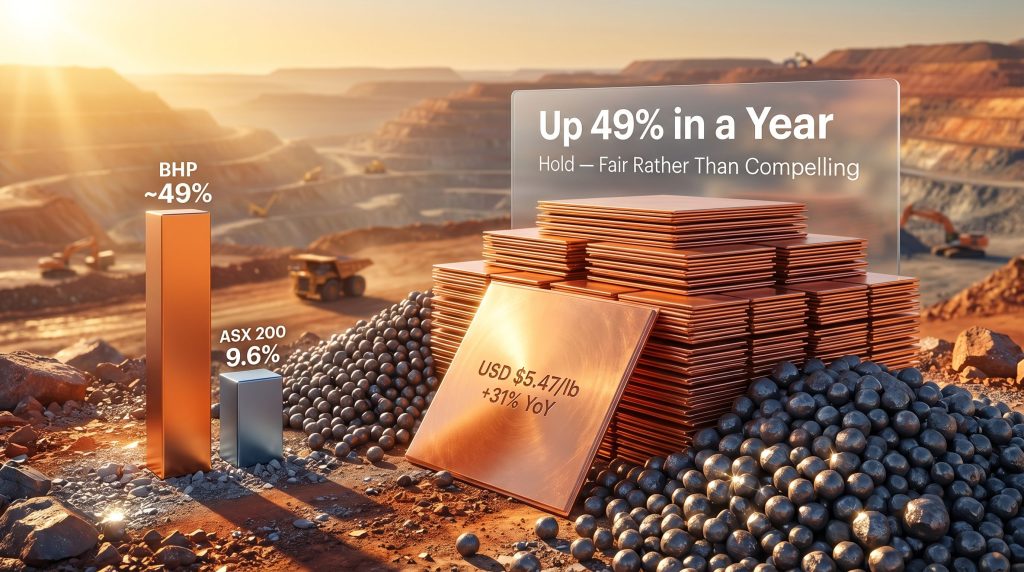
BHP Group Ltd (ASX: BHP) sits at an inflection point of a different kind. After delivering 49% total price appreciation over the 12 months to late April 2026, comfortably dwarfing the ASX 200's 9.6% gain over the same period, the question facing investors is no longer whether BHP has performed well. It is whether the stock still offers a compelling entry point for new capital, or whether the easy gains have already been captured.
The answer from the analyst community, across multiple exchanges and research houses, is consistent: the dominant BHP shares hold rating reflects a stock that has migrated from attractively priced to fairly valued. That is not a criticism of the business. It is a precise observation about what the current share price already embeds.
When big ASX news breaks, our subscribers know first
Understanding BHP's Commodity Portfolio and Why Diversification Matters
BHP's business is built across three primary commodity pillars: iron ore, copper, and potash. Each serves a different role in the portfolio and responds to different demand drivers.
-
Iron ore provides the near-term earnings engine. BHP's Western Australia Iron Ore (WAIO) operations are among the most capital-efficient iron ore production systems globally, and the nine months to March 2026 saw these integrated facilities achieve record output. Iron ore production reached 197 million tonnes, up 2% year-on-year.
-
Copper carries longer-duration structural demand from global electrification, electric vehicles, and renewable energy infrastructure. While copper production of 1.46 million tonnes for the nine-month period represented a 3% decline versus the prior corresponding period, the price environment more than compensated: BHP's average realised copper price surged 31% year-on-year to USD $5.47 per pound.
-
Potash, accessed through the Jansen project in Saskatchewan, Canada, represents the longest-duration optionality in the portfolio. Potash demand is driven by global agricultural productivity and food security, making it largely independent of industrial metals cycles.
This diversification creates what analysts describe as a natural hedge across economic phases. When iron ore demand softens due to Chinese property sector weakness, copper or potash can provide partial earnings support. When global growth accelerates, furthermore, all three can rise simultaneously.
Unlike single-commodity miners who must ride commodity cycles with no offsetting positions, BHP's blended exposure reduces the amplitude of earnings volatility across the cycle.
The Multi-Exchange Analyst Consensus: A Granular Breakdown
The BHP shares hold rating is not the view of a single broker or platform. It is a remarkably consistent signal across analyst communities covering BHP's multiple exchange listings simultaneously.
| Exchange / Platform | Analysts Covering | Consensus Rating | Average Price Target | Implied Direction |
|---|---|---|---|---|
| LON: BHP (London) | 4 analysts | Hold | GBX 2,462.50 | ~16% downside from GBX 2,980 close |
| NYSE: BHP (New York) | 9 analysts | Hold | ~USD $48.50 | ~13% downside from recent levels |
| NYSE: BHP (Benzinga) | 11 analysts | Hold / Market Perform | USD $52.60 | Range: $44 to $68 |
| NYSE: BHP (Barchart) | 19 analysts | Hold | 3.21/5 composite | Neutral |
| Investing.com | 15 analysts | Neutral | ~USD $43 | ~13% upside potential |
Several specific broker positions illustrate the nuances within this consensus:
-
Berenberg Bank reaffirmed its Hold rating on 23 April 2026, maintaining a GBX 2,500 price target on London-listed BHP shares.
-
JPMorgan raised its price target to GBX 2,600 while retaining a Neutral stance. This combination of target uplift without rating upgrade is particularly informative: it signals improving fundamentals without sufficient undervaluation to justify a Buy recommendation.
-
Bernstein assigned a Market Perform rating, consistent with the broader analyst community's cautious but not pessimistic positioning.
-
Morgans analyst Damien Nguyen characterised BHP as suited to investors seeking stability and income, while noting that its valuation looks fair rather than compelling given that commodity prices are reflecting mixed economic signals. This framing positions the Hold rating as a genuine neutral, not a soft downgrade.
An important technical note for investors reading analyst ratings: the terms Hold, Neutral, and Market Perform are functionally equivalent across most broker rating systems. All three indicate that analysts believe the stock is appropriately priced relative to fair value estimates, offering neither meaningful upside nor significant downside risk at current levels. For broader context, Goldman Sachs has similarly weighed in on comparative valuations across the major miners.
Why a 49% Return Paradoxically Creates a Less Attractive Entry Point
This seems counterintuitive on first encounter. How can a stock that has dramatically outperformed the market become less attractive as an investment? The answer lies in understanding how analyst price targets and fair value estimates function.
Analyst price targets are anchored to intrinsic value estimates derived from commodity price assumptions, production forecasts, operating cost projections, and discount rates. When BHP shares were trading 40% to 50% below these estimates, the margin of safety was large and the risk-reward was asymmetric in favour of buyers.
Today, after a 49% price appreciation, BHP's share price has converged toward those same intrinsic value estimates. The margin of safety has narrowed substantially. Investors entering at current prices are paying for BHP's asset quality and operational capability, not for a discount to fair value. According to BHP's consensus estimates, analyst expectations for the coming periods reflect this more measured outlook.
This dynamic explains a fundamental principle of commodity investing psychology: the best time to buy high-quality miners is often when their operational challenges are most visible, because that is when share prices embed excessive pessimism. Conversely, after strong operational performance and price appreciation, optimism becomes embedded in valuations.
The 49% gain over 12 months is not a reason to buy. For investors who already hold BHP, it represents crystallised value. For new capital, it represents the question of whether equivalent value creation lies ahead.
What the Copper Production Data Actually Signals
The 3% year-on-year decline in copper production to 1.46 million tonnes is worth examining more closely than the headline suggests. In large-scale copper mining operations, short-term production variability is common and can arise from multiple sources:
-
Planned maintenance shutdowns at major processing facilities, which temporarily reduce throughput but improve longer-term asset reliability.
-
Grade variability within ore bodies, where lower-grade ore sections produce less copper per tonne of rock processed, reducing output without reflecting operational problems.
-
Permitting or environmental compliance pauses in regions such as Chile or Peru, where BHP's South American copper operations are concentrated.
-
Weather-related disruptions affecting access to operations or energy supply.
The significance of distinguishing between these causes is material for forward production assessment. A production decline driven by planned maintenance is temporary and reverses naturally. A decline driven by grade depletion or permitting challenges, however, may persist and require capital investment to address.
BHP has not specified the precise cause breakdown for the 3% decline in the nine-month period. This ambiguity is one reason analyst caution persists: forward production sustainability cannot be fully assessed without understanding whether the volume shortfall is structural or cyclical. In addition, the broader copper supply crunch context across global markets adds further complexity to forward projections.
Meanwhile, the 31% surge in average realised copper price to USD $5.47 per pound demonstrates the price sensitivity of BHP's copper earnings. Copper's structural demand story from electrification is well understood in the market, but short-cycle price movements remain volatile.
BHP's Dividend Profile: What Fully Franked Really Means
BHP paid two fully franked dividends to eligible shareholders over the 12-month period to April 2026, with the stock carrying a 3.5% fully franked trailing dividend yield. For Australian investors unfamiliar with the mechanics, fully franked dividends carry significant tax advantages that enhance effective yield substantially.
The Australian dividend imputation system allows companies that have paid corporate tax at the standard rate to attach franking credits to dividends. Investors can then use these credits to offset their own tax liabilities.
| Investor Tax Rate | Nominal Yield | Estimated Gross Yield (Including Franking) |
|---|---|---|
| 30% corporate rate | 3.5% | ~5.0% |
| 45% marginal rate | 3.5% | ~6.4% |
| Superannuation fund (15% rate) | 3.5% | ~4.1% |
Note: Effective gross yields are estimates based on standard franking credit calculations. Individual tax outcomes vary depending on personal circumstances, and this information does not constitute financial advice.
For SMSF investors and retirees in pension phase, the franking credit advantage is particularly powerful. Superannuation funds in accumulation phase pay tax at 15%, meaning the 30% corporate tax already paid on BHP's earnings generates a refundable credit differential. For super funds in pension phase, where tax on earnings is effectively zero, franking credits can generate cash refunds from the Australian Taxation Office.
However, BHP's dividend sustainability is inherently tied to commodity earnings cycles. The company operates a minimum 50% payout ratio based on underlying attributable profit, which creates a structural floor but also means dividends fluctuate with earnings. Investors should model BHP's yield as cyclically variable rather than treating it as equivalent to the predictable income streams from utilities or infrastructure assets.
The next major ASX story will hit our subscribers first
The CEO Transition: Continuity or Strategic Pivot?
Leadership transitions at major resource companies routinely generate short-term share price sensitivity as markets assess the probability of strategic direction changes. BHP's transition is notable for its orderly structure and explicit continuity signals.
Outgoing CEO Mike Henry spent six and a half years leading BHP through a significant portfolio simplification strategy, which included exiting petroleum assets and sharpening focus on copper, iron ore, and potash. Henry confirmed that incoming CEO Brandon Craig, currently serving as President of the Americas division, will assume the role from 1 July 2026.
Henry indicated that Craig inherits a business operating from a position of strength, with reliable operations and a significant pipeline of copper and potash growth projects designed to deliver long-term value through the cycle. Notably, BHP's strategic pivot in recent years has meaningfully reshaped where the company's future earnings growth is expected to come from.
Craig's Americas background carries specific strategic relevance. BHP's largest copper growth assets are concentrated in South America, particularly in Chile and Peru. An Americas-experienced CEO brings direct familiarity with these dynamics at a time when copper growth execution is central to BHP's long-term investment thesis.
The orderly succession structure and explicit focus on copper and potash growth projects in the outgoing CEO's handover commentary suggests minimal near-term strategic disruption risk.
Risk Factors That Investors Must Incorporate Into Their Analysis
The Hold consensus reflects a balanced view of upside potential and downside risks. Understanding those risks in detail is essential for any investor evaluating BHP at current pricing.
Macro and Cyclical Risks
-
Chinese demand uncertainty remains the single largest swing factor for iron ore revenues, which continue to represent the dominant earnings contributor. Chinese steel output, property sector investment levels, and infrastructure stimulus cadence are the key leading indicators.
-
Global growth deceleration poses a secondary risk, particularly for copper demand from manufacturing and construction sectors outside China.
-
Currency exposure creates an embedded complexity: BHP earns predominantly in US dollars while a material portion of its operating costs are denominated in Australian dollars. AUD/USD movements affect reported margins in ways that are independent of operational performance.
Operational and Project Risks
-
The 3% copper production decline warrants continued monitoring. If this trend persists into full-year FY2026 results, it may trigger analyst downward revisions to production forecasts.
-
The Jansen potash project in Canada carries inherent large-scale capital project risks including construction cost overruns, commissioning delays, and market timing uncertainty for potash prices at the point of first production.
Geopolitical and ESG Risks
-
South American copper operations in Chile and Peru face ongoing sovereign risk exposure, including royalty regime renegotiations, community relations obligations, and water access constraints in arid operating environments.
-
Institutional investor ESG mandates continue to evolve, with potential implications for BHP's cost of capital and shareholder registry composition over time.
Comparing BHP Against Benchmark and Sector Peers
| Metric | BHP (ASX: BHP) | ASX 200 Index |
|---|---|---|
| 12-Month Price Return | ~49% | ~9.6% |
| Dividend Yield (Trailing) | 3.5% (fully franked) | ~4.0% (blended, partially franked) |
| Commodity Exposure | Diversified (Iron Ore, Copper, Potash) | Broad market |
| Analyst Consensus | Hold | N/A |
Relative to single-commodity peers, BHP's diversified model offers structural advantages in risk management. However, concentrated commodity bulls who want pure-play copper or iron ore exposure will find BHP's blended portfolio dilutes their thematic investment. For investors seeking to express a specific commodity view rather than broad resources sector exposure, more focused alternatives may better serve that objective.
BHP's scale also provides cost advantages through integrated logistics networks, shared infrastructure across the Pilbara, and purchasing power with major equipment suppliers. These structural efficiencies are difficult for smaller operators to replicate and contribute to the capital efficiency advantage at WAIO that underpins the business's earnings quality. Furthermore, this scale advantage is a key reason BHP as a decade hold remains a compelling thesis for long-term investors.
Three Scenarios for the Path Forward
| Scenario | Trigger Conditions | Likely Analyst Response |
|---|---|---|
| Bull Case | Chinese stimulus accelerates; copper holds above USD $5.50/lb; iron ore sustains above USD $100/tonne | Upgrades toward Buy; price targets revised higher |
| Base Case | Mixed commodity signals persist; China growth stabilises at moderate levels; in-line production delivery | Hold ratings maintained; targets range-bound |
| Bear Case | Chinese property sector deteriorates further; copper demand disappoints; global recession risk escalates | Downgrades toward Sell; dividend sustainability questioned |
For investors already holding BHP shares, the Hold consensus supports maintaining positions while monitoring these scenario triggers. For investors evaluating new entry, the current pricing environment demands careful consideration of whether commodity price assumptions embedded in current valuations are sustainable, or whether the strong realised copper price of USD $5.47 per pound represents a cyclical peak rather than a new baseline.
Who This Stock Actually Suits Right Now
The BHP shares hold rating is most instructive when matched against investor objectives rather than treated as a universal verdict.
Investors well-suited to holding BHP at current levels include:
-
Income-oriented investors seeking fully franked dividend income with resources sector exposure and the tax advantages of the franking credit system.
-
Long-term portfolio builders who want diversified commodity exposure across multiple demand cycles without concentrating risk in a single metal or market.
-
SMSF and superannuation investors who can maximise the value of franking credits within concessionally taxed structures.
-
Existing holders who have captured significant capital appreciation and are evaluating whether to maintain, trim, or add to their position.
Investors for whom BHP may not be the optimal choice at current pricing:
-
Growth-focused investors seeking high earnings growth rates. BHP's scale limits percentage growth achievable from its large base.
-
Short-horizon investors exposed to commodity price volatility over periods that may not allow for mean reversion.
-
Concentrated commodity bulls seeking pure-play thematic exposure to copper or iron ore rather than a blended portfolio approach.
For those weighing up the broader picture, a detailed assessment of BHP's stability and income potential offers additional context on whether the current price represents fair value for different types of investors.
This article contains general information only and does not constitute personal financial advice. Investors should consider their own financial circumstances and seek independent advice before making investment decisions. Past performance is not indicative of future returns, and commodity-linked investments carry significant cyclical risk. Price targets and analyst ratings referenced reflect publicly reported broker research as of April 2026 and are subject to change.
Want to Discover the Next Major ASX Resource Opportunity Before the Market Does?
While BHP offers stability and income at current valuations, the most significant wealth-creation moments in the resources sector often come from identifying transformative mineral discoveries at the earliest stage — and Discovery Alert's proprietary Discovery IQ model delivers real-time alerts the moment significant ASX discoveries are announced, turning complex data across 30+ commodities into immediately actionable insights. Explore historic discovery returns on Discovery Alert's dedicated discoveries page to see what early positioning in major finds has delivered, then begin a 14-day free trial to ensure new capital is never left waiting on the sidelines.