June 21, 2026
Critical Infrastructure Dependencies in Oil Production Systems
Global oil markets experienced significant supply tensions during January 2026 when Kazakhstan's production capacity fell by nearly half, highlighting the vulnerabilities inherent in centralised energy infrastructure. The Tengiz oil field restart became a critical focal point as markets watched the complex intersection of power generation failures, export terminal disruptions, and seasonal weather patterns create a cascade of supply chain disruptions that rippled through European crude markets. This incident reveals fundamental weaknesses in how landlocked oil producers manage operational risks across their entire value chain.
The complexity of modern oil field operations creates multiple single points of failure that can simultaneously affect production, processing, and export capabilities. When these systems experience concurrent failures, the results demonstrate how quickly regional supply dynamics can shift, affecting everything from benchmark pricing to long-term contract fulfilment obligations through tariff‑induced market impact.
When big ASX news breaks, our subscribers know first
Power Infrastructure Vulnerabilities at Kazakhstan's Largest Oil Producer
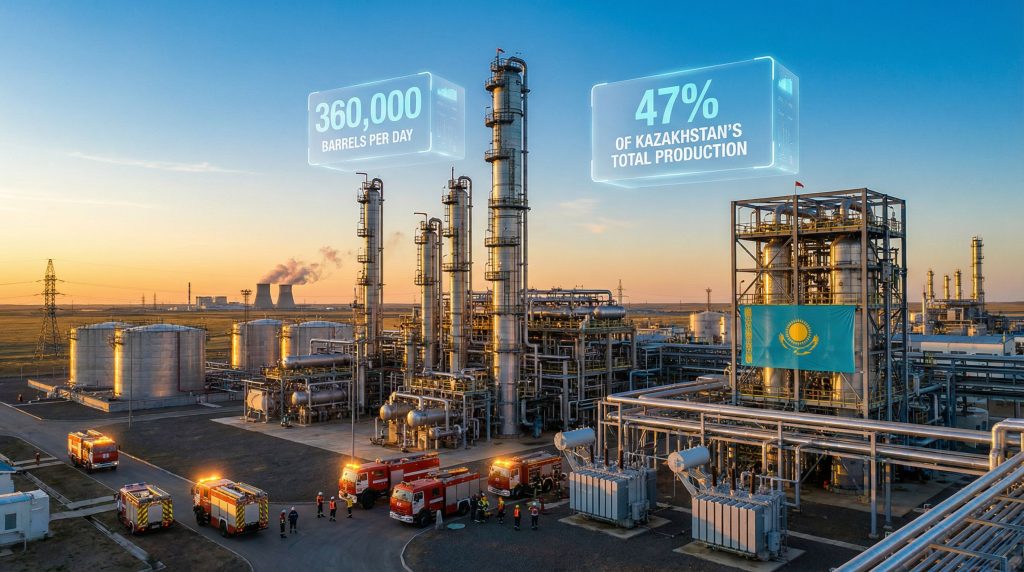
The GTES-4 power facility serves as the electrical backbone for one of the world's most significant oil production operations, supporting processing systems that handle 360,000 barrels per day of crude output. When transformer fires struck this critical infrastructure in January 2026, the incident exposed how mega-projects concentrate enormous production capacity within single power generation systems.
Oil field processing operations require continuous electrical supply for multiple critical functions:
- Separation systems that remove water and gas from crude oil
- Pumping stations that maintain pressure throughout the field
- Temperature control systems for crude handling and storage
- Safety instrumentation that cannot tolerate power interruptions
The dual transformer failures at GTES-4 triggered automated safety protocols that immediately halted all processing operations. This precautionary shutdown protected equipment worth billions of dollars but created an immediate supply gap equivalent to 47% of Kazakhstan's total oil production capacity. Furthermore, the power system vulnerabilities highlighted the interconnected nature of Central Asian energy infrastructure.
"Infrastructure Risk Assessment: The concentration of 360,000 barrels per day of production capacity within a single power generation facility represents a fundamental design vulnerability that affects global supply chains when failures occur."
Emergency Response and Safety Protocols
When power generation systems experience catastrophic failures, oil field operators must balance equipment protection against supply obligation requirements. The immediate shutdown decision at Tengiz reflected industry-standard practice where voltage instability poses risks to:
- Processing equipment damage from uncontrolled power fluctuations
- Environmental release incidents during system failures
- Personnel safety hazards from equipment operating under degraded conditions
The Kazakhstan Energy Ministry's oversight during the restoration process demonstrates regulatory coordination requirements for mega-project power system repairs. Ministry officials conducted independent safety verification before authorising production resumption, indicating institutional protocols for managing critical infrastructure failures.
Backup Power System Adequacy
The week-long production halt suggests that backup power systems at GTES-4 lacked sufficient capacity to maintain processing operations during primary system repairs. Industry analysis indicates that redundant power generation at remote oil facilities often prioritises safety systems over full production capacity maintenance.
Modern oil field power infrastructure typically includes:
- Primary generation systems for full production operations
- Secondary backup systems for critical safety equipment
- Emergency power supplies for controlled shutdown procedures
The simultaneous failure of dual transformers indicates potential cascading failure mechanisms that exceeded designed redundancy levels at the facility.
Timeline Analysis: From Crisis to Production Recovery
The Tengiz oil field restart process unfolded over eight days, from initial transformer fires on January 18, 2026, through full production authorisation on January 26. This timeline reveals the complexity of power system restoration at mega-scale oil production facilities.
Phase-by-Phase Recovery Process
Days 1-2 (January 18-19): Emergency response teams isolated damaged transformer units whilst conducting comprehensive damage assessment. The dual failure mechanism required investigation to prevent recurrence during restoration work.
Days 3-5 (January 20-22): Component replacement phase involved sourcing replacement transformers capable of handling the massive electrical loads required for 360,000 barrels per day of processing capacity. The logistics of transporting heavy electrical equipment to remote field locations typically extends restoration timelines.
Days 6-7 (January 23-24): System testing procedures included energising backup systems, conducting no-load electrical tests, and verifying voltage regulation stability under various load conditions.
Day 8 (January 26): Kazakhstan Energy Ministry conducted final safety verification protocols before authorising graduated production restart procedures.
| Recovery Phase | Duration | Key Activities | Critical Success Factors |
|---|---|---|---|
| Emergency Response | 24-48 hours | Damage isolation, safety securing | Preventing cascading failures |
| Component Replacement | 3-5 days | Transformer sourcing, installation | Equipment availability, logistics |
| System Testing | 2-3 days | Load testing, stability verification | Regulatory approval protocols |
| Production Restart | 1+ days | Graduated ramp-up, monitoring | Process safety management |
Market Forecast vs. Actual Recovery
JPMorgan analysts initially projected a month-long shutdown for the Tengiz facility, based on historical precedent for major power infrastructure failures at remote oil facilities. However, the actual eight-day restoration exceeded industry expectations, suggesting several factors accelerated the recovery process.
The faster-than-expected restoration timeline prevented more severe supply chain disruptions but still resulted in approximately 2.52 million barrels of lost production during the shutdown period. Consequently, this loss affected oil price stagnation factors across regional markets.
Pre-positioned equipment availability and contractor readiness played crucial roles in the accelerated timeline. Specialised electrical contractors capable of immediate mobilisation proved essential to the rapid response. Additionally, streamlined government approval processes for critical infrastructure repairs contributed to the efficient restoration process.
Kazakhstan's Role in OPEC+ Supply Coordination
Kazakhstan's position within OPEC+ creates strategic implications when production disruptions affect the country's 1.8 million barrels per day of typical output capacity. The January 2026 Tengiz shutdown reduced national production to 1.0-1.1 million barrels per day, representing a 39-44% production decline that immediately affected global supply dynamics.
European Market Impact Mechanisms
The supply disruption created measurable price support for European crude benchmarks through several market mechanisms. Supply concentration effects meant Kazakhstan supplies European refineries through limited pipeline infrastructure, making rapid substitution with alternative crude sources logistically challenging.
Contract obligation pressures between Kazakhstani producers and European refineries create immediate shortage conditions when production capacity disappears. Price discovery dynamics in European crude markets responded to the supply gap with benchmark price increases that reflected both immediate shortage conditions and uncertainty about restoration timelines. For instance, oil price rally dynamics demonstrated similar patterns during recent market disruptions.
The 700,000-800,000 barrels per day production shortfall, whilst representing less than 1% of global crude demand, concentrates within specific regional supply chains that serve European markets through established pipeline networks.
OPEC+ Quota Compliance Challenges
Production disruptions at mega-projects like Tengiz create immediate challenges for OPEC+ member states attempting to meet monthly production quotas. Kazakhstan's compliance with OPEC+ agreements depends heavily on consistent output from its largest production facilities.
The country's production allocation within OPEC+ structures reflects normal operational capacity rather than accounting for infrastructure failure scenarios. When single facilities represent 47% of national output, unexpected shutdowns require force majeure exemptions or quota adjustment discussions with other member states.
OPEC+ coordination mechanisms typically accommodate planned maintenance shutdowns through advance notification systems. Unplanned disruptions require force majeure reporting protocols, whilst market balancing adjustments by other member states address temporary shortfalls.
Export Infrastructure Bottlenecks and Compound Disruptions
Kazakhstan's oil export infrastructure demonstrates how geographic and political factors create vulnerability layers that compound production disruptions. The Caspian Pipeline Consortium (CPC) terminal handles 80% of Kazakhstan's crude exports, creating a critical bottleneck when multiple disruption factors align simultaneously.
CPC Terminal Operational Status
The export terminal's operational capacity depends on three offshore moorings that allow tanker loading operations. During the January 2026 period, concurrent disruptions affected terminal capacity across multiple infrastructure components.
The terminal operator's statement that two moorings guarantee fulfilment of annual shipping plans indicates designed redundancy levels that accommodate single mooring outages but struggle with simultaneous disruptions affecting two-thirds of loading capacity.
Military and Weather Risk Factors
The November 2026 drone attack attributed to Ukrainian forces demonstrates how regional military conflicts create infrastructure vulnerability for neutral energy suppliers. The attack's targeting of critical export infrastructure suggests strategic economic warfare extending beyond direct military participants.
Seasonal weather patterns in the Black Sea compound infrastructure vulnerabilities during December-January storm seasons. Multiple cargo loading operations experienced delays or cancellations due to weather conditions that prevent safe tanker operations at offshore moorings.
These combined factors created cargo backlogs estimated at 600,000-700,000 metric tons of delayed shipments, representing weeks of production accumulation that required resolution through normalised terminal operations. Subsequently, these delays contributed to global trade disruptions affecting broader market stability.
Alternative Export Route Analysis
Kazakhstan's limited export route diversification creates strategic dependency on the CPC terminal system. The Atyrau-Samara-Novorossiysk (ASN) Pipeline offers limited incremental capacity, primarily serving Russian refinery markets rather than European export terminals.
The Kazakhstan Pipeline System (KPS) provides domestic capacity for internal distribution and refinery supply, with minimal export capacity for international markets. The Tengizchevroil Pipeline connects Tengiz field production to CPC system, representing internal field gathering rather than export diversification.
The concentration of export infrastructure creates systemic risk where production disruptions combine with terminal capacity limitations to multiply supply chain impacts beyond the scale of individual facility outages.
Financial Impact Assessment and Market Recovery Dynamics
The eight-day production halt at Tengiz generated immediate financial consequences across multiple stakeholder categories, from operator revenue losses to market price volatility effects that influenced global crude trading patterns.
Revenue Impact Calculation Framework
Daily production of 360,000 barrels at current oil price levels translates to significant revenue exposure during shutdown periods. Assuming crude prices in the $75-85 per barrel range during January 2026, the daily revenue impact approached $27-30.6 million per day.
The eight-day total impact reached $216-245 million in gross revenue, whilst the monthly production shortfall approached approximately $600-680 million in January 2026 alone. These calculations reflect gross production value rather than net income impact, which depends on operational cost structures, insurance coverage, and force majeure provisions in supply contracts.
Insurance and Force Majeure Considerations
Major oil production facilities typically maintain comprehensive insurance coverage for operational interruptions, but policy terms vary significantly regarding covered event definitions. Whether power infrastructure failures qualify for business interruption coverage depends on specific policy language and causation requirements.
Waiting period provisions in insurance policies often include waiting periods before coverage begins, potentially excluding short-duration shutdowns like the eight-day Tengiz outage. Alternative cost coverage policies may cover additional expenses for expedited repairs or alternative supply arrangements to minimise business interruption duration.
Force majeure clauses in long-term supply contracts provide legal protection for operators experiencing infrastructure failures beyond their reasonable control, but may not compensate for market price impacts or customer relationship effects.
Investor Response and Market Sentiment
The Tengiz oil field restart announcement generated positive investor response across energy sector equities, particularly affecting companies with direct ownership stakes in the project. Chevron Corporation's 50% ownership stake reflected investor relief over faster-than-expected restoration timelines and avoidance of extended production losses.
ExxonMobil Corporation's 25% stake benefited from improved investor sentiment based on resolution of uncertainty regarding restoration complexity and timeline duration. KazMunayGas's 20% stake saw Kazakhstan's national oil company benefit from resolution of supply obligation concerns and restoration of export revenue streams.
Market psychology during infrastructure crisis events typically follows predictable patterns where uncertainty drives negative sentiment until restoration clarity emerges, followed by relief rallies when actual outcomes exceed worst-case scenarios.
The next major ASX story will hit our subscribers first
What Are the Infrastructure Resilience Lessons?
The Tengiz power system failure highlights broader industry trends toward infrastructure resilience planning that addresses single-point-of-failure vulnerabilities inherent in mega-project design approaches.
Redundancy Investment Economics
Power generation redundancy at remote oil facilities involves complex cost-benefit analyses that balance infrastructure investment against potential production loss exposure. Primary power systems require $50-100 million for mega-project electrical infrastructure, whilst backup generation capacity demands an additional 30-50% capital investment for full redundancy.
Maintenance and testing costs represent annual expenses for maintaining redundant systems. Modern risk management frameworks increasingly favour higher redundancy levels based on analysis of catastrophic loss potential versus incremental infrastructure investment requirements.
Predictive Maintenance Technology Integration
Advanced monitoring systems enable early detection of power infrastructure degradation before catastrophic failures occur. Thermal imaging monitoring provides continuous temperature monitoring of transformer units to identify developing problems before fire risk emergence.
Vibration analysis systems detect mechanical stress indicators in power generation equipment that precede major failures. Predictive analytics platforms utilise machine learning algorithms that analyse historical performance data to forecast maintenance requirements and failure probability windows.
These technologies represent industry evolution toward preventing infrastructure failures rather than simply responding to emergency situations after they develop.
Supply Chain Diversification Strategies
Kazakhstan's export infrastructure concentration demonstrates risks that other landlocked oil producers actively address through diversification investments. Pipeline route multiplication involves development of alternative export pathways that reduce dependence on single terminal systems.
Storage capacity expansion through strategic petroleum storage facilities provides buffer capacity during temporary export disruptions. Contract flexibility mechanisms include supply agreement terms that accommodate force majeure events through alternative delivery arrangements or timing adjustments.
Regional energy security planning increasingly incorporates infrastructure interdependency analysis that identifies systemic vulnerabilities across entire supply chains rather than focusing on individual facility resilience alone.
Operational Excellence Lessons and Industry Best Practices
The successful eight-day restoration at Tengiz provides insights into operational excellence frameworks that minimise recovery time whilst maintaining safety standards during critical infrastructure repairs.
How Did the Restoration Methodology Work?
The systematic approach to power system restoration demonstrates industry best practices for managing complex infrastructure recovery projects. Phase 1 immediate response (0-24 hours) involves damage isolation protocols to prevent cascading failures, personnel safety verification and evacuation procedures, and emergency power activation for critical safety systems.
Phase 2 assessment and planning (24-72 hours) includes root cause analysis to understand failure mechanisms, resource mobilisation for specialised repair contractors, and regulatory notification and coordination with government oversight.
Phase 3 component replacement (3-6 days) encompasses equipment procurement and transportation logistics, installation procedures following manufacturer specifications, and initial testing protocols under controlled conditions.
Phase 4 system verification (6-8 days) covers load testing sequences to verify capacity and stability, safety system validation through comprehensive inspections, and regulatory approval processes before production authorisation.
This structured approach enables systematic progress tracking whilst ensuring that safety requirements receive appropriate attention during time-sensitive restoration work.
Government Coordination Excellence
The Kazakhstan Energy Ministry's oversight role demonstrates effective coordination between private operators and regulatory authorities during critical infrastructure events. Real-time monitoring requirements meant government officials maintained continuous oversight throughout the restoration process, ensuring compliance with safety regulations.
Technical verification protocols included independent assessment of power system integrity before authorising production resumption, preventing premature restart decisions based solely on commercial pressure. Public communication coordination provided unified messaging between operator and government sources, offering market clarity about restoration progress and timeline expectations.
This coordination model serves as a template for other jurisdictions managing critical energy infrastructure within their regulatory frameworks.
Strategic Implications for Central Asian Energy Security
The Tengiz incident illuminates broader strategic vulnerabilities affecting Central Asian energy producers who depend on limited export infrastructure to reach global markets. These vulnerabilities create regional security considerations that extend beyond individual project operations and connect to broader OPEC global oil markets dynamics.
Regional Infrastructure Interdependence
Central Asian oil producers face common challenges related to geographic isolation and limited export route diversity. Pipeline capacity constraints force competition among regional producers for export access during peak production periods.
Transit country dependencies create export routes that traverse multiple national jurisdictions, creating political risk factors that affect supply chain reliability. Terminal capacity bottlenecks at export destinations create scheduling constraints that compound production disruptions.
These regional factors suggest that individual country energy security depends heavily on collective infrastructure development and political cooperation among transit corridor participants.
Technology Transfer and Operational Excellence
The Tengiz oil field restart demonstrates how international joint venture structures facilitate technology transfer and operational excellence across emerging oil producing regions. International expertise integration through joint ventures between local operators and global energy companies brings advanced operational practices to regional mega-projects.
Technology sharing mechanisms within partnership structures enable transfer of advanced monitoring, maintenance, and emergency response technologies. Best practice dissemination allows successful operational frameworks developed at individual projects to become models for industry-wide adoption across regional producers.
This technology transfer dynamic contributes to overall improvement in regional energy infrastructure reliability and operational performance standards.
Future Investment Priorities
The infrastructure vulnerabilities revealed by the Tengiz shutdown suggest investment priorities for strengthening Central Asian energy security. Redundant power generation systems require investment in backup power infrastructure that maintains full production capacity during primary system failures.
Export route diversification involves development of alternative pipeline routes and terminal facilities that reduce dependence on single export pathways. Regional cooperation frameworks need political and commercial agreements that facilitate mutual support during infrastructure disruption events.
Enhanced emergency response capabilities require contractor networks and equipment stockpiles that accelerate restoration timelines for critical infrastructure failures. These investment areas represent strategic priorities for both individual operators and regional governments seeking to enhance energy security through infrastructure resilience improvements.
The successful eight-day Tengiz oil field restart demonstrates that whilst infrastructure vulnerabilities remain significant challenges for mega-scale energy projects, coordinated emergency response and systematic restoration approaches can minimise market disruption duration. However, the incident underscores the critical importance of redundancy planning and diversified export infrastructure for maintaining energy security in geopolitically complex regions.
According to Reuters reporting on the incident, the coordinated response between international operators and local authorities proved crucial to the rapid restoration timeline. Additionally, Bloomberg's analysis highlighted how the incident influenced broader Central Asian energy security planning.
The lessons learned from this infrastructure crisis will likely influence future investment decisions across the region's energy sector, emphasising resilience over cost optimisation in critical infrastructure design.
Disclaimer: This analysis is based on publicly available information and industry assessments. Readers should conduct independent research and consult qualified professionals before making investment or business decisions related to energy sector operations. Production figures, financial estimates, and timeline projections are subject to change based on operational developments and market conditions.
Ready to Invest in the Next Major Energy Discovery?
Discovery Alert instantly alerts investors to significant ASX mineral discoveries using its proprietary Discovery IQ model, turning complex exploration data into actionable insights just like the infrastructure vulnerabilities highlighted in Kazakhstan's oil sector reveal investment opportunities across global energy markets. Understand why major mineral discoveries can lead to substantial returns by exploring Discovery Alert's dedicated discoveries page, and begin your 30-day free trial today to position yourself ahead of the market.