
May 20, 2026
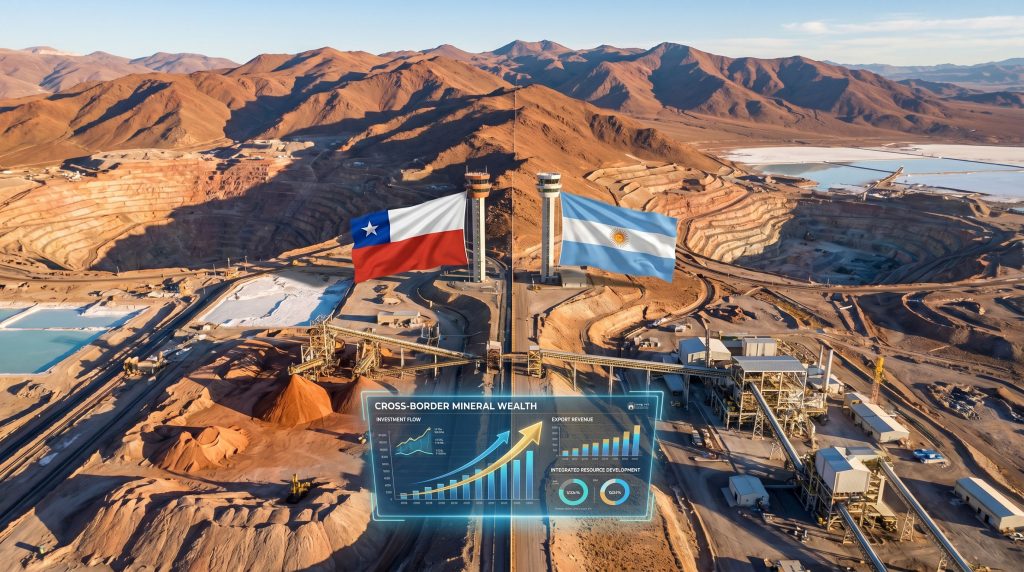
What Makes Cross-Border Resource Development Essential for Modern Mining?
Modern mining operations increasingly transcend traditional geographical boundaries, driven by geological realities that ignore political borders and economic imperatives that demand unprecedented scale. The evolution toward integrated resource districts reflects fundamental shifts in how mineral extraction creates value, manages risk, and serves global expansion strategies.
The Economics of Transnational Geological Formations
Mineral deposits rarely conform to national boundaries. The Puna plateau spanning Chile and Argentina contains extensive lithium, copper, and potassium formations that extend across both territories, creating natural economic zones that require coordinated development strategies. According to the U.S. Geological Survey's 2025 Critical Mineral Resources assessment, approximately 15-20% of major mineral deposits in South America span international borders, yet only 8% operate under formal bilateral frameworks.
Traditional approaches treating each side of a border as separate mining districts generate significant inefficiencies. Research from the Natural Resource Governance Institute indicates that shared infrastructure can reduce extraction costs by 15-30% compared to parallel, independent operations. These savings emerge from:
- Port access optimisation: Consolidated throughput reducing per-unit handling costs by 18-25%
- Processing facility economies: Larger scale operations justifying advanced technology investments
- Coordinated logistics networks: Reducing transportation redundancies and improving shipping efficiency
- Environmental compliance coordination: Eliminating duplicative assessment processes
Strategic Resource Security in Global Supply Networks
Supply chain vulnerabilities have intensified dramatically since 2015, with the USGS documenting a 23% increase in critical mineral supply disruptions. Geographical concentration of production creates systemic risks that integrated cross-border development can help mitigate. When mining operations span multiple jurisdictions, they benefit from:
- Regulatory diversification: Reducing exposure to single-country policy changes
- Infrastructure redundancy: Multiple export routes and processing options
- Political risk distribution: Shared sovereignty reducing nationalisation threats
- Market access optimisation: Leveraging different countries' trade relationships
Furthermore, the World Bank reports that mining sector foreign direct investment averaged $10-15 billion annually across Latin America during 2015-2020, with significant volatility tied to regulatory uncertainty. Cross-border frameworks can provide stability that attracts long-term capital investment.
When big ASX news breaks, our subscribers know first
How Do International Mining Cooperation Frameworks Function?
Bilateral mining treaties create legal architecture enabling transnational resource extraction while protecting national sovereignty. The Treaty between Chile and Argentina on Mining Integration and Complementation, established in the late 1990s, exemplifies how countries attempt to balance economic cooperation with territorial control.
Legal Architecture for Transnational Operations
Successful cross-border mining frameworks typically incorporate several key elements that differentiate them from standard bilateral investment treaties. These frameworks address specific challenges related to mining permitting insights and regulatory coordination:
| Framework Component | Chile-Argentina Model | Australia-PNG Arrangement | Canada-US Coordination |
|---|---|---|---|
| Investment Protection | Standard BIT provisions with mining-specific guarantees | Resource security clauses, revenue sharing protocols | Mutual recognition of environmental standards |
| Dispute Resolution | UNCITRAL arbitration with diplomatic fallback | Joint technical committees, ISDS mechanisms | International Joint Commission authority |
| Environmental Coordination | General protocols, site-specific assessments | Cumulative impact frameworks, joint monitoring | Transboundary water protection mandates |
| Permit Harmonisation | Case-by-case negotiation | Streamlined approval timelines | Single-window processing for qualifying projects |
The Australia-PNG framework, established through various agreements since 1989, demonstrates both opportunities and challenges. Consequently, the Porgera mine operated successfully under bilateral coordination until environmental concerns led to suspension in 2020, highlighting how environmental compliance coordination remains a critical success factor.
Investment Protection and Risk Mitigation Mechanisms
Modern mining projects require capital commitments spanning 15-25 years, making regulatory certainty essential for investment decisions. International bilateral investment treaties typically include investor-state dispute settlement clauses, national treatment guarantees, and fair and equitable treatment standards. However, mining-specific bilateral treaties often add provisions addressing:
- Resource security guarantees: Protecting extraction rights from unilateral policy changes
- Sovereign wealth protections: Ensuring host countries retain appropriate resource rents
- Technology transfer requirements: Balancing foreign investment with local capacity building
- Environmental liability allocation: Defining responsibility across jurisdictions
Why Modern Integrated Districts Challenge Traditional Treaty Frameworks
The Treaty between Chile and Argentina on Mining Integration and Complementation was designed during an era when mining operations followed isolated, single-commodity models. Contemporary projects increasingly operate as integrated districts combining multiple deposits, shared infrastructure, and coordinated development phases across both sides of the Andes.
Evolution from Single Mines to Integrated Districts
Three projects exemplify this transformation in Chilean-Argentine border regions. The Vicuña project integrates multiple ore bodies with shared infrastructure across the cordillera, representing a shift from traditional isolated operations to district-scale development. Similarly, Los Azules and Lunahuasi projects demonstrate how modern mining transcends single-site frameworks.
This evolution reflects broader industry evolution trends documented by the International Council on Mining and Metals. Mining operational models have shifted dramatically:
| Period | Operational Model | Key Characteristics | Regulatory Approach |
|---|---|---|---|
| 1980s-1990s | Isolated single mines | Independent operations, single commodity focus | Project-by-project permitting |
| 2000s-2010s | Company portfolio clusters | Multiple adjacent deposits, shared services | Portfolio planning, individual permits |
| 2010s-Present | Integrated mining districts | Multi-operator coordination, strategic infrastructure | District-level frameworks required |
Capital Efficiency Requirements
McKinsey & Company research indicates that integrated mining operations generate substantial capital efficiency gains through shared infrastructure:
- 20-35% reduction in infrastructure development costs through shared facilities
- 15-25% improvement in logistics efficiency via coordinated transportation networks
- 10-20% operational uptime gains through shared technical expertise and resource pooling
These efficiency requirements create pressure for regulatory frameworks that can accommodate district-scale planning rather than project-by-project approvals. In addition, Chile's mining ministry has identified a US$100 billion project pipeline requiring permit acceleration, much of which involves cross-border coordination challenges.
What Economic Impact Do Cross-Border Mining Districts Generate?
Integrated mining districts create economic effects that extend far beyond individual project boundaries. The Economic Commission for Latin America and the Caribbean reports that mining contributes 5-10% of GDP in mineral-rich regions, with cross-border projects generating additional multiplier effects through enhanced scale and coordination.
Regional Development and Employment Creation
Mining employment generates significant multiplier effects across border regions:
- Direct employment ratio: 1 mining job creates 3-5 indirect positions
- Service sector expansion: Mining districts attract specialised services, equipment suppliers, and logistics providers
- Infrastructure development: Shared facilities enable broader regional connectivity improvements
- Technology spillovers: Advanced mining operations transfer skills to local workforces
Chile's northern mining clusters demonstrate these dynamics in practice. The Atacama and Antofagasta regions, where multiple copper mines share port infrastructure, generate approximately 25,000 direct mining jobs plus 75,000-100,000 indirect positions according to Chilean Mining Council data.
Trade and Export Optimisation
Cross-border mining integration can significantly optimise export flows and reduce logistics costs:
- Port throughput consolidation: Antofagasta port handles 15-18 million tons annually of mining exports, reducing per-ton costs by approximately 20% versus individual port development
- Shipping schedule optimisation: Fuller vessels and reduced idle time cutting logistics costs by 12-18%
- Inventory management: Shared warehousing and coordination reducing working capital requirements by 8-15%
Argentina's lithium triangle spanning Jujuy, Salta, and Catamarca provinces illustrates rapid economic transformation potential. Provincial government revenues in resource-rich areas increased 300% year-over-year between 2021-2024, while direct mining employment reached approximately 5,000 positions supporting 15,000-20,000 indirect jobs across the region.
Which Institutional Reforms Could Unlock Cross-Border Potential?
Current permitting frameworks create significant bottlenecks for integrated district development. Industry analysis indicates that Chilean mining permit approvals average 24-36 months for major projects, while Argentine provincial coordination requirements extend timelines to 36-48 months. However, international benchmarks suggest streamlined processes should achieve 18-24 month approvals.
Single-Window Clearance Systems
Successful international examples demonstrate potential for streamlined coordination. For instance, examining cross-border mining frameworks reveals best practices that could be implemented:
- Indonesia's Online Single Submission system: Reduced mining permit processing time by 40% through digital integration
- Canada's Major Projects Management Office: Coordinates federal departments to achieve predictable timelines
- Australia's Northern Australia Infrastructure Facility: Provides single-point coordination for cross-jurisdictional projects
Proposed Binational Coordination Mechanisms
Industry experts identify several institutional reforms that could enhance cross-border mining development under the Treaty between Chile and Argentina on Mining Integration and Complementation:
- Binational mining development authority: Joint institution with technical expertise and coordination mandate
- Integrated permitting platforms: Digital systems enabling simultaneous processing across jurisdictions
- Standardised environmental protocols: Harmonised assessment frameworks reducing duplication
- Joint infrastructure planning: Coordinated development of ports, transportation, and processing facilities
- Unified dispute resolution: Streamlined arbitration processes for technical and commercial issues
How Do Asymmetric Regulatory Systems Impact Development?
Chile operates a centralised mining governance model with national-level decision-making authority, while Argentina's federal system grants significant autonomy to provinces. This fundamental asymmetry creates coordination challenges for cross-border projects that must navigate different institutional architectures, particularly when establishing a mining claims framework.
Centralised versus Federal Governance Models
The institutional differences between Chilean and Argentine mining governance create specific challenges:
Chilean Centralised Model:
- National mining ministry holds primary authority
- Standardised environmental assessment processes
- Predictable regulatory timelines
- Limited provincial variation in requirements
Argentine Federal Model:
- Provincial governments control mining development
- Variable environmental standards across provinces
- Multiple approval authorities requiring coordination
- Significant provincial autonomy in taxation and regulation
Harmonisation Strategies Without Sovereignty Compromise
International experience suggests several approaches for managing regulatory asymmetries. For instance, the Argentina-Chile Mining Integration Treaty provides specific guidance on managing these challenges:
- Mutual recognition protocols: Accepting equivalent standards rather than requiring identical processes
- Joint technical committees: Shared expertise development and best practice coordination
- Standardised information requirements: Common data formats and assessment criteria
- Coordinated approval sequencing: Synchronised timeline management across jurisdictions
The Canada-US framework provides relevant precedents through the International Joint Commission, which has authority to review projects affecting shared water resources while respecting national sovereignty.
The next major ASX story will hit our subscribers first
What Does the Future Hold for South American Mining Integration?
Technological advances create new opportunities for cross-border coordination that were unavailable when the current Treaty between Chile and Argentina on Mining Integration and Complementation was established in the late 1990s. Furthermore, global demand for critical minerals supply continues to drive integration needs.
Technology-Driven Integration Opportunities
Digital platforms enable coordination mechanisms that can address traditional barriers:
- Integrated permitting systems: Cloud-based platforms allowing real-time coordination between Chilean and Argentine authorities
- Environmental monitoring networks: Satellite-based systems providing continuous compliance verification across borders
- Supply chain optimisation: Advanced analytics coordinating extraction, processing, and export flows
- Shared technical expertise: Virtual collaboration platforms enabling binational engineering and geological teams
Strategic Scenarios for Regional Development
Three potential development pathways emerge for South American mining integration:
Scenario A: Enhanced Bilateral Integration
- Modernised treaty frameworks with streamlined approval mechanisms
- Binational institutions with technical authority and coordination mandates
- Integrated infrastructure development reducing per-project costs by 25-30%
- Timeline certainty attracting increased foreign investment
Scenario B: Status Quo Project-by-Project Approach
- Continued case-by-case negotiations under existing frameworks
- Regulatory uncertainty limiting large-scale investment commitments
- Suboptimal infrastructure development with higher per-unit costs
- Missed opportunities for regional economic integration
Scenario C: Expanded Regional Cooperation
- Multilateral frameworks incorporating Bolivia, Peru, and other Andean nations
- Regional infrastructure corridors optimising logistics across multiple countries
- Coordinated critical mineral development serving global supply chains
- Enhanced bargaining power in international commodity markets
Global Context and Competitive Positioning
South America's role in critical mineral supply chains faces increasing competition from other resource-rich regions. The U.S. recently committed $2.8 billion to secure rare earth supplies from Brazil's Serra Verde project, demonstrating how strategic mineral access drives international investment decisions.
Regional integration through enhanced bilateral frameworks could strengthen South America's competitive position by:
- Improving operational efficiency: Lower costs and higher reliability compared to geographically dispersed alternatives
- Enhancing supply chain resilience: Multiple export routes and processing options reducing single-point failure risks
- Attracting strategic investment: Long-term capital commitments requiring regulatory certainty and operational coordination
- Supporting energy transition: Critical mineral production essential for renewable energy and electrification technologies
Balancing Economic Integration with National Sovereignty
The modernisation of cross-border mining frameworks requires carefully balancing economic efficiency gains with legitimate sovereignty concerns. The Treaty between Chile and Argentina on Mining Integration and Complementation provides a foundation, but contemporary mining operations demand institutional evolution.
Implementation Priorities for Enhanced Cooperation
| Priority Area | Current Challenge | Proposed Solution | Expected Timeline |
|---|---|---|---|
| Permit Coordination | 36-48 month approval timelines | Binational single-window system | 18-24 month target |
| Environmental Assessment | Duplicative review processes | Harmonised protocols with joint monitoring | Mutual recognition framework |
| Infrastructure Planning | Ad-hoc project-by-project development | Strategic district-level coordination | Integrated 10-year development plans |
| Dispute Resolution | Lengthy diplomatic negotiations | Technical arbitration with defined timelines | 12-month maximum resolution periods |
Long-term Strategic Implications
Enhanced cross-border mining integration offers significant benefits for regional development, but success requires institutional innovation that respects national sovereignty while enabling operational efficiency. The experience of other international mining cooperation frameworks suggests that gradual, technically-focused improvements can build trust and demonstrate value before advancing to more ambitious coordination mechanisms.
The economic stakes are substantial. With global demand for critical minerals projected to increase 3-4 times by 2030 according to International Energy Agency projections, regions that can efficiently develop and export these resources will capture significant economic advantages. South American countries have geological endowments that position them advantageously in global supply chains, but realising this potential requires institutional frameworks that enable rather than constrain integrated development.
Disclaimer: This analysis is based on publicly available information and industry research. Mining investments involve significant risks, and prospective investors should conduct thorough due diligence and consult qualified professionals before making investment decisions. Regulatory frameworks and bilateral agreements are subject to change, and past performance does not guarantee future results.
Looking to Capitalise on Cross-Border Mining Opportunities?
Discovery Alert's proprietary Discovery IQ model delivers instant notifications on significant ASX mineral discoveries, helping investors identify actionable opportunities in the rapidly evolving mining sector before the broader market responds. Explore how major mineral discoveries generate substantial returns and begin your 14-day free trial today to position yourself ahead of cross-border mining developments and emerging opportunities.