August 12, 2026
Geographic Advantages and Trading Infrastructure Convergence
The global commodity landscape operates within a complex web of production centers, consumption markets, and strategic trade corridors that shape international economic flows. Understanding these patterns reveals why certain financial centres emerge as dominant hubs for commodity trading, whilst others struggle to gain meaningful market share despite substantial government investment and policy support.
Asia-Pacific region processes approximately 60% of global industrial metals production, creating massive trade flows that require sophisticated financial intermediation, risk management, and settlement systems. This concentration of production capacity, combined with rapidly growing consumption markets across Southeast Asia and the Middle East, generates opportunities for trading centres positioned along key shipping routes and equipped with appropriate regulatory frameworks.
The Hong Kong commodities market ecosystem represents a unique convergence of established financial infrastructure and emerging physical market capabilities. Its position between mainland production facilities and regional consumption centres creates natural advantages for developing comprehensive commodity trading operations that integrate both financial and physical market functions.
When big ASX news breaks, our subscribers know first
Strategic Location Benefits Within Global Supply Networks
Proximity to Production and Consumption Centres
Hong Kong's geographic positioning offers direct access to China's massive industrial metals production capacity, which dominates global output across multiple categories. Steel production reaches approximately 1.1 billion tonnes annually from Chinese facilities, whilst copper and aluminium processing capacities represent similar proportional shares of worldwide production.
Physical proximity to these production centres reduces transportation costs and delivery timeframes for commodity trading giants operating from Hong Kong. This advantage becomes particularly significant when managing just-in-time inventory requirements or responding to rapid price movements that require immediate physical delivery capabilities.
Legal Framework and Contract Enforcement Mechanisms
The common law legal system provides international contract certainty that many commodity traders require for large-scale transactions. This framework supports complex derivative structures, warehouse receipt financing, and multi-party trading arrangements that form the backbone of modern commodity markets.
Contract enforcement mechanisms in Hong Kong align with international standards familiar to global commodity trading houses, reducing legal risk premiums and enabling more competitive pricing structures. The "One Country, Two Systems" framework maintains these legal advantages whilst providing unique access to mainland Chinese markets through various cross-border arrangements.
Industrial Metal Market Dynamics and Scale Analysis
Steel Market Structure and Trade Flow Patterns
Global steel markets represent approximately $1.47 trillion in annual transaction value, making them one of the largest commodity segments worldwide. Furthermore, the supply chain structure involves iron ore imports primarily from Australia and Brazil, which undergo processing in Chinese facilities before distribution to regional markets.
Key trade flow patterns include:
- Iron ore imports: 1.1 billion tonnes annually into China
- Finished steel exports: 90-100 million tonnes to ASEAN countries
- Regional consumption growth: 4-6% annually across Southeast Asia
- Price volatility: Daily fluctuations of 2-5% common during market stress periods
The scale of steel trading creates opportunities for financial intermediation, risk management products, and specialised financing arrangements that can generate substantial revenue streams for commodity trading centres.
Copper and Aluminium Value Chain Analysis
Copper markets demonstrate different supply chain characteristics, with concentrate imports from South American and African sources feeding into Chinese processing facilities. However, unlike steel, approximately 70% of processed copper serves domestic Chinese consumption, limiting export-oriented trading opportunities.
| Metal | Market Size | Chinese Production Share | Export Percentage |
|---|---|---|---|
| Steel | $1.47 trillion | 55% | 8-10% |
| Copper | $300 billion | 45% | 15-20% |
| Aluminium | $200+ billion | 60% | 12-15% |
Aluminium value chains present unique opportunities due to energy-intensive smelting processes that concentrate production in regions with competitive electricity costs. Chinese aluminium production benefits from domestic coal resources, whilst creating export opportunities to energy-importing regions across Asia-Pacific markets.
Physical Infrastructure Development Requirements
Warehouse and Storage Capacity Expansion
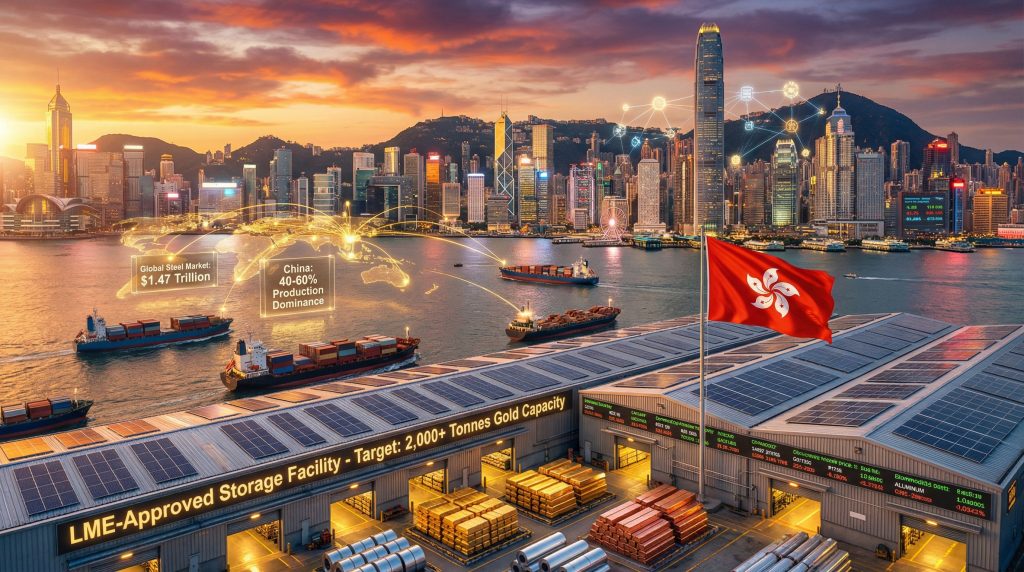
Current warehouse capacity in Hong Kong remains limited compared to established commodity hubs like Singapore or Rotterdam. LME-approved warehouse facilities in Yuen Long are scheduled for operational status by mid-2025, representing the first significant expansion of commodity storage infrastructure in over a decade.
Storage capacity targets include:
- Gold storage: 2,000+ tonnes within three years
- Base metals capacity: 500,000 tonnes across aluminium, copper, nickel
- Specialised facilities: Temperature-controlled storage for sensitive commodities
- Security systems: Enhanced protocols for precious metals handling
The development of adequate storage facilities requires substantial capital investment, with construction costs typically ranging from $200-400 per tonne of capacity depending on commodity specifications and security requirements. In addition, these investments must align with Hong Kong's gold trading centre development initiatives to maximise infrastructure utilisation.
Digital Trading Platform Integration
Modern commodity trading increasingly relies on digital platforms that operate continuously across global time zones. Implementation of blockchain technology and smart contract systems can reduce settlement times from days to hours whilst improving transparency and reducing counterparty risk.
24/7 trading capabilities become essential as Asian markets seek to capture trading volume during European and American business hours. Fractional ownership models enabled by digital platforms can expand market participation beyond traditional institutional traders to include smaller investors and regional commodity consumers.
Government Policy Framework and Market Development
Strategic Committee Formation and Coordination
The establishment of a Commodity Strategy Committee under Financial Secretary leadership represents a coordinated approach to market development that integrates multiple government departments and regulatory bodies. This structure aims to streamline approval processes and eliminate regulatory conflicts that can hinder market growth.
Integration priorities focus on four core areas:
- Trading system development: Harmonising regulations across cash and derivative markets
- Storage facility licensing: Streamlining approvals for warehouse construction and operation
- Shipping and logistics: Coordinating port facilities with commodity storage requirements
- Risk management frameworks: Developing appropriate oversight for commodity trading operations
Gold Trading Centre as Foundation Infrastructure
Government-backed gold trading initiatives serve as a foundation for broader commodity market development. The Shanghai Gold Exchange connectivity provides direct access to the world's largest physical gold market whilst maintaining Hong Kong's role as an international financial centre.
Gold trading volumes in Hong Kong currently average 15-20 tonnes daily, significantly below Singapore's 50+ tonnes or London's 150+ tonnes. Expanding this capacity requires both physical infrastructure development and regulatory framework enhancements that support institutional participation. Consequently, understanding gold market relationships becomes crucial for developing comprehensive trading strategies.
Trade Finance and Settlement System Evolution
Multi-Currency Settlement Infrastructure
RMB internationalisation through commodity trading represents a strategic opportunity to expand the currency's global usage whilst supporting Chinese commodity imports and exports. Current RMB settlement volumes for commodity trades remain below 15% of total transaction value, indicating substantial growth potential.
Structured credit facilities supporting Belt and Road Initiative projects create demand for commodity financing that can be channelled through Hong Kong financial institutions. These arrangements typically involve:
- Supplier financing: 180-360 day credit terms for commodity exports
- Buyer credit facilities: Import financing for infrastructure projects
- Documentary credit: Letters of credit supporting international commodity trades
- Hedging products: Currency and price risk management for multi-year contracts
Risk Management and Derivatives Development
Limited-volume futures contracts in gold, silver, and iron ore provide the foundation for expanding derivative product offerings. Exchange-traded funds (ETFs) enable retail investor access to commodity markets whilst creating additional liquidity for underlying physical markets.
Institutional hedging products require sophisticated risk management capabilities that can handle the volatility characteristics of commodity markets. Daily price movements of 3-8% are common during periods of supply disruption or macroeconomic uncertainty, requiring robust margin systems and position monitoring. For investors seeking exposure to commodity markets, our comprehensive ETCs investment guide provides detailed analysis of available instruments.
The next major ASX story will hit our subscribers first
High-Growth Market Segments and Opportunity Assessment
Renewable Energy Metals Focus
Global decarbonisation trends create structural demand growth for lithium, cobalt, rare earth elements, and other critical minerals used in renewable energy systems. Electric vehicle battery demand alone is projected to increase lithium consumption by 400-600% through 2030.
Green finance integration opportunities include:
- ESG-compliant sourcing: Verification systems for environmentally responsible mining
- Carbon credit trading: Integration with commodity transactions
- Sustainable development financing: Linking renewable energy project finance with critical mineral supply
- Impact investment products: Retail investment vehicles focused on clean energy metals
Traditional Base Metals Optimisation
Iron ore trading volumes represent the largest opportunity for near-term growth, with 1.5-2 billion tonnes traded globally each year. Hong Kong's position along major shipping routes from Australia and Brazil to Chinese ports creates natural advantages for developing iron ore trading operations.
Coal and liquefied natural gas (LNG) markets present opportunities despite storage limitations, as these commodities often trade on a delivered basis that reduces physical storage requirements. LNG spot market volumes have grown 40% annually across Asia-Pacific regions, driven by energy security concerns and natural gas transition policies. However, mining industry trends suggest evolving priorities towards sustainable extraction methods.
Regional Competition and Differentiation Strategies
Singapore's Commodity Trading Hub Analysis
Singapore currently processes approximately 35-40 million tonnes of commodity trading volume annually, supported by extensive storage facilities and established trading house operations. Key competitive advantages include:
- Storage capacity: 2.5 million tonnes across multiple commodities
- Trading house presence: 15+ major international commodity traders
- Shipping infrastructure: Direct access to global shipping routes
- Regulatory framework: Streamlined licensing and operational procedures
Hong Kong's differentiation strategy focuses on Chinese market access and RMB settlement capabilities that Singapore cannot fully replicate due to different political and economic relationships with mainland China.
Shanghai and Shenzhen Market Integration
Coordination with Shanghai Futures Exchange (SHFE) and other mainland commodity exchanges can create pricing influence mechanisms that benefit Hong Kong-based traders. Cross-border trading facilitation requires regulatory harmonisation that maintains Hong Kong's international status whilst enabling mainland market access.
Shanghai Gold Exchange connectivity already demonstrates the potential for successful market integration. Daily trading volumes exceed 300 tonnes, with Hong Kong participants accounting for approximately 15-20% of international transactions. Additionally, gold prices 2025 projections indicate continued growth in precious metals trading volumes.
Technology Integration and Market Modernisation
Automated Trading and Price Discovery Systems
Artificial intelligence-driven market making systems can provide continuous liquidity across commodity markets, reducing bid-ask spreads and improving price discovery efficiency. Real-time price transparency becomes essential as trading moves from traditional voice-based systems to electronic platforms.
Cross-platform arbitrage opportunities emerge when the same commodity trades at different prices across multiple exchanges or delivery locations. Automated systems can identify and execute these trades within milliseconds, generating consistent returns whilst improving market efficiency.
Supply Chain Digitisation and Compliance
Blockchain-based commodity provenance tracking addresses growing demand for ESG compliance verification and sustainable sourcing documentation. Smart contract automation can reduce settlement times from 5-7 days to 24-48 hours whilst eliminating manual processing errors.
Supply chain digitisation enables:
- Provenance tracking: Mine-to-market documentation for ESG compliance
- Quality verification: Digital certificates for commodity grades and specifications
- Logistics optimisation: Real-time tracking of commodity movements
- Automated settlement: Smart contract execution upon delivery confirmation
Implementation Challenges and Success Metrics
Current Volume Limitations and Scale Requirements
Limited trading activity compared to established commodity hubs represents the primary challenge for Hong Kong's commodity market development. Current volumes average less than 5% of Singapore's levels across most commodity categories.
Storage capacity constraints require investment of $500 million to $1 billion over the next three years to achieve competitive scale. Market maker attraction depends on achieving minimum daily trading volumes that justify the operational costs of maintaining Hong Kong-based trading operations.
Regulatory Framework Development and International Recognition
Dedicated metals trading regulations require development from existing financial services frameworks that may not address the unique characteristics of physical commodity markets. International standard alignment becomes essential for attracting global commodity trading houses and institutional investors.
Success metrics for Hong Kong commodities market ecosystem development include:
- Trading volume growth: Target 25% annual increase over five years
- Market share capture: 15-20% of Asia-Pacific commodity derivatives volume
- Infrastructure utilisation: 70%+ warehouse occupancy rates
- Trading platform adoption: 100+ active institutional participants
The development timeline for achieving these metrics typically requires 7-10 years based on the experience of other emerging commodity hubs, with initial infrastructure development and regulatory framework establishment consuming the first 3-4 years of this period. For instance, the Hong Kong gold trading centre development provides valuable insights into practical implementation challenges.
Furthermore, understanding regional market dynamics requires careful analysis of Hong Kong's expanding commodity market potential, which highlights the strategic advantages available to market participants. Consequently, the Hong Kong commodities market ecosystem represents a significant opportunity for international commodity traders seeking exposure to Asian markets whilst maintaining access to established financial infrastructure.
Disclaimer: This analysis contains forward-looking statements and projections based on current market conditions and government policy announcements. Actual market development may vary significantly from these projections due to changing economic conditions, regulatory modifications, or competitive responses from other commodity trading centres. Investment decisions should be based on comprehensive due diligence and professional advice.
Want to Capitalise on Asia-Pacific Commodity Market Opportunities?
Discovery Alert's proprietary Discovery IQ model identifies significant ASX mineral discoveries in real-time, helping investors capture opportunities across the booming Asia-Pacific commodity sector before they become mainstream knowledge. Explore historic examples of major discoveries that have generated substantial returns, and begin your 30-day free trial today to position yourself ahead of market developments in this rapidly evolving landscape.