
August 6, 2026
When Physical Demand Speaks Louder Than Futures Positioning
Base metal markets have a language of their own, and experienced traders know that the most honest signal rarely comes from the futures strip. It comes from the cash market, where physical buyers and sellers must transact in the immediate term, without the luxury of rolling positions or deferring delivery. When cash prices surge above forward contracts, the market is communicating something fundamental: right now, metal is needed, and it is becoming harder to find.
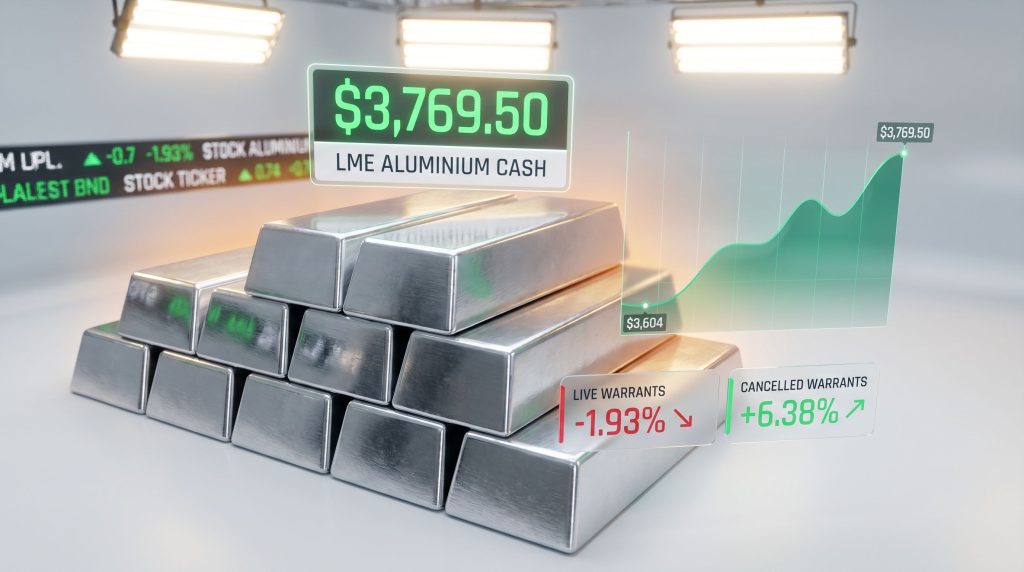
That is precisely the message embedded in the London Metal Exchange aluminium session of 29 May 2026, when LME aluminium prices recover as cash reaches $3,769.5 per tonne, establishing a clear backwardation structure against a 3-month contract sitting at $3,685.00 per tonne. Understanding what drove that move, what it means for market structure, and why physical inventory data amplifies the signal is essential for anyone monitoring aluminium's evolving supply-demand balance.
When big ASX news breaks, our subscribers know first
The Architecture Behind LME Aluminium Pricing
The London Metal Exchange operates a multi-tenor pricing system that gives market participants visibility across different time horizons. Each price point on that curve serves a distinct purpose, and the relationship between those price points often carries more analytical value than any individual number.
Here is how the key reference prices function:
- Cash (spot) price: Reflects same-day or next-day physical delivery. This is the market's most unfiltered reading of immediate supply and demand.
- 3-month contract: The primary hedging benchmark used by producers, consumers, and traders globally. Most physical aluminium trades are priced against this reference.
- Dec-27 forward contract: A longer-dated instrument used for production planning, capital allocation, and smelter restart economics.
- Asian Reference Price: A regionally calibrated benchmark that reflects aluminium pricing during Asian trading hours, important for markets across Japan, South Korea, and Southeast Asia.
One additional price that sits separately from the metal itself is the LME Alumina (Platts) price, which tracks the cost of the primary input material used in aluminium smelting. This figure is critical when assessing smelter profitability, as it captures the spread between raw material costs and finished metal revenue. Furthermore, the broader aluminium and alumina markets have been subject to significant structural shifts over recent years, making this relationship increasingly important to monitor.
Full Curve Analysis: What the 29 May 2026 Session Revealed
The breadth of the 29 May session gains is what distinguishes this recovery from a simple short-covering spike. Every tenor across the LME aluminium curve advanced, and the percentage moves were remarkably consistent, suggesting a fundamental market re-rating rather than a localised technical squeeze.
| Contract | 28 May 2026 | 29 May 2026 | Change | % Move |
|---|---|---|---|---|
| Cash Bid | $3,734.50/t | $3,769.00/t | +$34.50 | +0.92% |
| Cash Offer | $3,735.00/t | $3,769.50/t | +$34.50 | +0.92% |
| 3-Month Bid | $3,638.00/t | $3,684.50/t | +$46.50 | +1.28% |
| 3-Month Offer | $3,640.00/t | $3,685.00/t | +$45.00 | +1.24% |
| Dec-27 Bid | $3,258.00/t | $3,298.00/t | +$40.00 | +1.23% |
| Dec-27 Offer | $3,263.00/t | $3,303.00/t | +$40.00 | +1.23% |
| Asian Reference Price | $3,637.00/t | $3,666.50/t | +$29.50 | +0.81% |
| LME Alumina (Platts) | $306.75/t | $306.75/t | — | 0.00% |
Several observations from this data deserve particular attention:
- The 3-month contract outperformed cash in percentage terms (+1.24% vs. +0.92%), indicating forward market participants are pricing in an expectation that near-term tightness will persist, not just today.
- Dec-27 contracts gained 1.23% in a single session, a meaningful shift for a contract nearly 18 months out. Long-dated forward prices rarely move this sharply unless the market is materially revising its medium-term supply assumptions.
- LME Alumina (Platts) held flat at $306.75 per tonne, creating a divergence between input costs and metal prices that has direct implications for smelter economics, discussed in detail below.
Understanding Backwardation and Why It Matters for Aluminium Investors
The 29 May session produced a textbook backwardation structure, with the cash offer at $3,769.50 per tonne trading approximately $84.50 above the 3-month offer at $3,685.00 per tonne. For broader context on how such commodity market volatility affects trading strategies, the dynamics at play here are particularly instructive.
What is aluminium backwardation? Backwardation occurs when near-term prices exceed forward prices, inverting the more common contango structure where future delivery commands a premium over spot. In commodity markets, contango is the norm because it reflects storage costs, financing charges, and insurance. When backwardation emerges, it signals that physical buyers value immediate delivery more than future delivery, typically because near-term supply is visibly tightening.
In aluminium markets specifically, backwardation is relatively uncommon given the metal's significant above-ground stockpiles and relatively low storage costs per unit of value compared to other commodities. When it does appear, it commands attention. LME aluminium price recovery episodes in prior periods have similarly been preceded by these structural warning signs.
Historically, backwardation episodes in base metal markets have often coincided with or preceded:
- Sustained drawdowns in LME-registered warehouse inventories
- Accelerating physical offtake from industrial consumers
- Supply disruptions reducing the flow of primary metal into exchange systems
- Multi-week or multi-month price rallies as the physical squeeze propagates through the market
The 29 May 2026 session exhibited all four preconditions simultaneously.
The Physical Inventory Signal: Cancelled Warrants Are the Most Underrated Indicator
Beyond price itself, the most powerful confirmation of genuine physical tightness in LME markets comes from warehouse inventory data, and specifically from the relationship between live warrants and cancelled warrants.
| Inventory Metric | 28 May 2026 | 29 May 2026 | Change | % Move |
|---|---|---|---|---|
| Opening Stocks | 339,250 t | 338,000 t | -1,250 t | -0.37% |
| Live Warrants | 259,625 t | 254,625 t | -5,000 t | -1.93% |
| Cancelled Warrants | 78,375 t | 83,375 t | +5,000 t | +6.38% |
These figures require interpretation beyond the headline numbers. Here is what each metric reveals:
- Live warrants represent aluminium held in LME-registered warehouses that is available for immediate delivery. A 1.93% decline in a single session is a notable reduction in the exchange's deliverable supply buffer.
- Cancelled warrants are the critical leading indicator. When a warrant is cancelled, it means the holder has instructed the warehouse to prepare that metal for physical removal. The metal is no longer available for exchange delivery once the cancellation is processed. A 6.38% surge in cancelled warrants in a single session indicates that physical consumers, not traders, are actively withdrawing metal from the exchange system.
The distinction between speculative price moves and physically-driven price moves is one of the most important assessments any analyst must make in commodity markets. Speculative buying can inflate prices temporarily. Physical offtake removes metal from availability permanently until new supply enters the system. The 6.38% cancelled warrant spike on 29 May 2026 points decisively toward the latter.
The mechanics work as follows: once cancelled warrants are processed and metal is collected from warehouses, that inventory does not automatically return to the exchange system. This creates an asymmetric dynamic where inventory losses tend to be stickier than inventory builds.
What Is Driving the Mid-2026 Aluminium Price Recovery
The Middle East Supply Disruption Factor
The Middle East has grown substantially as a primary aluminium production hub over the past two decades. Countries including the UAE, Bahrain, and Saudi Arabia have invested heavily in energy-intensive smelting capacity, leveraging their access to low-cost hydrocarbon-based energy. Collectively, the Gulf Cooperation Council nations now account for a meaningful share of global primary aluminium output.
Supply disruptions in this region carry direct consequences for global primary metal balances. Unlike demand-side disruptions, which tend to be gradual, supply-side events can create immediate gaps in physical availability, particularly in markets that rely on Middle Eastern material for prompt delivery. The late-May 2026 rally has been linked to supply constraints originating from this region, reducing the volume of primary aluminium flowing into global trade channels.
The Broader May 2026 Price Trajectory
Contextualising the 29 May session within the broader monthly trend strengthens the fundamental case. LME aluminium cash prices were trading near $3,604 per tonne earlier in May 2026, meaning the late-month recovery to $3,769.50 represents an advance of approximately $165.50 per tonne, or roughly 4.6%, over the course of the month.
This is not the profile of a one-session anomaly. A sustained multi-day price recovery across multiple contract tenors, confirmed by physical inventory drawdowns, represents a durable market shift. Furthermore, commodity price impacts of this magnitude consistently flow through to producer revenues and sector valuations in meaningful ways. Multiple independent price tracking sources corroborated LME aluminium trading in the $3,674 to $3,769 per tonne corridor across late May 2026, establishing this range as the new near-term price floor.
The next major ASX story will hit our subscribers first
Smelter Economics: Why Flat Alumina Prices Are More Important Than They Appear
The Alumina-to-Aluminium Spread
The unchanged LME Alumina (Platts) price of $306.75 per tonne on 29 May deserves considerably more analytical attention than it typically receives in market commentary.
The aluminium smelting process requires approximately 4 to 5 tonnes of alumina to produce a single tonne of primary aluminium. This means the raw material cost contribution from alumina alone ranges between approximately $1,227 and $1,534 per tonne of aluminium output at current alumina prices.
With aluminium cash prices at $3,769.50 per tonne and alumina input costs remaining static, the spread between revenue and this key cost component has widened meaningfully. This margin expansion signal has several downstream implications:
- Idle smelter capacity becomes economically viable to restart when aluminium prices rise while input costs remain stable or decline
- Vertically integrated producers with captive alumina and bauxite operations capture the full benefit of the price improvement, as their upstream costs are already sunk or fixed
- Independent smelters purchasing alumina at spot prices experience direct margin improvement without needing to renegotiate supply contracts
The Alumina Price Lag Dynamic
A lesser-appreciated dynamic in the aluminium supply chain is that alumina prices typically lag aluminium price movements by several weeks to months. Alumina is primarily traded under long-term supply agreements, often with pricing mechanisms tied to a percentage of the LME aluminium price. When aluminium prices spike suddenly, the alumina price response is dampened and delayed.
This lag creates a temporary window of elevated smelter margins following aluminium price rallies, which historically has been a catalyst for production restarts and capacity additions. However, if aluminium prices sustain their recovery, alumina prices will eventually catch up, compressing margins back toward equilibrium levels. Monitoring alumina price trends in the weeks following a sharp aluminium rally is therefore an important risk management signal.
Key Variables for the Aluminium Price Outlook
Factors That Could Sustain Upward Momentum
- Continued inventory drawdown: If live warrants resume their decline and cancelled warrants remain elevated, the physical tightness narrative gains credibility with each session.
- Persistent supply disruption: Any extension of Middle Eastern production constraints would reduce global primary aluminium availability and keep physical premiums elevated.
- Demand recovery in key consuming sectors: The transport, packaging, and construction sectors collectively consume the majority of global primary aluminium. A pickup in any of these end-use categories amplifies the impact of supply-side tightness.
- Energy cost dynamics: Aluminium smelting is exceptionally energy-intensive, consuming roughly 13 to 15 megawatt-hours of electricity per tonne of primary metal. Rising energy costs in key producing regions can curtail smelter output independently of commodity price signals.
Risks That Could Reverse the Recovery
- Chinese production acceleration: China industrial demand and supply dynamics remain the single largest variable in base metal markets, as China accounts for approximately 57% to 60% of global primary aluminium output. Any coordinated production increase could rebalance the market quickly.
- Macroeconomic deterioration: A strengthening US dollar, slowing global industrial activity, or a sharp deterioration in manufacturing PMI data across major economies historically weighs on base metal prices regardless of supply fundamentals.
- Alumina cost catch-up: If alumina prices begin rising in response to the aluminium recovery, the margin expansion window for smelters narrows, reducing the economic incentive to restart idle capacity and potentially capping the price rally.
- LME inventory rebuilding: A reversal in cancelled warrant trends, with physical consumers reducing offtake and warehouses rebuilding live warrant positions, would signal that near-term demand pressure has been satisfied.
In addition, the impact of US aluminium tariffs continues to reshape global trade flows, adding another layer of complexity to the medium-term price outlook.
The Forward Curve Discount: What Dec-27 Pricing Implies
The December 2027 contract closing at $3,298 to $3,303 per tonne sits approximately $466 to $471 below the current cash price. This significant discount embedded in the forward curve reflects the market's baseline expectation that near-term supply tightness is a temporary condition that will eventually resolve.
However, the fact that Dec-27 contracts also advanced by 1.23% in a single session is meaningful. Long-dated contracts rarely move that decisively unless the market is genuinely reassessing medium-term supply assumptions, not just short-term positioning. This suggests that at least a portion of the late-May rally reflects a structural shift in the supply-demand balance, rather than a purely transient squeeze. LME price forward curve analysis during backwardation periods consistently supports this interpretation.
A note on forward curve interpretation: The shape of a commodity forward curve should never be read as a price forecast. It reflects the cost of carry, market expectations, and risk premiums embedded at the time of pricing. A steep backwardation today does not guarantee that spot prices will remain elevated, but it does confirm that the market is currently placing a significant premium on physical availability over financial exposure to future prices.
Frequently Asked Questions: LME Aluminium Price Mechanics
What is the LME aluminium cash price?
The LME aluminium cash price is the cost of purchasing physical aluminium for immediate or next-day delivery through the exchange. It is the most direct measure of current physical market conditions and is distinct from the more commonly quoted 3-month forward contract price.
What does a spike in cancelled warrants indicate?
Cancelled warrants represent aluminium in LME-registered warehouses that has been earmarked for physical withdrawal. A sharp increase, such as the 6.38% rise recorded on 29 May 2026, signals that physical buyers are actively removing metal from the exchange system, tightening available supply and typically supporting higher prices.
Why did LME aluminium prices recover in late May 2026?
The LME aluminium prices recover as cash reaches $3,769.5 per tonne outcome reflected a convergence of supply disruptions in the Middle East, active physical offtake as evidenced by surging cancelled warrants, declining live warrant inventories, and broad upward repricing across all contract tenors from cash through to December 2027.
What is the significance of backwardation in aluminium markets?
Backwardation in aluminium, where cash prices exceed forward prices, is relatively uncommon given the metal's typically well-supplied physical market. When it does emerge, it signals near-term physical tightness and is historically associated with sustained price recoveries when accompanied by inventory drawdowns.
How does alumina pricing affect aluminium smelter profitability?
Alumina is the primary feedstock for aluminium smelting, with roughly 4 to 5 tonnes required per tonne of primary metal produced. When aluminium prices rise while alumina costs remain stable, smelter margins expand, improving the economics of restarting idle capacity and increasing output.
This article is intended for informational purposes only and does not constitute financial or investment advice. Commodity markets involve significant risk, and past price movements are not indicative of future performance. Readers should conduct their own due diligence before making any investment decisions. Historical LME pricing data is available through the AL Circle aluminium price tracker.
Want to Capitalise on the Next Major Commodity Discovery Before the Broader Market?
Discovery Alert's proprietary Discovery IQ model scans ASX announcements in real time, instantly translating complex mineral data across more than 30 commodities into actionable investment insights — the same kind of structural shifts driving aluminium's current supply squeeze can equally reshape the fortunes of ASX-listed explorers and producers overnight. Explore historic discoveries and their market returns to understand the scale of opportunity, then begin your 14-day free trial at Discovery Alert to position yourself ahead of the next major market move.