
August 6, 2026
The Structural Fault Line Beneath Mexico's Mining Boom
When commodity prices surge, they have a remarkable ability to disguise structural problems. Revenue expands, tax receipts swell, and headlines celebrate record-breaking performance figures. But beneath the surface, the physical machinery of production can be quietly contracting. This is precisely the dynamic now unfolding across Mexico's mining-metallurgical sector, and understanding it requires separating two fundamentally different concepts: the value of what a country produces, and the volume of what it actually extracts from the ground.
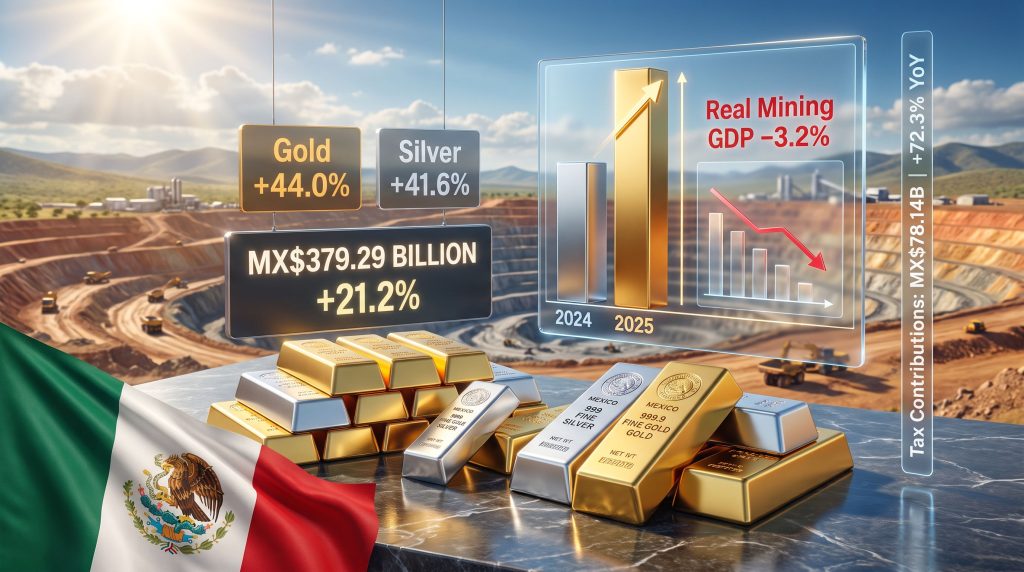
The distinction matters enormously for anyone assessing the long-term health of Mexico's resource economy. Mexico's mining-metallurgical production value reached a historic MX$379.29 billion (approximately US$22 billion) in 2025, representing a 21.2% year-over-year increase. Yet the physical volume index of national mining production registered a contraction of approximately 3.2% in real mining GDP during the same period. In other words, Mexico earned more from its mines while taking less out of them. That is not a paradox of efficiency. It is a warning about dependency.
When big ASX news breaks, our subscribers know first
Mexico Mining Value Up Despite Flat Production: Decoding the Price-Volume Split
The CAMIMEX Annual Report 2026, presented by the Cámara Minera de México, confirmed that the record revenue figure was driven almost entirely by elevated international commodity prices rather than any meaningful expansion in extraction capacity. Understanding this price-volume disconnect is central to evaluating where Mexico's mining sector actually stands.
Precious metals functioned as the dominant revenue amplifier across the sector:
- Silver production value grew by 34.9%, supported by an average annual price increase of 41.6%
- Gold production value expanded 31.8%, following an average price rise of 44% across the year
- Gold reached 53 historical price highs throughout 2025
- The combined precious metals segment grew 33.1% in total production value
- Industrial metals value rose 12.1%, with gains in copper, zinc, and molybdenum
- Siderurgical minerals increased 11.5%, led by a 14.3% recovery in iron ore pellet output
- Non-metallic minerals declined 14.7% in total value to MX$19.47 billion
Mexico retained its position as the world's leading silver producer and the ninth-largest gold producer globally, credentials that carry significant weight in international commodity markets. However, retaining a production ranking while volumes stagnate is a structurally precarious position. Rank is maintained only until competitors invest more aggressively in exploration and capacity expansion.
| Metal Segment | Value Growth (2025) | Key Price Driver |
|---|---|---|
| Silver | +34.9% | Average price +41.6% |
| Gold | +31.8% | Average price +44.0%; 53 record highs |
| Precious Metals (combined) | +33.1% | Multiple record highs |
| Industrial Metals | +12.1% | Copper, zinc, molybdenum gains |
| Siderurgical Minerals | +11.5% | Iron ore pellet recovery +14.3% |
| Non-Metallic Minerals | -14.7% | Value fell to MX$19.47 billion |
Mexico's Mining Sector as an Economic Pillar: Key Macroeconomic Indicators
The sector's contribution to national economic activity extends well beyond its production figures. According to CAMIMEX data for 2025:
- Mining accounted for 2.93% of national GDP and 4.5% of expanded GDP
- The sector represented 9.57% of total industrial GDP
- Mining-metallurgical exports grew by approximately 20% year-over-year to reach US$30.64 billion
- A trade surplus of US$13.75 billion was generated, restoring mining as Mexico's fifth-largest source of foreign exchange
At the regional level, the five primary mining states of Sonora, Zacatecas, Chihuahua, Durango, and Guerrero posted a combined economic growth rate of 1.5% in 2025. This more than doubled the national economic growth rate of 0.6%, illustrating how resource-dependent territories derive disproportionate economic benefit from commodity price environments, even when physical output is flat.
The regional outperformance of mining states relative to Mexico's national growth rate reveals a structural dependency that cuts both ways. Price-driven prosperity in these communities is highly vulnerable to commodity cycle reversals, particularly when the underlying production base is not expanding.
Fiscal Windfall: Record Tax Revenue and What It Actually Signals
Higher commodity valuations translated directly into a dramatic increase in fiscal contributions from the mining sector. Total tax payments reached MX$78.14 billion in 2025, representing a 72.3% increase compared to 2024.
This figure demands careful interpretation. The surge in government revenue was not the product of a more productive or expansive industry. It reflects the mathematical consequence of applying existing royalty and tax structures to a substantially higher nominal value base. Mexico's mining royalty framework, which includes a special mining duty introduced in 2014 and an extraordinary duty on precious metals, generates receipts that scale with commodity prices rather than production volumes.
A critical distinction for policymakers and investors: A 72.3% jump in fiscal revenue generated by the same physical output level is not a sign of sectoral health. It is a signal of price leverage. When commodity prices normalise, fiscal revenues will contract sharply without corresponding volume growth to compensate.
Investment trends reinforce this concern. Furthermore, the data below highlights the volatility within the capital deployment cycle:
| Year | Sector Investment | Change |
|---|---|---|
| 2024 | US$5.063 billion | +2.1% vs. 2023 |
| 2025 | US$4.896 billion | -3.3% vs. 2024 |
| 2026 (projected) | US$6.402 billion | Rebound expected |
The 3.3% decline in capital investment during 2025 is particularly significant given that revenues were simultaneously at record levels. When high-profit conditions do not stimulate investment growth, it typically indicates that non-financial barriers — specifically regulatory uncertainty and permitting delays — are constraining operator behaviour. Capital was available; the enabling conditions were not.
Three Structural Constraints Suppressing Physical Output
The volume stagnation documented in the CAMIMEX report is not a temporary anomaly. It reflects the convergence of three distinct structural constraints that compound one another over time.
1. Natural Mine Depletion
Every mine operates along a production lifecycle. As ore grades decline with depth and lateral extension, extraction costs rise and output volumes fall. Without an active pipeline of new projects replacing depleted reserves, aggregate national production faces inevitable structural decline. Mexico's existing operations across primary mining states are advancing through the later stages of productive lifecycles, and the exploration pipeline that would normally replenish them has been severely disrupted.
2. Environmental Permitting Delays
Regulatory processing timelines for environmental impact assessments have lengthened significantly. Operators who have obtained mining concessions and completed feasibility work cannot advance projects into production without environmental authorisations. Bottlenecks in this administrative process translate directly into delayed output and deferred investment. For a broader understanding of permitting and grade king dynamics, these delays represent one of the most consequential friction points in the entire mine development cycle.
3. The Three-Year Concession Freeze
Following regulatory reforms enacted in 2023, the granting of new mining concessions was effectively suspended. This pause, now extending across approximately three years, has created a structural gap in the early-stage exploration pipeline. Because mine development typically requires five to fifteen years from initial discovery to first production, the consequences of a three-year concession freeze will not be fully visible in output statistics for years. By the time the production shortfall becomes undeniable, the window for corrective action will have already narrowed.
Pedro Rivero, President of CAMIMEX, has highlighted that converting Mexico's recognised mining potential into sustained economic growth requires active promotion of exploration, new project development, and investment certainty. Without these conditions, revenue gains remain entirely dependent on external price movements beyond Mexico's control.
Mexico's Untapped Investment Pipeline: US$40 Billion at Stake
One of the most consequential figures to emerge from the CAMIMEX Annual Report 2026 is the scale of capital waiting to be deployed if regulatory conditions improve. Industry data indicates:
- Private operators hold an estimated US$14 billion in prospective capital ready for investment
- Approximately US$11 billion in project investments are currently stalled pending regulatory decisions and environmental permit approvals
- Total sector investment potential through the end of the current presidential term is projected to exceed US$40 billion
The gap between available capital and stalled projects reveals that the constraint is not financial appetite. Investors are willing. The missing ingredient is regulatory predictability. Mexico advanced from 49th to 36th place in the Fraser Institute Investment Attractiveness Index, a meaningful improvement, but CAMIMEX identifies further areas for advancement, particularly in the area of exploration incentives. The geopolitical landscape for metals in 2025 has, however, added further complexity to how foreign capital evaluates sovereign risk in resource jurisdictions.
The Fraser Institute Investment Attractiveness Index measures both mineral potential and policy perception. Mexico's 13-place improvement in 2025 demonstrates that investor sentiment is responsive to policy signals, but the absolute ranking of 36th still positions Mexico behind several Latin American peers in terms of exploration policy competitiveness.
The next major ASX story will hit our subscribers first
Critical Minerals and North American Supply Chain Integration
A joint study conducted with the Center for Research and Teaching in Economics (CIDE) identified 192 industrial production chains dependent on domestic Mexican mineral inputs. This research positions Mexico not as a simple commodity exporter, but as an embedded supplier within the broader North American industrial ecosystem.
Six minerals were specifically categorised as critical for North American industry:
| Mineral | Primary Industrial Applications |
|---|---|
| Copper | Electrical systems, EV manufacturing, renewable energy infrastructure |
| Zinc | Galvanizing, battery production, chemical manufacturing |
| Lead | Battery storage, radiation shielding, industrial applications |
| Fluorite | Aluminium production, refrigerants, pharmaceutical synthesis |
| Barite | Oil drilling fluids, medical imaging compounds |
| Molybdenum | High-strength steel alloys, aerospace and defence components |
An often-overlooked dimension of Mexico's mineral heritage is its contribution to metallurgical innovation. The country's engineers developed the direct reduction process for iron ore, a technology that fundamentally altered how steel is produced globally and reduced dependence on traditional blast furnace methods. Specialised processing techniques for manganese pioneered by Mexican metallurgists similarly represent intellectual contributions to global mining practice that rarely appear in headline production statistics.
CAMIMEX representatives have confirmed participation in consultations surrounding the upcoming USMCA review, with a specific focus on securing raw material supply guarantees across three key sectors. The growing critical minerals demand underpinning the energy transition makes these supply guarantees increasingly strategic:
- Automotive manufacturing, particularly given EV transition dependencies on copper and other critical minerals
- Clean energy infrastructure, including wind, solar, and grid storage technologies
- Advanced manufacturing corridors across the North American region
The Exploration Deficit: A Long-Term Threat Hiding Behind Strong Revenues
The financial strength of Mexico's 2025 mining performance creates a risk of misplaced confidence. Record revenues and tax contributions can obscure the fact that the sector's long-term productive capacity is gradually eroding through under-investment in exploration.
Karen Flores, Director General of CAMIMEX, has stressed that the finite nature of mineral resources means every producing mine is moving closer to depletion. Without sustained exploration discovering and proving new reserves, aggregate national output will contract structurally regardless of what commodity prices do. Flores has called for greater exploration incentives and clearer pathways for private operators during the research, development, and investment phases of the mine development cycle, when capital outflows are substantial and returns remain years away.
Beyond the six designated critical minerals, Flores has identified the following as priority domestic resources requiring sustained exploration commitment:
- Gold, iron ore, copper, zinc, and molybdenum
- Industrial minerals including gypsum, lime, cadmium, and dolomite
Collectively, the mining sector supports the livelihoods of an estimated 3 million families across Mexico's producing regions. Depletion without replacement does not just affect corporate balance sheets. It dismantles regional economies that have been built around multi-generational mining activity.
Employment Trends: High Wages, Falling Headcount
Despite record financial performance, employment in Mexico's mining sector contracted during 2025, reflecting the operational reality of flat-to-declining physical output.
| Employment Metric | 2025 Figure | Change vs. 2024 |
|---|---|---|
| Direct sector employment | 400,057 jobs | -4.0% |
| Estimated indirect employment | ~2.4 million jobs | Not separately quantified |
| Wage premium vs. national average | +28.5% | +7.5% annual wage increase |
| Basic food and non-food baskets covered | 5.1 baskets | Measure of household purchasing power |
| Female workforce participation | 18.5% (~73,000 women) | Growing trend |
The 4% decline in direct employment despite record revenues is a counterintuitive but important signal. It reflects the fact that value gains were price-driven rather than volume-driven, meaning there was no operational expansion requiring additional workforce. Average wages remain well above the national average, covering 5.1 basic food and non-food baskets, which positions mining employment as among the highest-quality formal job categories available in producing regions.
Female participation at 18.5% of the direct workforce, representing over 73,000 women across technical, operational, and executive roles, marks a continuing structural shift in an industry historically characterised by low gender diversity.
Three Scenarios for Mexico Mining Through 2030
The pathway from here depends almost entirely on whether regulatory conditions evolve to match the scale of private capital positioned for deployment.
Scenario 1: Policy Alignment (Optimistic)
Regulatory certainty is restored, the concession pipeline reopens, and exploration incentives are introduced. The US$40 billion investment projection materialises progressively, volume growth resumes, and Mexico strengthens its embedded role in North American critical mineral supply chains. According to recent investment projections, firms are already expanding projects and acquiring equipment in anticipation of this scenario.
Scenario 2: Managed Stagnation (Base Case)
Partial regulatory improvements occur but permitting delays persist. Investment rebounds modestly toward the US$6.4 billion 2026 projection but falls short of transformative levels. Revenue remains dependent on commodity price conditions, and volume growth lags behind regional competitors.
Scenario 3: Structural Deterioration (Risk Case)
The concession freeze extends, exploration investment remains suppressed, and existing mines reach depletion without replacement. Mexico's share of North American critical mineral supply contracts, reducing its leverage in USMCA negotiations and progressively diminishing regional economic competitiveness.
The 2025 data presents a financially impressive but structurally fragile picture. Mexico mining value up despite flat production is a headline that conceals as much as it reveals. Sustained growth requires regulatory conditions that enable the private sector to convert temporary price tailwinds into permanent expansion of the productive base.
Frequently Asked Questions: Mexico Mining Value and the CAMIMEX 2025 Data
Why did Mexico's mining value increase 21% while production stayed flat?
Higher international prices for precious metals, particularly gold with an average price increase of 44% and silver at 41.6%, inflated the peso-denominated value of existing output without requiring additional extraction volumes.
What is CAMIMEX and why does its annual report matter?
CAMIMEX (Cámara Minera de México) is Mexico's primary mining-metallurgical industry association. Its annual report provides the most comprehensive official dataset on production value, investment trends, employment figures, and regulatory conditions across the sector.
How much investment is currently blocked in Mexico's mining sector?
Approximately US$11 billion in project investments are stalled pending regulatory approvals and environmental permit decisions, out of an estimated US$14 billion in private capital ready for deployment.
What minerals does Mexico supply that are critical for North America?
Research has identified copper, zinc, lead, fluorite, barite, and molybdenum as the six minerals classified as critical for North American industry, embedded within 192 identified industrial production chains.
Did Mexico's mining investment attractiveness improve in 2025?
Mexico advanced from 49th to 36th place in the Fraser Institute Investment Attractiveness Index, though CAMIMEX identifies further improvement opportunities, particularly in exploration policy. The 2026 capital rebound and permitting environment will be critical to sustaining this momentum.
How many jobs does Mexico's mining sector support?
The sector directly employed 400,057 workers at the close of December 2025, down 4% from 2024, with an estimated 2.4 million indirect jobs supporting approximately 3 million dependent families across producing regions.
Disclaimer: This article contains forward-looking projections and scenario analyses based on industry data and operator estimates. Investment figures, production forecasts, and regulatory outcomes are subject to change. Nothing in this article constitutes financial or investment advice. Readers should conduct independent due diligence before making any investment decisions related to the mining sector.
Want to Track the Next Major Mineral Discovery Before the Market Does?
Discovery Alert's proprietary Discovery IQ model delivers real-time alerts on significant ASX mineral discoveries, translating complex geological and commodity data into actionable investment insights for both short-term traders and long-term investors — explore the historic returns major discoveries have generated and begin your 14-day free trial today to position yourself ahead of the market.