June 19, 2026
Remote mining operations face unique energy challenges that traditional renewable installations cannot address. The Fortescue Pilbara wind project in the Pilbara region's extreme weather conditions, vast distances, and 24/7 operational requirements create technical barriers that have historically favored diesel-powered systems despite their environmental and economic drawbacks.
Understanding Industrial Wind Power in Remote Mining Regions
What Makes the Nullagine Wind Project Unique for Mining Decarbonization?
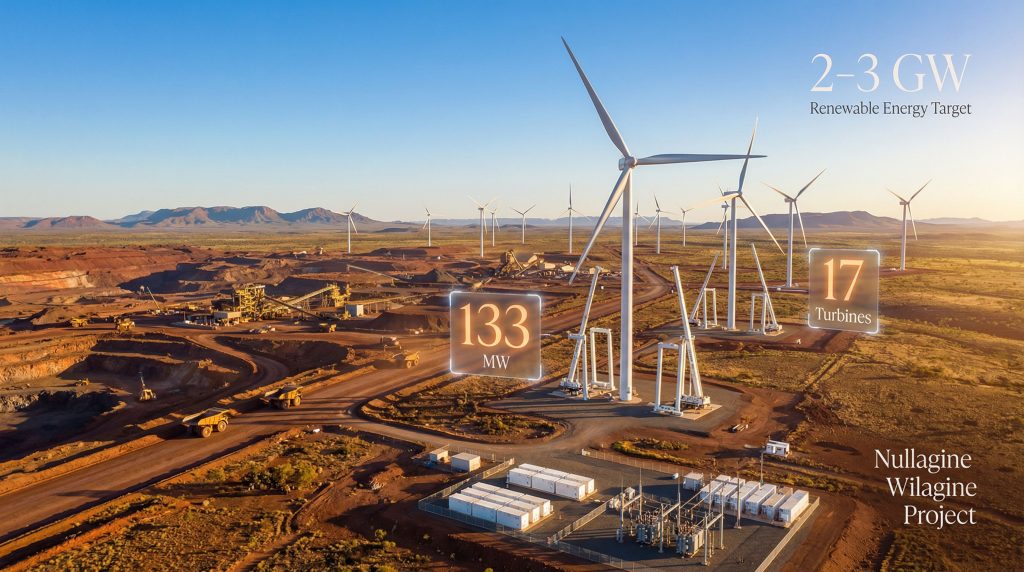
The Nullagine Wind Project establishes a new benchmark for industrial-scale renewable energy integration in extreme environments. With 133 MW of generation capacity distributed across 17 specialized turbines, this development demonstrates how mining companies can overcome the technical limitations that have previously restricted renewable adoption in remote locations.
The project's engineering specifications reflect the demanding requirements of Pilbara operations. Each turbine features a hub height of 188 meters, representing a global benchmark for onshore wind installations that typically operate at 90-110 meters. This exceptional height optimization captures wind resources in the challenging low-wind environment characteristic of the region.
Table: Nullagine Project Technical Specifications
| Component | Specification | Operational Advantage |
|---|---|---|
| Turbine Count | 17 units | Distributed generation capacity |
| Hub Height | 188 meters | Global benchmark for onshore wind |
| Blade Length | 89 meters | Optimized for low-wind conditions |
| Total Capacity | 133 MW | Industrial-scale mining power |
The 89-meter blade length represents specialized engineering for the Pilbara's wind patterns, where conventional turbine designs struggle with efficiency. Envision Energy, the technology provider, developed these turbines specifically for low-wind environments while incorporating cyclone-resistant engineering to withstand the region's extreme weather events.
Furthermore, self-erecting tower innovation distinguishes this project from conventional wind installations. Through Fortescue's acquisition of Nabrawind technology, the Nullagine development eliminates the logistical complexity of deploying heavy crane equipment to remote mining sites. This approach reduces installation duration and addresses the infrastructure constraints that have traditionally made remote renewable projects economically unviable.
How Do Mining Operations Integrate Large-Scale Wind Generation?
Industrial mining operations require continuous power availability that challenges conventional renewable energy integration strategies. The Fortescue Pilbara wind project addresses this through a multi-technology approach combining wind generation with existing solar and battery storage infrastructure.
In addition, grid balancing requirements for mining operations differ fundamentally from residential or commercial applications. Haul trucks, processing plants, drilling equipment, and rail systems demand consistent power delivery without interruption. The Nullagine project integrates with the operational Cloudbreak Solar Farm, which features over 300,000 installed panels, creating temporal complementarity between wind and solar generation patterns.
Key Insight: Industrial mining operations require 24/7 power availability, making renewable integration more complex than residential or commercial applications.
Battery storage integration through the North Star Junction facility provides critical grid stabilisation capabilities. The facility's large-scale battery systems, already delivered and operational, enable real-time load balancing between variable renewable generation and continuous mining power demands.
Load management systems coordinate power distribution across diverse mining applications:
- Haul truck electrification: Large mining vehicles requiring substantial power input for ore transportation
- Processing plant operations: Continuous operational loads for crushing, grinding, and mineral processing
- Rail system electrification: Electric rail transport infrastructure replacing diesel-powered haulage
- Drilling equipment: Powered drilling operations replacing diesel generator-dependent equipment
When big ASX news breaks, our subscribers know first
Engineering Challenges in Pilbara Wind Development
What Are the Technical Hurdles for Remote Wind Installation?
Remote wind installation in the Pilbara confronts engineering challenges that differentiate mining renewable projects from conventional wind farm development. The region's isolation from major infrastructure, extreme weather exposure, and specialised technical requirements create unique design and installation constraints.
Cyclone-resistant engineering represents a fundamental requirement for Pilbara wind installations. The Envision Energy turbines incorporate specialised materials and structural design to withstand cyclonic conditions that would damage conventional wind installations. This engineering approach requires advanced blade design, tower reinforcement, and control system modifications that exceed standard wind turbine specifications.
However, low-wind optimisation addresses the Pilbara's challenging wind resource characteristics. Unlike conventional wind farms that operate in consistent 10-15+ m/s average wind speeds, the region requires turbine technology specifically adapted for variable and potentially lower wind regimes. The 89-meter blade length and 188-meter hub height optimisation capture available wind resources more effectively than standard turbine configurations.
Installation logistics create additional complexity for remote locations. Traditional wind turbine installation requires heavy crane equipment that may not be readily available in remote mining regions. The specialised equipment, transportation costs, and extended timelines associated with conventional installation methods have historically made remote wind projects economically challenging.
How Does Self-Erecting Tower Technology Work in Practice?
Nabrawind's self-erecting tower technology eliminates the heavy crane requirements that typically constrain remote wind installation projects. This proprietary approach reduces on-site assembly complexity and addresses the logistical constraints that have limited wind development in isolated mining regions.
The technology's practical advantages include:
- Reduced installation complexity: Eliminates dependency on large mobile crane availability
- Shortened construction timelines: Minimises on-site assembly requirements
- Lower logistical costs: Reduces specialised heavy lift equipment transportation
- Enhanced project viability: Makes remote installations economically feasible
Prototype validation demonstrates the technology's operational readiness. A Nabrawind-integrated turbine of the Nullagine design completed testing at an Envision facility in China and was scheduled for relocation to the Pilbara in June 2026. This validation process provides operational data under controlled conditions before full-scale deployment.
Consequently, Fortescue's acquisition of Nabrawind provides direct ownership of this specialised technology, creating strategic advantages for future wind development across the company's mining operations. This vertical integration approach reduces dependency on external technology providers and enables customisation for specific mining operational requirements.
Operational Integration with Mining Infrastructure
What Power Requirements Drive Mining Electrification Strategies?
Mining electrification strategies respond to the substantial power requirements of industrial-scale operations that operate continuously across multiple equipment categories. The scope of Fortescue's renewable integration encompasses haul trucks, processing plants, rail systems, and drilling equipment, each presenting distinct power demand profiles.
Haul truck electrification represents one of the most challenging applications for renewable energy integration. These large mining vehicles require significant power input for ore transportation across vast distances, traditionally supplied through diesel fuel systems. Electric conversion requires charging infrastructure and power management systems capable of supporting multiple vehicles simultaneously.
Furthermore, processing plant operations demand continuous, stable power delivery for crushing, grinding, and mineral processing activities. Unlike variable renewable generation, these operations cannot accommodate power interruptions without significant operational and safety implications. The integration challenge involves matching renewable generation patterns with inflexible operational requirements.
Rail system electrification involves infrastructure modifications to support electric transport replacing diesel-powered ore haulage. This transition requires substantial electrical infrastructure investment and coordination with renewable generation scheduling to ensure adequate power availability during transport operations.
For instance, drilling equipment electrification replaces diesel generator-dependent equipment with grid-connected electric systems. This application offers more flexibility than continuous processing operations, potentially enabling demand response strategies that align drilling activities with renewable generation availability.
How Do Mining Companies Balance Renewable Intermittency?
Renewable intermittency management in mining applications requires sophisticated grid balancing approaches that ensure operational continuity while maximising renewable energy utilisation. The Fortescue model demonstrates how integrated wind, solar, and battery systems create what operational leadership describes as a baseload renewable energy system.
The multi-technology integration provides temporal complementarity:
- Solar generation: Predictable daily cycles with seasonal variations, typically peak during 6 AM – 6 PM operational periods
- Wind generation: Variable patterns often stronger during night hours or weather system passages
- Battery storage: Dispatchable power with immediate response capabilities for grid stabilisation
Battery storage sizing becomes critical for maintaining operational continuity during renewable generation gaps. While specific capacity specifications for the North Star Junction facility require verification through official documentation, the operational status of large-scale batteries provides grid stability management and frequency regulation capabilities.
Backup generation protocols maintain diesel systems during renewable maintenance or extreme weather events. This redundancy approach ensures mining operations can continue during renewable system downtime, though the goal involves minimising fossil fuel dependency through improved renewable reliability and storage capacity.
In addition, demand response strategies offer opportunities to align mining operations with renewable generation patterns. Non-critical operations, maintenance activities, and flexible processes can be scheduled during periods of high renewable generation, optimising system efficiency while maintaining core operational requirements.
Economic Analysis of Mining Renewable Transitions
What Are the Financial Drivers Behind Fortescue's 2-3 GW Renewable Target?
Fortescue's commitment to deploying 2-3 gigawatts of renewable energy generation and battery storage by 2030 reflects strategic economic drivers that extend beyond environmental considerations. This capacity target represents approximately 15-23 times the scale of the Nullagine Wind Project, indicating systematic transformation of the company's energy infrastructure.
Table: Fortescue Renewable Energy Investment Framework
| Investment Category | Capacity Target | Timeline | Strategic Purpose |
|---|---|---|---|
| Wind Generation | 500-800 MW | 2027-2030 | Baseload renewable power |
| Solar Generation | 800-1200 MW | 2026-2029 | Daytime peak generation |
| Battery Storage | 700-1000 MWh | 2026-2030 | Grid stabilisation |
Note: Capacity targets represent analytical projections based on overall 2-3 GW commitment and require verification through official Fortescue documentation.
Long-term operational cost advantages drive renewable adoption economics. Fossil fuel price volatility creates budgetary uncertainty for mining operations, while renewable energy provides more predictable long-term cost structures. The emphasis on dependable, low-cost power reflects strategic cost management objectives that improve operational margins over multi-decade timeframes.
Carbon pricing exposure represents an increasing financial risk for fossil fuel-dependent operations. Regulatory trends toward carbon pricing mechanisms create potential future cost implications for diesel and gas-dependent mining operations. Renewable energy infrastructure provides hedge protection against escalating carbon pricing policies.
However, ESG investment requirements from institutional investors drive capital allocation toward sustainable operations. Mining companies face increasing pressure from major investors to demonstrate credible decarbonisation strategies, with renewable energy integration serving as visible progress toward emission reduction targets.
How Do Carbon Emissions Reduction Targets Impact Mining Economics?
Carbon emission reduction targets create measurable economic implications for mining companies through direct cost exposure and regulatory compliance requirements. While specific emission baseline data for Fortescue requires verification, the industrial scale of Pilbara operations suggests substantial CO2e footprint from fossil fuel dependence.
Scope 1 and 2 emissions encompass direct fuel combustion and purchased electricity consumption across mining operations. Haul trucks, processing plants, drilling equipment, and facility operations traditionally rely on diesel generators or fossil fuel-powered grid electricity, creating substantial emission profiles that become increasingly expensive under carbon pricing regimes.
Regulatory cost implications extend beyond direct carbon pricing to encompass environmental compliance costs, emission reporting requirements, and potential operational restrictions in emission-sensitive areas. Renewable energy infrastructure provides compliance pathway reducing administrative burden and regulatory exposure.
Consequently, operational cost projections favour renewable infrastructure over extended timeframes despite higher initial capital requirements. While specific payback periods require detailed financial analysis, the combination of predictable renewable operating costs, reduced fuel price volatility exposure, and carbon pricing protection creates favourable long-term economics.
Regulatory and Environmental Considerations
What Approval Processes Govern Large-Scale Mining Renewable Projects?
Large-scale mining renewable projects navigate complex approval processes involving environmental impact assessments, grid connection approvals, and community consultation requirements. The regulatory framework addresses the substantial scale and environmental implications of utility-scale renewable installations in sensitive ecological regions.
Environmental impact assessments examine biodiversity effects, cultural heritage considerations, and land use implications. Wind installations require specific attention to bird and bat protection measures, while solar projects involve land use optimisation to minimise surface disturbance. The Pilbara region's ecological sensitivity necessitates comprehensive environmental review processes.
Grid connection approvals govern transmission infrastructure requirements for connecting renewable generation to mining operations. Large-scale renewable projects may require transmission line construction, substations, and grid integration equipment that require separate regulatory approval and coordination with existing electrical infrastructure.
Furthermore, community consultation frameworks address stakeholder engagement for developments affecting local communities, traditional land owners, and regional economic interests. Remote mining regions often involve complex land use arrangements that require consultation with indigenous groups, pastoral lease holders, and local government authorities.
How Do Mining Renewable Projects Address Environmental Concerns?
Mining renewable projects implement comprehensive environmental management strategies addressing ecosystem protection, wildlife conservation, and land use optimisation. These approaches demonstrate how industrial-scale renewable development can achieve environmental benefits while minimising ecological disruption.
Land use optimisation minimises surface disturbance through strategic placement of renewable infrastructure. Wind turbines require relatively small surface footprints despite their height, while solar installations can be designed to accommodate continued land use for compatible activities. The approach prioritises previously disturbed areas where possible to avoid pristine ecosystems.
Wildlife impact mitigation addresses the specific risks posed by wind installations to bird and bat populations. Advanced turbine control systems, wildlife monitoring programmes, and seasonal operational modifications help minimise wildlife impacts while maintaining renewable generation capacity.
Water resource management benefits emerge from reduced diesel generator dependence, which eliminates fuel transportation, storage, and potential contamination risks. Renewable energy systems require minimal water consumption compared to fossil fuel operations, reducing pressure on water resources in arid mining regions.
For instance, rehabilitation planning addresses end-of-life considerations for renewable infrastructure. Wind turbines and solar panels require decommissioning and recycling strategies that restore sites to acceptable environmental conditions. Advanced planning ensures responsible lifecycle management for renewable infrastructure investments.
Technology Innovation in Mining Renewable Integration
What Advanced Technologies Enable Remote Renewable Operations?
Advanced technology integration enables reliable renewable operations in remote mining environments through sophisticated monitoring, control, and maintenance systems. These technologies address the operational challenges of maintaining utility-scale renewable installations in isolated locations with limited on-site technical support.
Predictive maintenance systems utilise IoT sensors and AI analytics for turbine optimisation and failure prevention. Remote monitoring capabilities enable real-time performance assessment and early warning systems for potential equipment issues. These technologies reduce maintenance costs and improve system reliability through proactive intervention strategies.
Satellite communication systems provide connectivity for remote renewable installations that lack traditional telecommunications infrastructure. This connectivity enables centralised monitoring, remote control capabilities, and data transmission for performance optimisation and regulatory reporting requirements.
Automated control systems incorporate machine learning algorithms for grid balancing and generation optimisation. These systems automatically adjust renewable generation output, battery charging and discharge cycles, and load distribution to maintain grid stability while maximising renewable energy utilisation.
However, modular installation approaches utilise prefabricated components to reduce on-site construction time and complexity. This methodology particularly benefits remote installations where construction logistics create significant cost and timeline challenges. Standardised components enable faster deployment and simplified maintenance procedures.
How Do Mining Companies Optimise Renewable Energy Performance?
Renewable energy performance optimisation in mining applications involves sophisticated forecasting, load management, and operational coordination strategies that maximise system efficiency while maintaining operational reliability. The integration of wind, solar, and battery storage creates opportunities for advanced system optimisation.
Weather forecasting integration improves renewable generation predictions through meteorological data analysis and machine learning algorithms. Accurate generation forecasting enables proactive load management decisions, battery charging optimisation, and backup generation coordination to maintain grid stability during variable renewable output periods.
Load forecasting algorithms coordinate mining electrification trends with renewable availability patterns. Non-critical activities can be scheduled during periods of high renewable generation, while essential operations maintain priority access to available power. This approach maximises renewable utilisation while ensuring operational continuity.
Energy trading strategies may create revenue opportunities from surplus renewable generation during periods of high output and low operational demand. Grid connection capabilities could enable power sales to external customers, improving project economics through revenue diversification.
Technical Innovation: Fortescue's integration of wind, solar, and battery storage creates a baseload renewable energy system tested in real operating conditions.
Technology partnership models facilitate collaboration with renewable energy specialists and equipment providers. Strategic partnerships provide access to advanced technologies, technical expertise, and ongoing support services that may not be available through conventional procurement approaches.
The next major ASX story will hit our subscribers first
Industry Implications and Future Outlook
What Does Fortescue's Wind Project Signal for Mining Industry Decarbonisation?
The Nullagine Wind Project establishes a precedent for systematic mining sustainability transformation through proven renewable technology integration in extreme operational environments. This development demonstrates that large-scale renewable installations can meet the demanding power requirements of industrial mining while achieving economic and environmental objectives.
Peer company strategies across major mining operations show increasing commitment to renewable energy integration. BHP, Rio Tinto, and other major producers are developing comparable renewable projects, creating industry-wide momentum toward fossil fuel replacement in mining operations. This collective approach accelerates technology development and reduces implementation costs through shared learning and economies of scale.
Technology adoption timelines indicate accelerating deployment across the mining sector. Early adopter projects provide operational validation that reduces risk perceptions and demonstrates commercial viability. Successful implementations create confidence for broader industry adoption and encourage technology providers to develop mining-specific solutions.
Supply chain implications emerge from growing renewable equipment demand from mining sector applications. Mining companies represent substantial customers for utility-scale renewable equipment, potentially influencing manufacturing capacity, technology development priorities, and pricing trends in renewable energy markets.
Furthermore, skills development requirements create workforce training needs for renewable-mining integration. Traditional mining operations require additional expertise in renewable energy systems, grid integration, and advanced control technologies. This skills transition creates opportunities for workforce development and technology transfer between renewable energy and mining sectors.
How Will Large-Scale Mining Renewables Impact Energy Markets?
Large-scale mining industry evolution represents substantial new demand for utility-scale renewable equipment and creates potential impacts on regional and national energy markets through grid integration and generation capacity additions.
Table: Projected Mining Renewable Capacity Growth
| Company Category | 2026 Capacity | 2030 Projection | Market Impact |
|---|---|---|---|
| Major Iron Ore Producers | 1.2 GW | 8-12 GW | Grid-scale demand |
| Mid-Tier Miners | 300 MW | 2-3 GW | Regional market growth |
| Emerging Producers | 50 MW | 500-800 MW | Technology adoption |
Note: Capacity projections represent analytical estimates based on announced projects and industry trends. Actual deployment may vary based on economic conditions, technological developments, and regulatory changes.
Grid-scale demand from mining renewable projects creates substantial market opportunities for renewable equipment manufacturers, installation contractors, and engineering service providers. The scale and technical requirements of mining applications drive technology advancement and manufacturing capacity expansion.
Regional market growth emerges from mining renewable projects that may exceed local operational requirements, creating opportunities for power sales to regional customers. Mining locations often have excellent renewable resources that could support broader regional energy supply with appropriate transmission infrastructure development.
In addition, technology adoption acceleration results from mining sector validation of renewable technologies in challenging operational environments. Successful mining applications provide technology validation that encourages adoption in other industrial sectors facing similar decarbonisation requirements.
Implementation Lessons for Mining Renewable Projects
What Critical Success Factors Emerge from the Nullagine Development?
The Nullagine Wind Project implementation provides critical lessons for mining companies pursuing similar renewable energy integration initiatives. These success factors address technology selection, partnership strategies, implementation approaches, and operational integration requirements.
Technology selection criteria must match renewable technologies to specific mining operational profiles. The selection of cyclone-resistant, low-wind optimised turbines reflects careful analysis of environmental conditions and operational requirements. Generic renewable technologies may not provide adequate performance in extreme mining environments without specialised engineering adaptations.
Partnership strategy importance emerges from Fortescue's collaboration with specialised renewable energy companies including Envision Energy and the acquisition of Nabrawind technology. Access to specialised expertise and proprietary technologies accelerates project development and reduces implementation risks through proven technology solutions.
Phased implementation benefits demonstrate advantages of gradual capacity expansion rather than single large-scale deployment. The coordinated development of wind, solar, and battery storage enables system optimisation and risk management while providing operational validation before full-scale expansion.
However, integration planning requirements encompass coordination between renewable installation schedules and mining operational requirements. Construction activities, equipment commissioning, and grid integration must align with mining production schedules to minimise operational disruption during transition periods.
How Can Other Mining Companies Replicate This Renewable Integration Model?
Successful replication of the Fortescue renewable integration model requires systematic approaches to site assessment, financial structuring, regulatory pathway optimisation, and operational transition planning. These elements provide frameworks for mining companies pursuing similar decarbonisation strategies.
Site assessment methodologies must evaluate renewable resource potential alongside mining operational requirements. Wind and solar resource assessment requires specialised analysis for mining locations that may differ significantly from conventional renewable development sites. Technical feasibility studies must address grid integration requirements, transmission infrastructure needs, and environmental constraints specific to mining operations.
Financial structuring options include various capital allocation approaches for renewable infrastructure investment. Mining companies may pursue direct ownership, power purchase agreements, joint ventures with renewable developers, or hybrid approaches depending on capital availability, risk tolerance, and strategic objectives. Each approach provides different risk and return profiles requiring careful financial analysis.
Regulatory pathway optimisation involves understanding approval processes, stakeholder consultation requirements, and environmental compliance obligations specific to mining renewable projects. Early engagement with regulatory authorities, environmental consultants, and community stakeholders reduces approval timelines and implementation risks.
Consequently, operational transition planning addresses the technical and logistical challenges of shifting from fossil fuel to renewable power systems. This transition requires backup power protocols, staff training, equipment modifications, and system integration testing to ensure operational continuity during the conversion process.
Conclusion: The Future of Mining Energy Infrastructure
The Nullagine Wind Project represents a fundamental shift in mining energy infrastructure development, demonstrating that industrial-scale renewable integration can meet the rigorous operational demands of remote mining while achieving substantial environmental and economic benefits. The project's technical innovations, particularly self-erecting tower technology and extreme weather engineering, address traditional barriers to renewable deployment in challenging mining environments.
This development establishes a replicable model for mining sector decarbonisation through integrated renewable energy systems that combine wind, solar, and battery storage technologies. The operational validation of baseload renewable energy systems in actual mining conditions provides confidence for broader industry adoption and accelerates the transition away from fossil fuel dependence in industrial operations.
The economic drivers supporting Fortescue's 2-3 GW renewable expansion by 2030 reflect compelling long-term advantages of renewable energy infrastructure over volatile fossil fuel costs and increasing carbon pricing exposure. These financial benefits, combined with ESG investment requirements and regulatory pressure, create strong incentives for systematic renewable adoption across the mining sector.
Industry-wide implications extend beyond individual company benefits to encompass technology advancement, supply chain development, and workforce skill evolution that support broader economic transformation toward sustainable industrial operations. The success of mining renewable projects validates technology solutions and operational approaches applicable to other energy-intensive industries facing similar decarbonisation challenges.
Similarly, developments in other renewable technologies, such as the green iron project and battery recycling breakthrough, complement these efforts to create a comprehensive approach to sustainable mining operations.
Future mining energy infrastructure will likely feature integrated renewable systems as standard development practice rather than experimental initiatives. The Fortescue Pilbara wind project provides a proven pathway for this transformation, establishing technical, economic, and operational frameworks that enable confident replication across diverse mining applications and geographical locations.
Looking to capitalise on Australia's mining energy transition?
Discovery Alert's proprietary Discovery IQ model delivers instant notifications when ASX-listed miners announce significant renewable energy projects and technological breakthroughs, enabling subscribers to identify investment opportunities ahead of the broader market. Explore how major mining discoveries have historically generated substantial returns and begin your 30-day free trial today to position yourself at the forefront of the industry's energy transformation.