May 21, 2026
Understanding Turkey's Energy Infrastructure Through Global Risk Management Frameworks
Energy infrastructure security has emerged as one of the most critical challenges facing developing economies in an era of increasing climate volatility and geopolitical instability. Modern industrial facilities, particularly petroleum refineries and processing plants, operate within complex regulatory environments that must balance operational efficiency with public safety requirements. When these systems fail, the consequences extend far beyond immediate operational disruptions, revealing systemic weaknesses in oversight mechanisms and emergency preparedness protocols.
The intersection of aging infrastructure, evolving safety standards, and mounting environmental pressures creates a perfect storm of vulnerabilities that regulatory frameworks struggle to address comprehensively. Understanding how these systems operate, where they fail, and what lessons can be learned from major incidents like Turkey's biggest refinery fire provides crucial insights for policymakers, industry operators, and communities dependent on critical energy infrastructure.
When big ASX news breaks, our subscribers know first
Regulatory Architecture Governing Turkish Petroleum Infrastructure
National Energy Security and Oversight Mechanisms
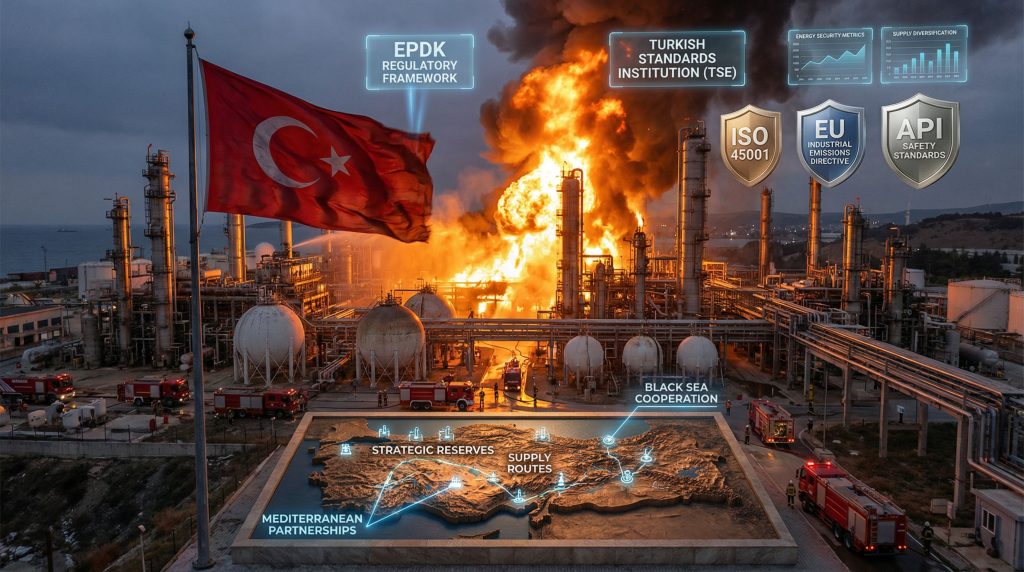
Turkey's energy infrastructure operates under a multi-layered regulatory framework designed to ensure both operational safety and strategic energy security. The Energy Market Regulatory Authority (EPDK) serves as the primary oversight body, wielding comprehensive authority over petroleum refining operations, storage facilities, and distribution networks.
Key regulatory components include:
• Industrial Safety Standards enforced by the Turkish Standards Institution (TSE)
• Environmental Impact Assessment requirements for major facilities
• Emergency Response Protocols mandated by the Disaster and Emergency Management Authority (AFAD)
• Strategic Reserve Management policies governing minimum inventory requirements
The regulatory architecture requires major refineries to maintain continuous monitoring systems for storage tank integrity, implement real-time leak detection protocols, and establish coordinated emergency response plans with local authorities. Furthermore, these digital monitoring trends demonstrate how technology integration can enhance safety protocols. However, the effectiveness of these requirements often depends on enforcement consistency and technological implementation standards.
International Compliance and Harmonization Standards
Turkey's petroleum infrastructure regulation increasingly aligns with international safety frameworks, particularly those developed by the European Union and American Petroleum Institute (API). The country has adopted elements of the EU Industrial Emissions Directive, requiring major facilities to implement Best Available Techniques (BAT) for pollution prevention and safety management.
Critical international standards include:
• ISO 45001 occupational health and safety management systems
• API 570 piping inspection codes for aging infrastructure
• International Maritime Organization (IMO) port facility security protocols
• Seveso III Directive principles for major accident prevention
These standards establish minimum safety thresholds for equipment inspection, personnel training, and incident reporting. However, implementation timelines and enforcement mechanisms vary significantly across different facility types and regional jurisdictions.
Infrastructure Vulnerabilities and Policy Response Gaps
Inspection and Monitoring System Deficiencies
Current regulatory frameworks reveal significant gaps in proactive risk assessment and predictive maintenance requirements. Many Turkish refineries operate aging infrastructure installed during the 1970s and 1980s, when safety standards were considerably less stringent than today's requirements.
Critical vulnerabilities include:
| Risk Category | Current Standard | Identified Gap |
|---|---|---|
| Storage Tank Inspection | Annual visual inspection | Limited ultrasonic testing frequency |
| Pipeline Integrity | 5-year comprehensive review | Inadequate corrosion monitoring |
| Emergency Systems | Quarterly testing | Insufficient integration testing |
| Personnel Training | Annual certification | Limited specialized skill development |
The regulatory framework lacks mandatory third-party verification protocols for aging infrastructure, particularly storage tanks and processing units over 25 years old. This creates potential blind spots where operators may delay costly upgrades while maintaining minimum compliance standards.
Emergency Preparedness and Coordination Shortcomings
Turkey's biggest refinery fire incidents expose critical weaknesses in inter-agency coordination and public notification systems. Current emergency response protocols often assume ideal conditions for equipment functionality and personnel availability, failing to account for cascade failure scenarios where multiple systems fail simultaneously.
Emergency preparedness gaps include:
• Inconsistent evacuation procedures across different facility types
• Limited cross-border coordination with neighbouring countries for major incidents
• Inadequate public warning systems for hazardous material releases
• Insufficient backup power systems for critical safety equipment
Recent incidents have demonstrated that existing evacuation radius calculations may be inadequate for large-scale fires involving multiple storage tanks, particularly when wind conditions spread smoke and toxic emissions beyond predicted zones. Consequently, effective supply chain resilience planning becomes essential for maintaining operational continuity during such emergencies.
Strategic Energy Security and Supply Chain Resilience
Domestic Refining Capacity Protection
Turkey's energy security policy prioritises domestic refining capacity preservation through various regulatory incentives and investment protection measures. The government has established investment tax credits for facility modernisation projects, particularly those incorporating advanced safety monitoring systems and environmental protection technologies.
Policy mechanisms include:
• 15% tax credit for safety system upgrades exceeding regulatory minimums
• Foreign ownership restrictions limiting international control to 49% of critical infrastructure
• Technology transfer requirements for international partnership agreements
• Workforce development programmes targeting specialised technical skills
However, these incentives may be insufficient to address the $2.3 billion estimated cost of bringing all Turkish refineries to modern safety standards. Current policy frameworks lack mandatory modernisation timelines, allowing operators to defer expensive upgrades indefinitely while meeting minimum regulatory requirements.
Geographic Distribution and Alternative Supply Routes
Turkey's strategic petroleum reserve management policy mandates 90-day minimum inventory requirements distributed across multiple geographic regions. This approach aims to ensure supply continuity during facility emergencies or regional disruptions. Moreover, these considerations align with broader energy security insights for regional stability.
The concentration of refining capacity in coastal areas creates significant vulnerability to natural disasters and security threats, requiring enhanced protection protocols and alternative supply arrangements.
Current distribution includes:
• Mediterranean coast facilities handling 60% of total capacity
• Black Sea region refineries processing 25% of domestic demand
• Inland storage facilities maintaining 15% of strategic reserves
This geographic concentration amplifies risks when major facilities experience disruptions, as alternative capacity may lack sufficient processing flexibility to handle different crude oil grades and product specifications.
Enhanced Market Oversight and Technology Integration
Financial Accountability and Insurance Requirements
Regulatory reforms under consideration include mandatory insurance coverage levels scaled to facility capacity and risk profiles. Current proposals suggest minimum coverage of $500 million for major refineries, with additional requirements for environmental remediation insurance and business interruption protection.
Enhanced oversight mechanisms include:
• Progressive penalty structures for repeated safety violations
• Corporate governance requirements for energy infrastructure operators
• Mandatory incident disclosure within 24 hours of any safety-related event
• Public accessibility of safety inspection reports and violation records
These measures aim to create market-based incentives for proactive safety management while ensuring adequate financial resources for incident response and environmental remediation.
Digital Monitoring and Predictive Analytics
Technology integration requirements represent a critical evolution in regulatory approaches to infrastructure safety. New standards mandate real-time monitoring systems capable of detecting early indicators of equipment failure, corrosion, and operational anomalies.
Required technology implementations include:
• Artificial intelligence-based predictive maintenance for critical equipment
• Continuous emissions monitoring with automated regulatory reporting
• Integrated cybersecurity protocols for industrial control systems
• Data sharing requirements between operators and regulatory authorities
Implementation timelines require major facilities to achieve full digital integration by 2028, with intermediate milestones for critical safety systems by 2026. However, smaller facilities may receive extended timelines based on demonstrated financial hardship and alternative safety measures.
International Policy Models and Best Practices
European Union Industrial Safety Frameworks
The Seveso III Directive provides comprehensive guidance for major accident prevention in industrial facilities, establishing risk-based regulatory approaches that scale oversight intensity with potential hazard levels. Turkish policymakers increasingly reference EU frameworks when developing domestic regulations.
Key EU principles include:
• Safety Management System requirements for high-hazard facilities
• Land-use planning restrictions around major industrial sites
• Public participation requirements in facility safety assessments
• Cross-border notification protocols for transboundary risks
The EU model emphasises operator responsibility for demonstrating safety rather than relying solely on regulatory compliance, shifting the burden of proof toward facility owners and operators. In addition, understanding geopolitical risk strategies helps inform policy frameworks during periods of international tension.
United States Process Safety Management Standards
The U.S. Environmental Protection Agency's Risk Management Program and OSHA Process Safety Management standards offer alternative regulatory models emphasising systematic risk analysis and management system integration.
US framework components include:
| Program Element | Implementation Requirement | Verification Method |
|---|---|---|
| Process Hazard Analysis | Every 5 years minimum | Third-party audit |
| Emergency Response Planning | Annual update and testing | Community involvement |
| Incident Investigation | Within 48 hours | Root cause analysis |
| Management of Change | Prior to any modification | Formal approval process |
The Chemical Safety Board investigation methodologies provide detailed frameworks for incident analysis, emphasising systemic factors rather than individual operator error as primary causes of major accidents.
The next major ASX story will hit our subscribers first
Regulatory Reform and Governance Modernisation
Independent Oversight Body Establishment
Proposed regulatory reforms include establishing an independent industrial safety authority with technical expertise and enforcement authority separate from economic regulators and industry promotion agencies. This approach aims to eliminate conflicts of interest where the same agency promotes industry development and enforces safety standards.
Reform components include:
• Technical expertise requirements for regulatory staff with minimum 10 years industry experience
• Mandatory rotation policies preventing excessive industry influence
• Performance measurement frameworks based on safety outcomes rather than administrative metrics
• Public transparency requirements for all regulatory decisions and enforcement actions
The proposed authority would have direct budget allocation from parliament rather than industry fees, ensuring independence from operator influence in funding decisions.
Climate Resilience and Future-Proofing Requirements
Legislative modernisation priorities increasingly emphasise climate change adaptation for coastal facilities and long-term decommissioning planning for aging infrastructure. New requirements mandate sea-level rise assessments for facilities within 5 kilometres of coastlines and extreme weather preparedness plans for temperature and precipitation changes.
Future-proofing elements include:
• Climate resilience standards for new facility construction
• Environmental justice considerations in permit approvals for disadvantaged communities
• Mandatory decommissioning bonds ensuring adequate funds for facility closure
• Technology transition planning for renewable energy integration
Economic Incentives for Proactive Safety Management
Market-Based Safety Mechanisms
Financial incentive structures represent critical tools for encouraging voluntary safety improvements beyond minimum regulatory requirements. Turkey's carbon pricing system, scheduled for implementation in 2027, will include emissions penalties that make aging, inefficient facilities more expensive to operate.
Incentive mechanisms include:
• Green bonds offering reduced interest rates for clean technology adoption
• Insurance premium reductions up to 25% for certified safety management systems
• Tax benefits for facilities achieving zero lost-time incident records
• Public-private partnership models for infrastructure modernisation projects
Carbon pricing impacts are projected to add $15-25 per ton of CO2 equivalent for older refineries, creating economic pressure for efficiency improvements and safety system upgrades that reduce emission risks. Furthermore, energy storage investments in backup systems enhance overall facility resilience.
Investment Framework for Infrastructure Modernisation
Current economic analysis suggests $8.7 billion in total investment required to bring Turkish energy infrastructure to international safety standards. Government policy frameworks propose cost-sharing arrangements where operators contribute 60% of upgrade costs while public funds support 40% through various incentive programmes.
Investment priorities include:
| Infrastructure Category | Estimated Cost (USD Billions) | Priority Level |
|---|---|---|
| Storage Tank Replacement | $3.2 | Critical |
| Pipeline Integrity Systems | $2.1 | High |
| Emergency Response Equipment | $1.4 | High |
| Digital Monitoring Systems | $1.2 | Medium |
| Training and Certification | $0.8 | Medium |
Regional Energy Cooperation and Security Integration
Mediterranean Energy Security Partnerships
Regional cooperation frameworks offer opportunities for shared emergency response protocols and coordinated strategic reserve management. Turkey has initiated discussions with Greece, Cyprus, and Italy regarding joint incident response capabilities and cross-border evacuation procedures.
Cooperation mechanisms include:
• Shared emergency response teams with specialised equipment for major industrial accidents
• Coordinated strategic reserve releases during regional supply disruptions
• Harmonised safety standards across Mediterranean refining facilities
• Joint training programmes for emergency response personnel
Cross-border pipeline safety protocols require coordination of inspection schedules, maintenance windows, and emergency shutdown procedures to minimise regional supply disruptions during routine maintenance activities.
Black Sea Energy Corridor Development
Turkey's position as a critical energy transit hub necessitates enhanced coordination with Romania, Bulgaria, and Georgia for alternative supply route development and infrastructure security. Recent agreements focus on redundant pipeline capacity and shared storage facility access during emergency conditions.
Regional development priorities include:
• Alternative supply route diversification reducing dependence on single pipeline systems
• Maritime safety protocol standardisation across Black Sea ports handling petroleum products
• Environmental protection framework integration for transboundary pollution prevention
• Investment coordination mechanisms preventing duplicative infrastructure development
Adaptive Governance and Future Policy Evolution
Evidence-Based Decision Making Frameworks
Turkey's energy policy evolution increasingly emphasises data-driven regulatory development and regular policy review mechanisms. New governance frameworks require quinquennial comprehensive reviews of all major safety regulations, incorporating incident analysis, technological developments, and international best practices.
Adaptive governance elements include:
• Stakeholder consultation requirements for all major regulatory changes
• Cost-benefit analysis mandates for new safety requirements
• International benchmark comparisons for regulatory effectiveness
• Performance measurement systems tracking safety outcomes over time
Evidence-based approaches require regulatory agencies to demonstrate quantifiable safety improvements from new requirements, moving beyond compliance-focused metrics toward outcome-based evaluation criteria.
Long-Term Energy Transition Planning
Future-proofing strategies must account for Turkey's renewable energy targets of 60% renewable electricity by 2035 and potential stranded asset risks for aging petroleum infrastructure. Regulatory frameworks increasingly emphasise transition planning and just transition policies for communities dependent on fossil fuel infrastructure.
Transition considerations include:
• Workforce retraining programmes for renewable energy sector employment
• Community economic development support for regions facing facility closures
• Environmental restoration requirements for decommissioned industrial sites
• Technology innovation incentives for clean energy infrastructure development
The regulatory evolution must balance immediate safety imperatives with long-term sustainability goals, ensuring that current infrastructure investments support rather than hinder Turkey's energy transition objectives. However, analysis of incidents such as Turkey's biggest refinery fire reveals critical gaps in current frameworks that require immediate attention. Consequently, sophisticated planning mechanisms must adapt to changing energy markets while maintaining critical safety standards throughout the transition period.
Given Turkey's strategic position in regional energy markets, as highlighted by detailed assessments of the country's refining capabilities, effective risk management becomes even more crucial for maintaining stability. For instance, recent incidents at Tüpraş facilities demonstrate the immediate need for enhanced safety protocols and emergency response coordination.
Disclaimer: This analysis is based on publicly available information and regulatory frameworks as of early 2026. Policy developments and regulatory changes may affect the accuracy of specific requirements and timelines discussed. Readers should consult current regulatory guidance and qualified professionals for specific compliance requirements.
Want to Stay Ahead of Energy Market Disruptions?
Discovery Alert's proprietary Discovery IQ model delivers instant notifications on significant ASX mineral discoveries, empowering investors to identify actionable opportunities across critical energy transition materials and infrastructure sectors ahead of the broader market. Explore Discovery Alert's comprehensive discoveries page to understand how major mineral findings can generate substantial returns, then begin your 14-day free trial today to secure your market-leading advantage in the evolving energy landscape.