August 9, 2026
Understanding the Strategic Framework Behind U.S. Energy Blockades
The intersection of geopolitical pressure and critical energy infrastructure demonstrates how modern economic warfare targets the foundational elements of petroleum production systems. When export restrictions combine with financial isolation, they create cascading operational constraints that extend far beyond simple market access limitations. Venezuela's petroleum sector faces this complex challenge as Washington implements comprehensive economic restrictions targeting the nation's hydrocarbon exports. Furthermore, the U.S. blockade Venezuela oil production represents a significant escalation in foreign policy tools that directly impact global oil supply chains and regional geopolitics.
The technical complexity of extra-heavy crude production creates unique vulnerabilities when subjected to international sanctions regimes. Unlike conventional petroleum operations, Venezuela's primary production assets require continuous capital investment, specialized equipment maintenance, and complex supply chain coordination to maintain basic operational functionality. This infrastructure dependency transforms economic restrictions from temporary market barriers into potential long-term production capacity constraints.
When big ASX news breaks, our subscribers know first
Geographic Significance of Venezuela's Petroleum Reserves
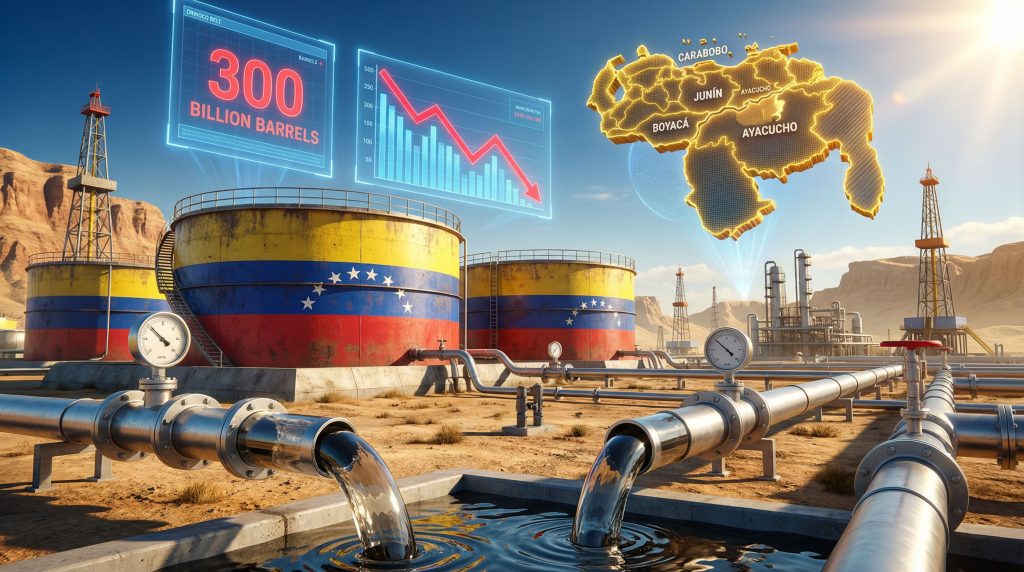
The Orinoco Belt represents one of the world's most significant petroleum geological formations, containing approximately 303 billion barrels of oil originally in place, with roughly 236 billion barrels classified as technically recoverable reserves according to U.S. Geological Survey assessments. This massive deposit spans four primary development blocks: Boyacá, Junín, Ayacucho, and Carabobo, covering approximately 55,000 square kilometers of northeastern Venezuela.
The concentration of such extensive reserves within a single geographic region creates both strategic advantages and critical vulnerabilities. While the scale enables economies of scale in infrastructure development, it also creates single-point-of-failure risks when subjected to external disruption. The Junín block contains the heaviest crude oil with API gravity between 6-8 degrees, while the Carabobo block produces relatively lighter crude within the extra-heavy category at 12-16 degrees API gravity.
Geological Formation Characteristics
The Orinoco Belt's geological structure represents a Miocene-age fluvio-deltaic stratigraphic succession characterised by braided river systems and deltaic depositional environments. Reservoir quality varies significantly across development blocks, with porosity ranging from 25-35% and permeability values of 1,000-10,000 millidarcies in primary productive intervals.
These geological characteristics create specific operational requirements:
• Complex drilling programmes requiring horizontal and directional capabilities
• Specialised completion designs for unconsolidated formations
• Enhanced oil recovery methods due to high viscosity crude properties
• Extensive surface processing infrastructure for crude quality improvement
The reserve base represents an asymmetric geopolitical asset where extensive volume requires substantial capital investment, advanced technology, and consistent market access, making the region vulnerable to disruption through financial or technological restrictions.
Technical Complexity of Extra-Heavy Crude Production
Extra-heavy crude production from the Orinoco Belt presents fundamentally different operational parameters compared to conventional petroleum extraction. The crude oil exhibits API gravity ranging from 6-16 degrees and viscosity between 100-1,000+ centipoises at reservoir conditions, compared to conventional crude viscosity of 2-10 cP.
These physical properties create cascading technical requirements throughout the production system:
Thermal Recovery Requirements
Cyclic steam stimulation represents the primary enhanced recovery method, involving high-pressure steam injection into production wells in cycles of 7-14 days. Steam-oil ratio requirements typically range from 3-5 barrels of steam per barrel of oil produced, creating substantial energy input demands and infrastructure complexity.
In-situ upgrading technologies offer alternative approaches through partial oxidation at reservoir conditions, potentially increasing production rates by 20-40% compared to unenhanced extraction methods.
Processing Infrastructure Dependencies
Traditional Venezuelan upgraders employ delayed coking, hydrotreating, and hydrocracking processes to convert extra-heavy crude to synthetic crude oil with API gravity of 25-30 degrees. These facilities require:
• Continuous feedstock flow of 200,000-400,000 barrels per day
• Minimum sustainable operating rates of 80-85% capacity
• Specialised catalyst systems and replacement schedules
• Dedicated utilities infrastructure including steam generation and hydrogen supply
The Petropiar upgrading facility historically processed approximately 155,000 barrels per day before sanctions impact reduced operations to 15,000-30,000 barrels per day by 2023, illustrating operational constraint severity.
Diluent Management Systems
Orinoco extra-heavy crude requires blending with diluent products at ratios of 20-40 volume percent to achieve pipeline transport specifications. This creates dependency on either domestic naphtha production, international imports, or condensate supplies from offshore operations. Junín block crude traditionally required approximately 25-30% naphtha diluent by volume, creating consistent demand for 50,000-70,000 barrels per day of naphtha during optimal production periods.
Storage Capacity Limitations Under Export Restrictions
The implementation of comprehensive export restrictions creates immediate storage capacity constraints across Venezuela's petroleum infrastructure. Moreover, the Venezuela oil production halt has reached critical levels across multiple facility types, forcing operational decisions that directly impact production sustainability.
| Storage Type | Capacity (Million Barrels) | Current Utilisation | Impact Level |
|---|---|---|---|
| Tank Farms | 45-50 | 95%+ | Critical |
| Marine Terminals | 8-12 | 100% | Severe |
| Pipeline Systems | 15-20 | 90%+ | High |
Critical Storage Bottlenecks
Tank farm capacity of 45-50 million barrels operates at 95%+ utilisation, representing approximately 42.75-47.5 million barrels currently stored. This near-maximum utilisation eliminates operational flexibility and forces immediate production curtailment when export channels become unavailable.
Marine terminal facilities with 8-12 million barrels capacity have reached 100% utilisation, creating severe constraints on crude oil loading operations and forcing extended vessel waiting periods when export authorisations become available.
Pipeline system capacity of 15-20 million barrels operates at 90%+ utilisation, creating operational bottlenecks throughout the transportation network from production facilities to export terminals.
Storage Overflow Management Protocols
When storage facilities approach maximum capacity, petroleum companies implement systematic overflow management procedures:
- Production curtailment phases: Gradual reduction from peak capacity targeting least efficient wells
- Selective well targeting: Prioritising high-maintenance or low-productivity assets for shutdown
- Infrastructure preservation: Maintaining critical pipeline and processing systems during reduced operations
- Restart cost calculations: Evaluating future reactivation expenses for mothballed facilities
The current situation forces at least 25% production reduction in the Orinoco Belt to 500,000 barrels per day, representing a 15% cut of Venezuela's overall output from 1.1 million barrels per day.
Well Shutdown Protocols and Technical Consequences
The decision to implement well shutdowns represents a critical operational transition with long-term technical and economic implications. However, well shutdown protocols follow systematic approaches designed to minimise formation damage while preserving future restart capability.
Production Curtailment Methodology
PDVSA has initiated shutdowns beginning with the Junín division, which produces the most extra-heavy crude oil, before extending to Ayacucho and Carabobo blocks containing less heavy oils. This prioritisation reflects both technical considerations and logistical constraints in managing different crude quality streams.
The phased approach involves:
• Phase 1: Junín block well closures targeting highest viscosity production
• Phase 2: Ayacucho block selective shutdowns based on well productivity
• Phase 3: Carabobo block closures if storage constraints persist
• Phase 4: Complete production suspension if export channels remain blocked
Formation Damage Risk Assessment
Critical Infrastructure Alert: Extended well shutdowns can result in permanent formation damage, requiring expensive workover operations and potentially reducing ultimate recovery rates by 10-25%.
Extended well shutdowns in extra-heavy crude reservoirs create specific technical risks:
Wellbore stability issues emerge when production ceases, as pressure differentials change and formation fluids cool, potentially causing sand production or casing deformation during restart operations.
Formation plugging occurs when heavy crude solidifies in near-wellbore regions, requiring thermal stimulation or chemical treatments to restore productivity during reactivation.
Equipment deterioration accelerates in idle wells due to corrosive reservoir fluids and lack of regular maintenance access, increasing restart costs and timeline requirements.
Restart Economics and Timeline Considerations
Well reactivation in extra-heavy crude operations involves substantial cost and time requirements:
| Restart Component | Cost Range (per well) | Timeline |
|---|---|---|
| Wellbore Inspection | $50,000-100,000 | 2-3 weeks |
| Thermal Stimulation | $200,000-500,000 | 4-8 weeks |
| Equipment Replacement | $100,000-300,000 | 6-12 weeks |
| Production Testing | $25,000-75,000 | 2-4 weeks |
The aggregate restart cost for 500+ wells in the affected Orinoco blocks could exceed $175-500 million, representing a substantial capital requirement that may delay production restoration even after export restrictions are modified or lifted.
How Does the U.S. Blockade Venezuela Oil Production Affect Global Markets?
Venezuela's petroleum sector generates approximately 95% of the nation's export earnings, making production curtailments directly translatable to fiscal and economic impacts. In addition, the current 15% reduction in overall production creates measurable revenue consequences across multiple economic sectors.
Daily Revenue Calculations
At current crude prices of approximately $60-70 per barrel, the production reduction of 165,000 barrels per day (15% of 1.1 million barrels per day) translates to:
• Daily revenue loss: $10-11.5 million
• Monthly revenue impact: $300-345 million
• Annual fiscal impact: $3.6-4.1 billion in reduced export earnings
These calculations assume sustained production curtailment and stable international crude pricing, though actual revenue impacts may vary based on crude quality differentials and transportation cost adjustments.
Economic Spillover Effects
The petroleum sector's dominant role in Venezuelan economics creates cascading impacts throughout related industries:
Employment effects extend beyond direct petroleum workers to include:
• Service company personnel (drilling, completion, maintenance)
• Transportation and logistics workers
• Port and terminal operations staff
• Administrative and technical support roles
Regional economic spillover affects:
• Local supplier networks providing goods and services
• Construction and infrastructure maintenance companies
• Financial services handling petroleum-related transactions
• Tourism and hospitality sectors in petroleum-producing regions
Government Fiscal Constraints
Reduced petroleum revenues directly impact government fiscal capacity through multiple channels:
Direct tax revenue from petroleum operations includes corporate income taxes, royalty payments, and special petroleum taxes that typically represent 60-70% of total government revenues.
Foreign exchange earnings from petroleum exports provide the primary source of hard currency for essential imports including food, medicine, and industrial equipment.
Social programme funding relies heavily on petroleum revenues to support education, healthcare, and infrastructure development initiatives.
The next major ASX story will hit our subscribers first
Comparative Analysis: Venezuela vs. Global Heavy Oil Producers
Venezuela's position within global heavy oil markets demonstrates both the scale of potential supply disruption and the relative concentration of extra-heavy crude production capability. Furthermore, comparative analysis reveals significant structural differences between Venezuelan operations and other major heavy oil producing regions.
| Producer | Daily Output (bpd) | Heavy Oil Share | Sanctions Status |
|---|---|---|---|
| Venezuela | 1.1 million | 85% | Active restrictions |
| Canada | 5.2 million | 60% | No restrictions |
| Mexico | 1.8 million | 40% | No restrictions |
| Iran | 3.1 million | 25% | Partial restrictions |
Production Profile Distinctions
Canadian oil sands operations produce heavy crude with API gravity of 18-22 degrees, which is substantially lighter than Venezuelan extra-heavy crude at 6-16 degrees. Canadian operations utilise mining and SAGD (Steam-Assisted Gravity Drainage) technologies that differ significantly from Venezuelan thermal stimulation methods.
Mexican heavy oil production from fields such as Ku-Maloob-Zaap involves conventional heavy crude with API gravity of 22-28 degrees, requiring less complex processing and transportation infrastructure compared to Venezuelan extra-heavy operations.
Iranian heavy crude from fields including Soroosh and Nowruz produces oil with API gravity of 16-24 degrees, falling within conventional heavy crude classifications that require standard refining capabilities rather than specialised upgrading infrastructure.
Market Substitutability Analysis
Venezuelan extra-heavy crude serves specific market segments that cannot be easily replaced by other heavy oil producers:
Upgrader feedstock for synthetic crude production requires specific viscosity and sulphur content characteristics that limit substitution options to similar extra-heavy deposits.
Blending components for heavy fuel oil production utilise Venezuelan crude's unique properties to create marine fuel products meeting international specifications.
Specialised refinery configurations in markets such as India and China have been optimised for Venezuelan crude characteristics, creating switching costs for alternative supply sources.
Global Supply Impact Assessment
The removal of 165,000 barrels per day of Venezuelan heavy crude from global markets represents approximately 0.16% of total global production but 3-4% of global extra-heavy crude supply. This concentration creates potential price premiums for remaining extra-heavy crude producers and supply chain adjustments for refineries configured to process Venezuelan crude. Consequently, recent developments have contributed to oil price rally scenarios, while simultaneously raising concerns about potential oil price crash scenarios.
China's Role as Primary Petroleum Buyer
China's position as Venezuela's primary petroleum buyer creates a critical commercial relationship that influences both countries' strategic energy planning and trade policy implementation. Chinese state-owned enterprises maintain approximately 80% market share of Venezuelan crude exports, representing a substantial portion of China's crude oil import requirements.
Commercial Relationship Structure
China National Petroleum Corporation (CNPC) and Sinopec maintain long-term supply agreements with PDVSA spanning multiple years and incorporating various commercial terms including:
• Loan-for-oil arrangements providing upfront financing in exchange for future crude deliveries
• Infrastructure development agreements combining petroleum sector investment with crude supply commitments
• Joint venture operations in upstream development projects including enhanced oil recovery initiatives
• Refinery adaptation programmes modifying Chinese processing facilities to handle Venezuelan extra-heavy crude
Payment and Settlement Mechanisms
Chinese petroleum purchases from Venezuela utilise non-dollar denominated transactions that circumvent traditional international banking systems. These arrangements include:
Yuan-denominated contracts providing China with additional international currency usage while offering Venezuela access to Chinese goods and services markets.
Barter trade systems exchanging Venezuelan crude for Chinese manufactured goods, construction services, and technology transfers without requiring hard currency settlements.
Strategic petroleum reserve deliveries where Venezuelan crude contributes to China's emergency stockpile accumulation programmes while providing guaranteed purchase commitments.
Infrastructure Investment Programmes
Chinese companies have participated in substantial infrastructure development projects within Venezuela's petroleum sector:
Upstream development investments totalling $20+ billion since 2007 include drilling programmes, enhanced oil recovery projects, and production facility construction.
Refinery and petrochemical projects involve technology transfer and equipment supply for domestic processing capability enhancement.
Transportation infrastructure improvements include pipeline construction, port facility upgrades, and tank farm expansion projects supporting increased export capacity.
Strategic Petroleum Reserve Integration
China's strategic petroleum reserve programme incorporates Venezuelan crude as part of emergency stockpile diversification:
• Long-term supply security through multi-year purchase agreements
• Price hedging utilising fixed-price contracts during volatile market periods
• Quality diversification including extra-heavy crude in strategic reserve mix
• Geopolitical risk distribution reducing dependence on Middle Eastern suppliers
This relationship provides China with energy security benefits while offering Venezuela guaranteed revenue streams during periods of restricted market access. However, the trade war global effects continue to influence these arrangements significantly.
Alternative Market Development Strategies
Venezuelan petroleum officials have pursued comprehensive market diversification initiatives to reduce dependence on traditional Western markets and develop alternative commercial relationships that circumvent U.S. financial restrictions.
Asian Market Expansion Initiatives
Indian refinery partnerships have emerged as significant alternative markets, with companies such as Reliance Industries and Indian Oil Corporation developing specialised processing capabilities for Venezuelan extra-heavy crude. These relationships involve:
• Custom refinery modifications optimising processing units for Venezuelan crude characteristics
• Long-term supply contracts providing price certainty and volume commitments
• Technology sharing agreements improving Venezuelan upstream operations through Indian engineering expertise
• Joint venture opportunities in downstream processing and petrochemical development
Malaysian and Thai markets represent emerging opportunities for Venezuelan crude exports, particularly for:
• Marine fuel oil production utilising extra-heavy crude as blending components
• Petrochemical feedstock applications where heavy crude serves specialised processing requirements
• Regional refinery optimisation programmes adapting existing facilities for Venezuelan crude processing
Regional Partnership Development
The Petrocaribe initiative with Caribbean nations provides regional market opportunities while supporting energy security for participating countries:
Preferential financing terms offer petroleum products to Caribbean nations with extended payment periods and concessional interest rates.
Infrastructure development cooperation includes refinery upgrades, storage facility construction, and distribution system improvements in participating countries.
Regional energy integration creates interconnected supply networks reducing dependence on external petroleum suppliers.
Barter Trade System Implementation
Oil-for-goods arrangements with allied nations provide alternative transaction mechanisms avoiding traditional financial systems:
| Trading Partner | Exchange Products | Volume (bpd) | Settlement Terms |
|---|---|---|---|
| Russia | Machinery/Technology | 50,000-75,000 | 6-month delivery |
| Turkey | Construction Materials | 25,000-40,000 | Project-based |
| Iran | Refined Products | 30,000-50,000 | Quarterly balance |
These arrangements provide Venezuela with essential goods and services while maintaining petroleum export revenues through non-traditional commercial structures.
Deferred Maintenance and Capital Investment Challenges
Extended periods of restricted market access create cascading infrastructure deterioration that extends beyond immediate production impacts. Venezuelan petroleum facilities face mounting maintenance backlogs and capital investment constraints that threaten long-term production capability.
Critical Infrastructure Degradation
Upgrading facility maintenance requires specialised components and technical expertise that may be subject to export restrictions:
• Delayed coking drum replacement units requiring high-temperature steel specifications
• Heat exchanger components with specialised metallurgy for heavy crude processing
• Catalyst replacement systems for hydrotreating and hydrocracking operations
• Rotating equipment overhauls including compressors, pumps, and turbines
The Petropiar upgrading facility exemplifies infrastructure challenges, with production declining from 155,000 barrels per day to 15,000-30,000 barrels per day primarily due to equipment maintenance constraints and component replacement limitations.
Maintenance Cost Escalation
Deferred maintenance creates compounding cost increases over time:
| Maintenance Category | Normal Cost | Deferred Cost Multiplier | Extended Delay Impact |
|---|---|---|---|
| Routine Inspection | $100,000 | 1.5x | 2.0x |
| Component Replacement | $500,000 | 2.0x | 4.0x |
| Major Overhaul | $2,000,000 | 2.5x | 6.0x |
| Emergency Repair | $1,000,000 | 3.0x | 8.0x |
Preventive maintenance programmes become increasingly expensive as equipment operates beyond recommended service intervals, creating reliability risks and unplanned shutdown scenarios.
Spare parts inventory management becomes critical when replacement components require extended procurement timelines or alternative sourcing strategies.
Technology Obsolescence Risks
Extended periods without equipment upgrades create technological gaps that affect operational efficiency:
Digital oilfield technologies including real-time monitoring, optimisation software, and automated control systems require regular updates and technical support that may be restricted under sanctions regimes.
Safety and environmental systems such as blowout preventers, emission control technologies, and leak detection systems require ongoing certification and component replacement to maintain regulatory compliance.
Production optimisation equipment including artificial lift systems, flow measurement devices, and well testing equipment requires technical support and calibration services that may become unavailable.
Capital Investment Postponement
Restricted access to international capital markets and technology providers forces postponement of critical development projects:
Enhanced oil recovery projects requiring steam generation facilities, thermal injection systems, and specialised drilling equipment face indefinite delays when technology transfer restrictions prevent equipment acquisition.
Facility expansion programmes including new upgrading capacity, storage tank construction, and pipeline development require substantial capital investment that may be unavailable during sanctions periods.
Environmental compliance upgrades including emissions control systems, waste treatment facilities, and remediation projects may be postponed despite regulatory requirements. This creates both OPEC meeting impact considerations and broader commodity market impact consequences.
Technology Transfer Restrictions and Operational Impacts
U.S. economic restrictions typically include comprehensive limitations on technology transfers that create operational constraints extending far beyond financial transactions. These restrictions target critical components necessary for maintaining complex petroleum operations.
Advanced Drilling Equipment Limitations
Horizontal and directional drilling systems represent critical technologies for optimising recovery from the Orinoco Belt's geological formations:
• Rotary steerable systems enabling precise wellbore placement in thin pay zones
• Measurement-while-drilling tools providing real-time geological and engineering data
• Advanced bit technologies optimised for extra-heavy crude formations
• Completion equipment including sand control systems and thermal completion designs
The restriction of these technologies limits new well development and forces reliance on conventional drilling methods that may reduce ultimate recovery efficiency by 15-25% in complex reservoir conditions.
Digital Oilfield Technology Access
Modern petroleum operations rely heavily on integrated digital systems for optimisation and monitoring:
Real-time monitoring systems providing continuous surveillance of:
• Production rates and pressure measurements
• Equipment performance and maintenance requirements
• Safety system status and alarm management
• Environmental compliance monitoring
Optimisation software platforms enabling:
• Production forecasting and reservoir modelling
• Artificial lift optimisation and energy efficiency improvements
• Preventive maintenance scheduling and cost optimisation
• Supply chain management and inventory optimisation
Cybersecurity and data management systems protecting critical infrastructure from operational disruption and ensuring data integrity across complex industrial networks.
Refinery and Processing Equipment Constraints
Venezuelan upgrading facilities require specialised components subject to technology transfer restrictions:
Catalyst systems for heavy oil conversion processes include:
• Hydroprocessing catalysts for sulphur and nitrogen removal
• Cracking catalysts for molecular weight reduction and quality improvement
• Reforming catalysts for octane enhancement in gasoline production
• Specialised additives for process optimisation and equipment protection
Critical processing equipment includes:
• High-temperature reactors designed for heavy oil conversion
• Separation systems for product quality control
• Heat recovery equipment for energy efficiency optimisation
• Environmental control systems for emissions management
Safety and Environmental Technology Restrictions
Blowout prevention systems represent critical safety technologies subject to export restrictions:
• Advanced BOP stacks with automated activation systems
• Control system components for remote operation capability
• Testing and maintenance equipment for regulatory compliance
• Emergency response technologies for well control scenarios
Emission control technologies required for environmental compliance include:
• Flare gas recovery systems for methane emission reduction
• Sulphur recovery units for air quality compliance
• Water treatment systems for produced water management
• Leak detection and repair equipment for fugitive emission control
The restriction of these technologies creates potential safety risks and environmental compliance challenges that may force production curtailment beyond economic considerations.
Regulatory Compliance Framework for International Energy Companies
International corporations operating in global energy markets must navigate complex regulatory frameworks when engaging with Venezuelan petroleum operations. The compliance requirements extend beyond direct business relationships to include secondary sanctions risks and financial system restrictions.
Due Diligence Requirements Under U.S. Sanctions Law
Office of Foreign Assets Control (OFAC) regulations require comprehensive due diligence procedures for any potential Venezuelan petroleum transactions:
Entity identification protocols involving:
• Beneficial ownership analysis of counterparties and intermediaries
• Sanctions list screening against designated persons and blocked entities
• Corporate structure verification identifying government ownership or control
• Transaction chain analysis tracing payment flows and commodity transfers
Documentation requirements for compliance purposes include:
• Legal entity formation documents and ownership registrations
• Financial institution relationships and account verification procedures
• Insurance and shipping documentation confirming sanctions compliance
• Product origin certification verifying petroleum source and processing history
Secondary Sanctions Risk Management
Non-U.S. entities face potential penalties for Venezuelan petroleum transactions even without direct U.S. jurisdiction:
Financial institution restrictions include:
• Correspondent banking limitations affecting international payment processing
• Letter of credit constraints restricting trade finance availability
• Asset freezing risks for banks processing sanctioned transactions
• Dollar clearing restrictions limiting access to U.S. financial systems
Insurance and shipping constraints affect:
• Marine insurance availability for vessels transporting Venezuelan crude
• Cargo coverage limitations restricting risk management options
• Port access restrictions in jurisdictions enforcing sanctions compliance
• Flag state regulations governing vessel registration and operation
Risk Assessment Methodologies for Energy Investments
Energy companies develop comprehensive risk frameworks addressing multiple compliance dimensions:
| Risk Category | Assessment Criteria | Mitigation Strategies |
|---|---|---|
| Legal/Regulatory | Sanctions compliance status | Legal review processes |
| Operational | Infrastructure access limitations | Alternative supply chains |
| Financial | Payment mechanism availability | Non-dollar transactions |
| Reputational | Stakeholder perception management | ESG compliance programmes |
Legal and regulatory risk assessment involves:
• Jurisdiction analysis determining applicable legal frameworks
• Regulatory change monitoring tracking sanctions modification and enforcement
• Compliance cost calculation quantifying legal and administrative expenses
• Enforcement precedent review analysing historical penalty patterns
Operational risk evaluation includes:
• Supply chain vulnerability assessment identifying critical dependency points
• Technology transfer limitations evaluating equipment and service availability
• Infrastructure reliability analysis assessing maintenance and upgrade capabilities
• Force majeure scenario planning preparing for operational disruption events
Compliance Programme Implementation
Corporate compliance frameworks require systematic implementation across multiple organisational levels:
Senior management oversight involving:
• Board-level sanctions committee establishment
• Executive accountability for compliance programme effectiveness
• Regular compliance training for decision-making personnel
• Performance measurement linking compliance to management evaluation
Operational compliance procedures including:
• Transaction approval workflows with multiple authorisation levels
• Real-time screening systems for customer and supplier verification
• Documentation retention meeting regulatory record-keeping requirements
• Audit and monitoring programmes ensuring ongoing compliance effectiveness
Future Scenarios: Policy Evolution and Market Adaptation
The trajectory of Venezuelan petroleum sector development depends heavily on potential changes in international sanctions regimes and diplomatic engagement frameworks. Historical precedent suggests multiple possible resolution pathways with distinct implications for market participants and infrastructure development.
Potential Sanctions Relief Pathways
Negotiated political settlements represent the most comprehensive resolution mechanism:
• Democratic transition agreements potentially involving international oversight and verification mechanisms
• Human rights compliance frameworks linking sanctions relief to specific policy implementations
• Regional diplomatic initiatives involving Latin American countries as mediating parties
• International organisation engagement utilising UN, OAS, or other multilateral frameworks
Graduated sanctions lifting approaches may involve phased implementation:
Phase 1: Humanitarian exemptions allowing medical supplies, food imports, and essential services while maintaining petroleum export restrictions.
Phase 2: Limited petroleum transactions permitting specific volume limits or designated buyer arrangements with enhanced monitoring requirements.
Phase 3: Technology transfer permissions enabling infrastructure maintenance and safety system upgrades while maintaining broader economic restrictions.
Phase 4: Comprehensive sanctions removal restoring full market access and financial system integration following political agreement implementation.
Infrastructure Recovery Timeline Scenarios
Rapid recovery scenario (6-12 months sanctions relief):
• Well restart operations requiring $175-500 million investment across 500+ wells
• Equipment replacement programmes addressing critical maintenance backlogs
• Technology system restoration updating digital infrastructure and safety systems
• Workforce reactivation recalling skilled personnel and implementing training programmes
Extended recovery scenario (2-5 years gradual relief):
• Phased production restoration prioritising highest-productivity wells and facilities
• Infrastructure modernisation combining restoration with technology upgrade programmes
• International partnership development attracting foreign investment and technical expertise
• Market reintegration rebuilding commercial relationships and supply chain networks
Strategic Planning for Energy Market Participants
Scenario planning methodologies enable companies to prepare for multiple policy outcomes:
Investment decision frameworks considering:
• Risk-adjusted return calculations incorporating sanctions duration scenarios
• Technology transfer timeline assumptions for equipment availability
• Market access probability assessments for various resolution pathways
• Competitive positioning analysis during market reintegration periods
Alternative asset evaluation strategies:
• Geographic diversification reducing exposure to single-country risk factors
• Technology adaptation developing sanctions-compliant operational capabilities
• Financial structure optimisation utilising non-dollar financing and payment systems
• Partnership development with non-U.S. entities maintaining market access
Long-Term Market Integration Considerations
Supply chain reconstruction requires systematic rebuilding of commercial relationships:
Equipment and service providers must navigate:
• Technology gap assessment determining infrastructure modernisation requirements
• Regulatory compliance verification ensuring ongoing sanctions compliance during transition
• Financial system reintegration restoring normal payment and financing mechanisms
• Quality assurance programmes verifying operational reliability after extended disruption
International petroleum buyers face considerations including:
• Supply contract renegotiation reflecting changed market conditions and pricing
• Quality specification verification ensuring crude characteristics meet processing requirements
• Transportation logistics rebuilding shipping networks and terminal access
• Risk management strategies addressing political and operational uncertainty
The complexity of these considerations demonstrates how comprehensive economic restrictions create long-term market disruption extending well beyond the immediate sanctions period, requiring sustained effort and investment to restore full operational capability.
Conclusion: Balancing Geopolitical Objectives with Energy Market Stability
The implementation of comprehensive economic restrictions targeting the U.S. blockade Venezuela oil production demonstrates the complexity of modern geopolitical tools and their far-reaching consequences. The technical intricacies of extra-heavy crude operations create particular vulnerabilities when subjected to systematic supply chain disruption and technology transfer limitations.
Venezuela's petroleum sector challenges illustrate how economic warfare extends beyond simple financial restrictions to encompass critical infrastructure dependencies. The cascading effects of export limitations, storage constraints, and deferred maintenance create compounding operational difficulties that may persist long after policy restrictions are modified or removed.
The global energy market implications of Venezuelan production curtailments highlight the interconnected nature of international petroleum supply chains. While the immediate volume impact represents a small percentage of global production, the concentration of extra-heavy crude reserves and specialised refining infrastructure creates specific market vulnerabilities that affect pricing and supply chain resilience.
Future policy considerations must balance geopolitical objectives with energy market stability requirements. The technical complexity of petroleum infrastructure and the extended timeline requirements for operational restoration suggest that comprehensive economic restrictions create long-term consequences extending well beyond their immediate policy objectives.
Ready to Capitalise on Critical Energy Market Disruptions?
Discovery Alert's proprietary Discovery IQ model provides instant notifications on significant ASX mineral discoveries, including those in the critical energy and uranium sectors that may benefit from global supply disruptions. Understand why major mineral discoveries can lead to substantial market returns by exploring Discovery Alert's dedicated discoveries page, showcasing historic examples of exceptional investment outcomes. Begin your 30-day free trial today to position yourself ahead of these rapidly evolving energy markets.