
May 16, 2026
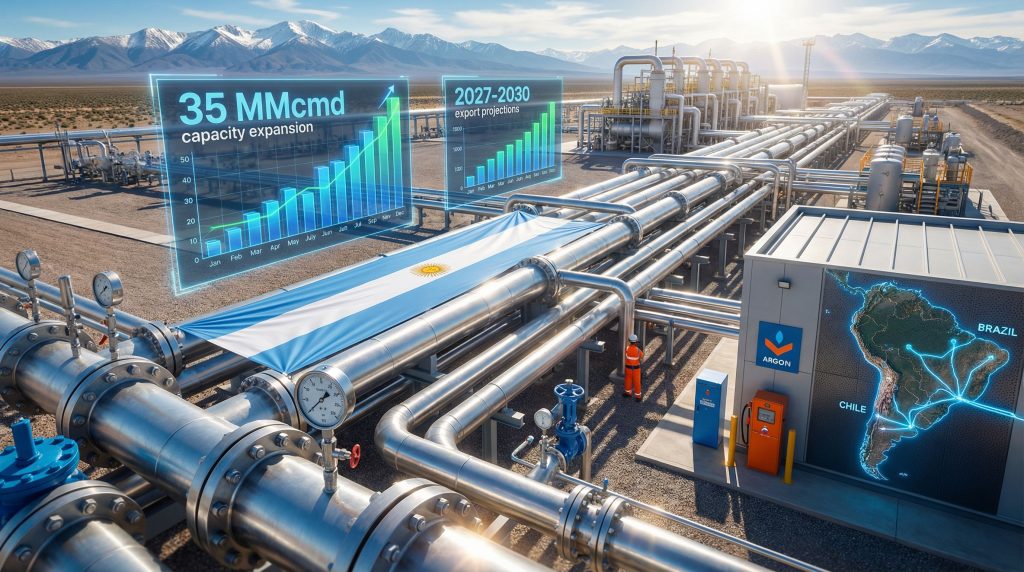
Global energy markets face unprecedented structural transformation as traditional supply chains fragment and regional production centers emerge as critical strategic assets. The convergence of geopolitical tensions, infrastructure constraints, and resource depletion creates complex scenarios where unconventional reserves become central to national energy security. Argentina's gas transportation network exemplifies this transition, where legacy systems designed for declining conventional sources must adapt to accommodate prolific shale production from previously peripheral regions. These energy transition challenges affect global oil price dynamics and influence energy security measures worldwide.
Strategic Infrastructure Realignment Drives Argentina's Energy Revolution
Argentina's gas transportation system requires fundamental restructuring to accommodate the dramatic shift from traditional northern production zones to the Neuquén basin's unconventional resources. The existing network, originally engineered for North-South flow patterns from Bolivia and the declining Cuenca Noroeste region, now faces the challenge of reversing direction to evacuate massive volumes from Vaca Muerta.
Infrastructure Legacy Constraints and Production Geography Misalignment
The current transportation bottleneck stems from decades of infrastructure investment optimised for a completely different production landscape. Historical gas flows originated from:
- Cuenca Noroeste fields in northern Argentina's conventional basins
- Bolivian imports through established cross-border pipelines
- Traditional southern fields with limited production capacity
This infrastructure configuration created a North-South delivery pattern serving major population centres in Buenos Aires and surrounding provinces. However, the emergence of Vaca Muerta as Argentina's dominant production region fundamentally inverts these flow requirements.
Current System Limitations:
| Original Design | Current Requirements |
|---|---|
| North-South flow direction | South-North evacuation |
| Conventional field integration | Shale gas processing capacity |
| Import-dependent supply chains | Export-oriented infrastructure |
| Limited compression capacity | High-volume transportation needs |
The Vaca Muerta gas transportation system reconfiguration addresses these structural mismatches through comprehensive pipeline modifications, compressor station additions, and flow direction reversals across multiple trunk lines.
Market-Driven Infrastructure Investment Requirements
Argentina's shale gas production potential significantly exceeds current evacuation capacity, creating investment opportunities for pipeline operators and infrastructure developers. The gap between production capability and transportation bottlenecks constrains both domestic supply optimisation and export revenue generation.
Key Market Forces:
- Production growth rates in Vaca Muerta outpacing pipeline capacity additions
- Brazilian and Chilean gas import demand creating export opportunities
- LNG export potential requiring dedicated transportation corridors
- Domestic energy security considerations replacing Bolivian import dependency
The transformation from import-reliant to export-capable infrastructure represents a fundamental strategic shift requiring billions in private investment and regulatory framework restructuring. Furthermore, these developments impact global oil benchmarks and provide valuable investment strategy insights for energy sector participants.
When big ASX news breaks, our subscribers know first
Resolution 66/2026 Fundamentally Restructures Argentina's Gas Market Architecture
The Argentine government's Resolution 66/2026 dismantles decades of state-controlled gas transportation allocation, introducing market-based mechanisms designed to optimise capacity utilisation and eliminate infrastructure access bottlenecks. This regulatory transformation addresses both technical inefficiencies and economic distortions inherent in government-managed transportation systems.
Termination of State Transportation Control Mechanisms
Resolution 66/2026 officially terminated the Transport.Ar program, which had reserved significant pipeline capacity for state-directed gas allocation. According to government rationale, the state management approach failed to achieve efficiency and expansion objectives, creating unnecessary system costs.
Key Policy Change: The resolution orders rescission of the Perito Pascasio Moreno Pipeline transportation contract between ENARSA and CAMMESA within ten days, freeing reserved capacity for competitive allocation.
The government's assessment concluded that reserved capacity was underutilised for its intended purpose of replacing liquid fuels in thermal power plants, generating costs without corresponding system benefits. This capacity liberation enables market participants to compete for transportation access based on economic efficiency rather than administrative allocation.
Competitive Allocation Framework Implementation
The new regulatory structure introduces several fundamental changes to gas transportation access:
1. Open Bidding Processes
- Non-discriminatory capacity auctions replace direct state allocations
- Competitive pricing mechanisms determine transportation rates
- Free access principles eliminate administrative barriers
2. Operational Integration Requirements
- Unified operation between private and state-owned pipeline assets
- Elimination of contractual boundaries between ENARSA, TGS, and TGN systems
- Single-chain transportation functionality across multiple operators
3. Private Investment Prioritisation
- Market-driven capacity expansion replaces government-funded projects
- Risk allocation between operators and capacity purchasers
- Investment returns tied to actual utilisation rather than reserved capacity
This framework transition requires extensive regulatory adaptation, including tariff restructuring and unified dispatch system implementation across previously separate pipeline networks.
Critical Pipeline Projects Enable Vaca Muerta Production Evacuation
Multiple pipeline enhancement projects must coordinate to achieve the infrastructure capacity required for full Vaca Muerta development. These projects involve both flow direction modifications and substantial capacity additions across Argentina's trunk pipeline system.
Northern Pipeline Network Reversal Strategy
The reversal of northern pipeline flows represents one of the most complex technical challenges in Argentina's infrastructure transformation. Traditional pipelines designed to deliver Bolivian and northwestern Argentine gas to southern markets must accommodate reverse flows from Neuquén toward northern provinces and export corridors.
Technical Modification Requirements:
- Compressor station reconfiguration for bidirectional operation
- Pressure management system adjustments throughout the network
- Pipeline integrity assessments for reverse-flow compatibility
- Dispatch system integration across multiple operators
The northern reversal strategy directly supports reduced import dependency whilst enabling domestic production to reach previously supply-constrained regions. This geographic rebalancing strengthens national energy security whilst creating new market access for Vaca Muerta producers.
TGS Infrastructure Investment Program
Transportadora de Gas del Sur (TGS) represents the primary private sector vehicle for pipeline capacity expansion, with a $3,000 million integrated project encompassing gas processing, transportation, and export infrastructure.
TGS NLGs Project Scope:
- Gas processing facilities in Neuquén province
- Dedicated transportation system to Bahía Blanca
- Liquids fractionation and export capabilities
- Integrated industrial chain from wellhead to international markets
This integrated approach addresses the full value chain from Vaca Muerta production through international market delivery, creating substantial infrastructure capacity whilst generating export revenues. The project alignment with Resolution 66/2026's market-based allocation principles demonstrates private sector response to regulatory reform.
Market-Based Capacity Allocation Replaces Administrative Control Systems
The transition from government-controlled pipeline capacity to competitive allocation mechanisms requires sophisticated auction systems and transparent pricing discovery. This transformation affects both operational efficiency and investment allocation across Argentina's gas sector.
Auction Design and Implementation Framework
Competitive capacity allocation relies on structured bidding processes that ensure non-discriminatory access whilst optimising economic efficiency. The auction framework must balance multiple objectives:
Primary Auction Principles:
- Transparency: Open bidding with published selection criteria
- Non-discrimination: Equal access regardless of company ownership structure
- Economic efficiency: Capacity allocation to highest-value users
- System reliability: Maintaining operational stability during transition
The auction mechanism design directly impacts investment returns for pipeline operators whilst determining access costs for gas producers and marketers. Proper price discovery ensures capacity flows to users generating maximum economic value from transportation services.
Private Investment Integration Models
Market-based allocation creates opportunities for private investment in pipeline capacity whilst establishing clear risk allocation between infrastructure developers and capacity purchasers. This approach contrasts sharply with previous government-funded expansion programs.
Investment Structure Benefits:
- Risk allocation based on actual capacity utilisation
- Return on investment tied to market demand rather than administrative guarantees
- Competitive pressure driving operational efficiency improvements
- Capital allocation flowing to highest-return infrastructure projects
The TGS expansion project, adjudicated in October 2025, exemplifies this market-driven approach where private investment responds to demonstrated commercial demand rather than government capacity reservations. Moreover, this project demonstrates how Argentina's Vaca Muerta shale boom creates significant opportunities for infrastructure development.
Regional Economic Transformation Through Enhanced Market Access
Argentina's pipeline infrastructure transformation creates substantial regional economic opportunities through improved domestic supply efficiency and enhanced export revenue generation. The shift from import-dependent to export-capable infrastructure fundamentally alters Argentina's energy trade balance.
Export Revenue Potential and Market Positioning
YPF CEO projections envision a $37.5 billion export hub emerging from full Vaca Muerta development, representing massive foreign exchange earnings potential for Argentina's economy. This projection reflects both hydrocarbon exports and associated industrial development.
Regional Export Performance (2025):
According to INDEC data, Patagonia gained significant ground over the Pampean region in provincial export contributions during 2025, driven primarily by Vaca Muerta energy production and mining sector growth.
| Export Drivers | Economic Impact |
|---|---|
| Vaca Muerta gas and oil | Foreign exchange earnings |
| Pipeline transportation services | Regional employment growth |
| Associated petrochemical development | Industrial value-added production |
| Mining sector expansion | Diversified export base |
This export transformation positions Argentina as a significant regional energy supplier, reducing South American dependence on traditional suppliers whilst generating substantial domestic economic benefits. Additionally, the key gas pipeline expansion approved by Argentine authorities highlights the strategic importance of infrastructure development.
Domestic Supply Security Enhancement
The infrastructure reconfiguration directly addresses Argentina's energy security by replacing declining import sources with domestic production. Bolivia's supply exhaustion and Cuenca Noroeste depletion make Vaca Muerta the sole guarantor of national gas supply according to government assessments.
Supply Security Improvements:
- Elimination of import dependency reducing foreign exchange requirements
- Domestic production reliability enhancement through infrastructure redundancy
- Regional supply balance optimisation reducing transportation costs
- Price stability through reduced exposure to international market volatility
The transition from import-reliant to domestically-supplied gas markets creates substantial macroeconomic benefits whilst strengthening Argentina's energy independence and regional influence.
Technical Integration Challenges Across Multiple Pipeline Networks
Successful implementation of Argentina's gas transportation transformation requires overcoming complex technical challenges involving multiple operators, different asset vintages, and sophisticated coordination systems. The integration complexity extends beyond individual pipeline modifications to encompass system-wide operational coordination.
Flow Reversal Engineering and Operational Requirements
Converting pipeline networks from North-South to South-North flow patterns involves extensive technical modifications affecting pressure management, compression capacity, and safety systems throughout the integrated network.
Critical Engineering Challenges:
- Compressor station modifications: Reconfiguration for bidirectional operation requires substantial mechanical and control system changes
- Pressure management: Flow reversal affects pressure profiles requiring system-wide adjustments
- Pipeline integrity: Reverse-flow operations require comprehensive assessment of existing infrastructure compatibility
- Safety protocols: Emergency response procedures must accommodate altered flow patterns and pressure profiles
The complexity multiplies when coordinating these modifications across assets operated by different companies (TGS, TGN, ENARSA) whilst maintaining continuous gas supply to domestic and industrial consumers.
Unified Operations and Dispatch System Integration
Resolution 66/2026 envisions gas transportation functioning as a single integrated chain, eliminating operational boundaries between state-owned and private assets. This integration requires sophisticated dispatch and scheduling systems.
Integration Requirements:
- Unified dispatch: Single control system managing multiple operator assets
- Coordinated scheduling: Integrated capacity allocation across different pipeline segments
- Emergency response: System-wide protocols for operational disruptions
- Performance monitoring: Integrated measurement and accountability systems
The technical challenge involves creating seamless operation whilst maintaining existing contractual structures and operator responsibilities during the transition period.
The next major ASX story will hit our subscribers first
International Benchmarking Against Global Shale Development Models
Argentina's infrastructure transformation approach can be evaluated against established shale development regions, particularly regarding regulatory frameworks, private investment models, and timeline acceleration strategies.
Comparative Analysis with North American Shale Regions
United States Permian Basin development relied heavily on private investment and competitive access to transportation infrastructure, creating rapid capacity expansion driven by market demand rather than government planning.
Canadian Montney Formation development involved both private and government coordination, particularly regarding export pipeline access and regulatory approval processes for international market access.
| Region | Regulatory Approach | Investment Model | Timeline |
|---|---|---|---|
| Argentina Vaca Muerta | Government-to-market transition | Mixed private/state assets | 2026-2030 implementation |
| US Permian Basin | Market-driven from inception | Private investment dominant | 2010-2020 rapid expansion |
| Canada Montney | Government-private coordination | Regulated utility model | 2015-2025 structured development |
Argentina's approach combines elements from both North American models, transitioning from government control toward market-based allocation whilst maintaining significant state asset integration.
Global LNG Market Positioning and Competitive Advantages
Argentina's entry into global LNG markets occurs during a period of supply tightness and regional market fragmentation. Industry assessments suggest the world is experiencing the end of cheap, globalised energy, with 2026 marking a transition toward regional energy blocs.
Competitive Positioning Factors:
- Resource scale: Vaca Muerta represents massive unconventional reserves comparable to major North American formations
- Geographic advantages: Proximity to Brazilian and Chilean import markets reducing transportation costs
- Cost competitiveness: Shale development costs declining through operational experience and technology application
- Market timing: Entry during global supply constraints and geopolitical supply disruptions
International industry perspective from Continental Resources founder Harold Hamm characterises Vaca Muerta as the most promising unconventional asset outside the United States, indicating significant international investor interest.
Investment Opportunities Emerging from Infrastructure Transformation
The pipeline reconfiguration creates substantial investment opportunities across multiple sectors, from transportation infrastructure to upstream production capacity and downstream processing facilities.
Pipeline Operator Growth Prospects and Valuation Implications
TGS and TGN expansion opportunities benefit from increased throughput volumes and capacity utilisation improvements under market-based allocation systems. The elimination of government-reserved but underutilised capacity creates immediate revenue enhancement opportunities.
Investment Thesis Components:
- Volume growth: Vaca Muerta production expansion driving transportation demand
- Utilisation improvements: Market allocation eliminating reserved but unused capacity
- Tariff optimisation: Competitive pricing potentially improving margins
- Integrated development: Value chain integration from production to export
The $3,000 million TGS project demonstrates private sector confidence in long-term returns from Vaca Muerta infrastructure investment, with integrated development reducing execution risk whilst capturing multiple value streams.
Upstream Producer Benefits and Capital Allocation Efficiency
Enhanced transportation access directly benefits Vaca Muerta producers through improved netback pricing and reduced production constraints. Infrastructure bottleneck elimination enables optimised capital allocation and production growth.
Producer Economic Benefits:
- Reduced transportation costs: Competitive allocation eliminating administrative premiums
- Improved market access: Multiple evacuation routes reducing single-pipeline dependence
- Export pricing: Access to international markets improving netback realisations
- Production optimisation: Infrastructure capacity matching production capability
Capital allocation efficiency improvements enable producers to focus investment on drilling and completion activities rather than transportation infrastructure development, accelerating overall field development.
Implementation Timeline and Operational Considerations
The transformation from government-controlled to market-based gas transportation requires careful coordination to maintain system reliability whilst implementing fundamental structural changes. Consequently, the Vaca Muerta gas transportation system reconfiguration must proceed through carefully planned phases.
Phased Implementation Strategy and Critical Milestones
Immediate Actions (2026):
- Contract rescissions and capacity liberation within 10-day timeframes
- Auction framework design and regulatory approval processes
- Technical assessment of flow reversal requirements across pipeline networks
Medium-term Implementation (2026-2027):
- Compressor station modifications and pressure management system adjustments
- Unified dispatch system development and testing
- Integrated tariff structure implementation and market participant training
Long-term Optimisation (2027-2030):
- Full system integration and operational optimisation
- Export corridor completion and international market development
- System expansion based on demonstrated demand and investment returns
Consumer Impact and Pricing Mechanism Changes
The transition to market-based allocation affects gas pricing for both residential and industrial consumers through modified tariff structures and competitive transportation costs.
Pricing Impact Considerations:
- Competition effects: Market allocation potentially reducing transportation costs through efficiency improvements
- Regional convergence: Improved infrastructure access reducing price differentials between regions
- Supply reliability: Enhanced domestic production reducing import-related price volatility
Consumer protection mechanisms during the transition ensure price stability whilst enabling market efficiency improvements over time.
Argentina's Strategic Positioning for Regional Energy Leadership
The comprehensive gas transportation system transformation positions Argentina as South America's primary energy hub, leveraging Vaca Muerta resources for both domestic energy security and export revenue generation.
Long-term Competitive Advantages and Market Development
Argentina's infrastructure investment creates sustainable competitive advantages through:
1. Resource Base Integration
- Massive unconventional reserves connected to efficient transportation networks
- Integrated value chains from production through export delivery
- Technology application enabling continuous cost reductions and productivity improvements
2. Regional Market Position
- Strategic location serving Brazilian and Chilean import demand
- Reduced regional dependence on traditional suppliers and vulnerable supply routes
- Export revenue generation supporting macroeconomic stability and industrial development
3. Economic Diversification Support
- Energy sector growth enabling broader industrial development
- Export revenues supporting infrastructure investment across multiple sectors
- Regional employment and technology development creating sustainable economic benefits
Production Capacity Targets and Export Ambitions Through 2030
Forward-looking projections suggest Argentina's infrastructure transformation enables substantial production capacity expansion and export revenue growth through the remainder of the decade. In addition, the successful implementation of the Vaca Muerta gas transportation system reconfiguration, combined with continued private investment in pipeline capacity, positions Argentina to achieve energy export leadership in South America whilst maintaining domestic supply security and price competitiveness.
Furthermore, industry reports indicate that the project represents a transformative opportunity for Argentina's energy sector, with implications extending far beyond immediate transportation capacity improvements to encompass regional economic development and international market positioning.
Disclaimer: This analysis involves forecasts and projections based on current policy initiatives and industry assessments. Actual results may differ significantly due to regulatory changes, market conditions, technical challenges, and geopolitical factors affecting energy markets and infrastructure development.
Looking to Capitalise on Argentina's Energy Infrastructure Boom?
Discovery Alert's proprietary Discovery IQ model delivers real-time alerts on significant ASX mineral and energy discoveries, instantly empowering subscribers to identify actionable opportunities ahead of the broader market. Understand why major infrastructure developments like Argentina's gas transformation create substantial investment returns by exploring Discovery Alert's dedicated discoveries page, and begin your 14-day free trial today to position yourself ahead of the market.